
Evaluación del efecto nematicida de cepas de bacillus spp.
Barra lateral del artículo
Contenido principal del artículo
Resumen
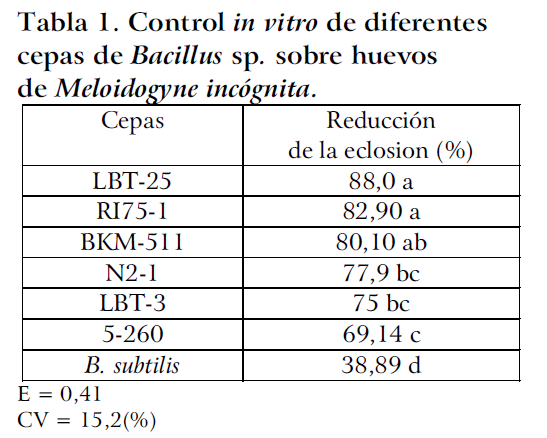
Se evaluó la actividad nematicida de diferentes aislados de Bacillus spp. Los mejores resultados sobre la reducción de la eclosión de los huevos de Meloidogyne incognita se obtuvieron con las cepas RI75-1 (82,9%) de Bacillus licheniformis y LBT-25 (88%) de Bacillus thuringiensis. Se determinó la actividad biológica de las fracciones tóxicas de cada una de las cepas y resultó que en el caso de Bacillus licheniformis (RI75-1), el efecto nematicida se encontró en el sobrenadante filtrado. Esto puede relacionarse con la presencia de enzimas exocelulares responsables de dicha actividad. La acción inhibitoria de Bacillus thuringiensis estuvo presente en las tres fracciones, lo que explica que hay un efecto combinado a causa de la acción de las diferentes toxinas.
Detalles del artículo

Esta obra está bajo una licencia internacional Creative Commons Atribución-NoComercial 4.0.
Aquellos autores/as que tengan publicaciones con esta revista, aceptan los términos siguientes de la Licencia CC Reconocimiento-NoComercial 4.0 Internacional (CC BY-NC 4.0):
Usted es libre de:
- Compartir — copiar y redistribuir el material en cualquier medio o formato
- Adaptar — remezclar, transformar y crear a partir del material
El licenciador no puede revocar estas libertades mientras cumpla con los términos de la licencia.
Bajo las condiciones siguientes:
- Reconocimiento — Debe reconocer adecuadamente la autoría, proporcionar un enlace a la licencia e indicar si se han realizado cambios. Puede hacerlo de cualquier manera razonable, pero no de una manera que sugiera que tiene el apoyo del licenciador o lo recibe por el uso que hace.
- NoComercial — No puede utilizar el material para una finalidad comercial.
- No hay restricciones adicionales — No puede aplicar términos legales o medidas tecnológicas que legalmente restrinjan realizar aquello que la licencia permite.
La revista no se responsabiliza con las opiniones y conceptos emitidos en los trabajos, son de exclusiva responsabilidad de los autores. El Editor, con la asistencia del Comité de Editorial, se reserva el derecho de sugerir o solicitar modificaciones aconsejables o necesarias. Son aceptados para publicar trabajos científico originales, resultados de investigaciones de interés que no hayan sido publicados ni enviados a otra revista para ese mismo fin.
La mención de marcas comerciales de equipos, instrumentos o materiales específicos obedece a propósitos de identificación, no existiendo ningún compromiso promocional con relación a los mismos, ni por los autores ni por el editor.
Cómo citar
Referencias
Atkinson, H. J.: «Oportunities for Plant Molecular Biology in Crop Production», Parasitology 98: 479-487, 1993.
Cayrol, J. C.: «Biological Control of Meloidogyne with Arthobotrys irregularis», Revue de Nematologie 6: 265-273, 1983.
Hockenbell, L.: «Bacitracin», Progress in Industrial Microb. P. 4, Ed. Pergaman Press, Nueva York, pp. 214-230, 1963.
Faust, R. M.; A. B. Lee: «Bacterial and Their Toxins As Insecticides in Microbial and Viral Pesticides», New York: Marcel Dekker. 3: 75-206, 1982.
Joyet, P. N.; N. Declerck; C. Gaillardin: «Hyperthermostable Variants of a Highly Thermostable Alpha Amylase», Bio_technology, E.U., 10 (12):1579-1583, 1992.
Keckey, R. G.: «Bacitracin», Progress in Microbiology 5:93-150, 1964.
Lee, D. L.: «The Organization of the Nematode Body», The Physiology of Nematodes, Oliver and Boyd. Edinburgh and London, Inglaterra, 1965, p. 1148.
Leskhova, A.: «Condiciones para la formación de la beta exotoxina por cepas de B. thuringiensis», Pat. Tr. 83:422, 1986.
Leyns, F.; G. Borgonie; G. Arnaut; D. de Waele: «Nematicidal activity of Bacillus thuringiensis isolates», Fundam. Appl. Nematol. 18(3):211218, 1995.
Márquez, María Elena; V. García; O. Fernández; M. Escobar: «Efecto nematicida de B. licheniformis. Estudio preliminar», Protección Vegetal 12 (2):95:98, 1997.
Meadows, J. S.; S. S. Gill; L.W. Bone: «Bacillus thuringiensis Affects Population Growth of the Free Living Nematode Torbatrix aceti», Invert. Reprod. and Devel., 17:73-76, 1990.
Mena, J.; G. de la Riva; R. Vázquez; M. Fernández: «Empleo de B. thuringiensis para el control de Radopholus similis», Centro Agrícola 123:1-3, 31-38, 1996.
Narva, K. E.; J. Payne; J. Schwab; G. E. Hickle; L. A. Galison; A. J. Sick: «Novel Bacillus thuringiensis Microbes Active Toxins Cloned from Bacillus thuringiensis», European Patent Application 91305047.2, 1991.
Noel, G. R.: «Evaluation of thuringiensin of H. glycines on Soybean», Suppl. J. Nematology. 22(4s):763-766, 1990.
Oduor-Owino, P.; S. W. Wauds: «Effect of Delay in Planting After Application of Chicken Monune on Meloidogyne javanica and P. lilacinus», Nematología Mediterránea 24:7-11, 1996.
Sharma, R. V.: «Bacillus thuringiensis: A Biocontrol Agent of Meloidogyne incognita on Barley», Nematologia Brasileira 18:79-84, 1994.
Sidquiand, Z. A.; I. Mahmood: «Biological Control Root Rot Disease Complex of Chickea Caused by Meloidogyne incognita Race 3 and Macrophomina phaseolina», Nematol. Mediterránea 20:199-202, 1992.
Weibelzalhl-Feilton, E.; D. W. Dickson: «Meloidogyne arenaria and Pausteria penetrans Population Density Development As Affected by on Intercocropping System», Third International Nematology Congress Gosier, Guadeloupe Antillas, French West Indies, 1996.
Zeck, W.: «A Rooting Scheme for Field Evaluation of Root-Knot Nematode Infestation», Planzenschutz Nachriten Bayer 24:141-144, 1971.
Zuckerman, B. M.; M. B. Dicklow; N. Acosta: «A Strain of Bacillus thuringiensis for the Control of Plant Parasitic Nematodes», Biocontrol of Science and Technology 3(1):41-46, 1993.