
Evaluación del efecto nematicida de cepas de bacillus spp.
Article Sidebar
Main Article Content
Abstract
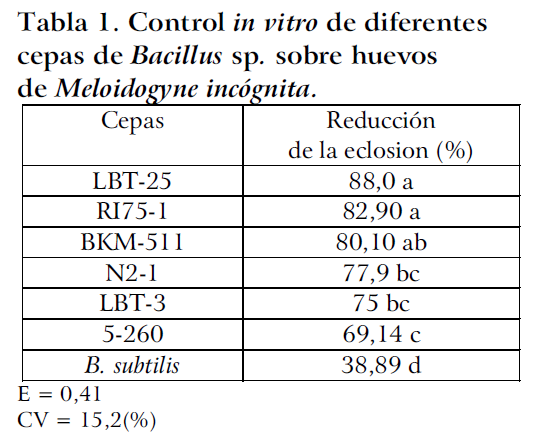
Nematicidal activity of several isolates of Bacillus spp. was evaluated. Best results about reduction of Meloidogyne incognita egg supernatant were obtained with strain RI75-1 (82,9%) of Bacillus licheniformis and strain LBT-25 (88%) of Bacillus thuringiensis. Biological activity of toxically fractions from each strain was determined. For Bacillus licheniformis (RI75-1), nematicidal effect was found in filtrated supernatant; that can be related with presence of exocellular enzymes responsible of this activity. Inhibitory action of Bacillus thuringiensis was present in three fractions. That means there is a combined effect, because of action of several toxins.
Article Details

This work is licensed under a Creative Commons Attribution-NonCommercial 4.0 International License.
Those authors who have publications with this journal accept the following terms of the License Attribution-NonCommercial 4.0 International (CC BY-NC 4.0):
You are free to:
- Share — copy and redistribute the material in any medium or format
- Adapt — remix, transform, and build upon the material
The licensor cannot revoke these freedoms as long as you follow the license terms.
Under the following terms:
- Attribution — You must give appropriate credit, provide a link to the license, and indicate if changes were made. You may do so in any reasonable manner, but not in any way that suggests the licensor endorses you or your use.
- NonCommercial — You may not use the material for commercial purposes.
- No additional restrictions — You may not apply legal terms or technological measures that legally restrict others from doing anything the license permits.
The journal is not responsible for the opinions and concepts expressed in the works, they are the sole responsibility of the authors. The Editor, with the assistance of the Editorial Committee, reserves the right to suggest or request advisable or necessary modifications. They are accepted to publish original scientific papers, research results of interest that have not been published or sent to another journal for the same purpose.
The mention of trademarks of equipment, instruments or specific materials is for identification purposes, and there is no promotional commitment in relation to them, neither by the authors nor by the publisher.
How to Cite
References
Atkinson, H. J.: «Oportunities for Plant Molecular Biology in Crop Production», Parasitology 98: 479-487, 1993.
Cayrol, J. C.: «Biological Control of Meloidogyne with Arthobotrys irregularis», Revue de Nematologie 6: 265-273, 1983.
Hockenbell, L.: «Bacitracin», Progress in Industrial Microb. P. 4, Ed. Pergaman Press, Nueva York, pp. 214-230, 1963.
Faust, R. M.; A. B. Lee: «Bacterial and Their Toxins As Insecticides in Microbial and Viral Pesticides», New York: Marcel Dekker. 3: 75-206, 1982.
Joyet, P. N.; N. Declerck; C. Gaillardin: «Hyperthermostable Variants of a Highly Thermostable Alpha Amylase», Bio_technology, E.U., 10 (12):1579-1583, 1992.
Keckey, R. G.: «Bacitracin», Progress in Microbiology 5:93-150, 1964.
Lee, D. L.: «The Organization of the Nematode Body», The Physiology of Nematodes, Oliver and Boyd. Edinburgh and London, Inglaterra, 1965, p. 1148.
Leskhova, A.: «Condiciones para la formación de la beta exotoxina por cepas de B. thuringiensis», Pat. Tr. 83:422, 1986.
Leyns, F.; G. Borgonie; G. Arnaut; D. de Waele: «Nematicidal activity of Bacillus thuringiensis isolates», Fundam. Appl. Nematol. 18(3):211218, 1995.
Márquez, María Elena; V. García; O. Fernández; M. Escobar: «Efecto nematicida de B. licheniformis. Estudio preliminar», Protección Vegetal 12 (2):95:98, 1997.
Meadows, J. S.; S. S. Gill; L.W. Bone: «Bacillus thuringiensis Affects Population Growth of the Free Living Nematode Torbatrix aceti», Invert. Reprod. and Devel., 17:73-76, 1990.
Mena, J.; G. de la Riva; R. Vázquez; M. Fernández: «Empleo de B. thuringiensis para el control de Radopholus similis», Centro Agrícola 123:1-3, 31-38, 1996.
Narva, K. E.; J. Payne; J. Schwab; G. E. Hickle; L. A. Galison; A. J. Sick: «Novel Bacillus thuringiensis Microbes Active Toxins Cloned from Bacillus thuringiensis», European Patent Application 91305047.2, 1991.
Noel, G. R.: «Evaluation of thuringiensin of H. glycines on Soybean», Suppl. J. Nematology. 22(4s):763-766, 1990.
Oduor-Owino, P.; S. W. Wauds: «Effect of Delay in Planting After Application of Chicken Monune on Meloidogyne javanica and P. lilacinus», Nematología Mediterránea 24:7-11, 1996.
Sharma, R. V.: «Bacillus thuringiensis: A Biocontrol Agent of Meloidogyne incognita on Barley», Nematologia Brasileira 18:79-84, 1994.
Sidquiand, Z. A.; I. Mahmood: «Biological Control Root Rot Disease Complex of Chickea Caused by Meloidogyne incognita Race 3 and Macrophomina phaseolina», Nematol. Mediterránea 20:199-202, 1992.
Weibelzalhl-Feilton, E.; D. W. Dickson: «Meloidogyne arenaria and Pausteria penetrans Population Density Development As Affected by on Intercocropping System», Third International Nematology Congress Gosier, Guadeloupe Antillas, French West Indies, 1996.
Zeck, W.: «A Rooting Scheme for Field Evaluation of Root-Knot Nematode Infestation», Planzenschutz Nachriten Bayer 24:141-144, 1971.
Zuckerman, B. M.; M. B. Dicklow; N. Acosta: «A Strain of Bacillus thuringiensis for the Control of Plant Parasitic Nematodes», Biocontrol of Science and Technology 3(1):41-46, 1993.