
Assembly in web ambient of the optional course of Acarology
Article Sidebar
Main Article Content
Abstract
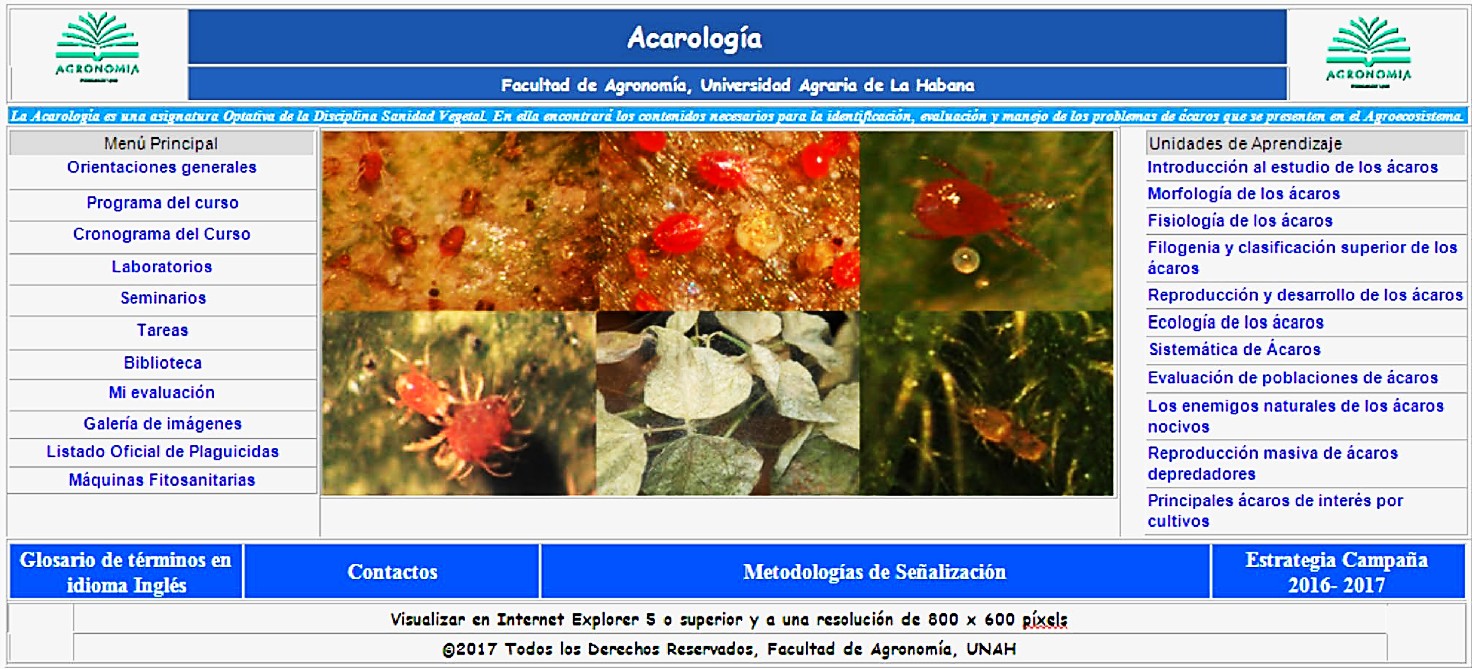
The objective of the present work was to show the assembly in a Web environment of the optional course of Acarology of discipline Plant Protection in the Agronomy career. The course is imparted in the fourth year of the career of Agronomy, within the Discipline Plant Health. The objective of the course is to utilize the techniques and appropriate methods for the identification, evaluation and management of the noxious mites that attack the economical crops. The program of the course was structured in five topics, with 60 total hours, 36 dedicated to classes and 24 to the search-labor practice. So that the student plays a more active paper as administration of the knowledge, the course was assembly in web ambient, where the student that opts by the same will find all the information it required in order to administer the knowledge. In the assembly of the course an important paper is attributed to the “units of learning,” as via in order to facilitate the organization, conduction and evaluation of the process of learning and to the “task”, as tool that facilitates the organization, conduction and control of the independent work of the student. For each one of the units of learning a guide was elaborated. They resigned 11 units of learning, with seven tasks, four practices of laboratory and two seminars. Were planned a partial tests and a seminar final integral for the evaluation of the learning of the students. Also since the Web page could be mobilized all the information scientific- technique that requires the student for the learning of the contents, offers a gallery of pictures and a glossary of acarology’s terms.
Article Details

This work is licensed under a Creative Commons Attribution-NonCommercial 4.0 International License.
Those authors who have publications with this journal accept the following terms of the License Attribution-NonCommercial 4.0 International (CC BY-NC 4.0):
You are free to:
- Share — copy and redistribute the material in any medium or format
- Adapt — remix, transform, and build upon the material
The licensor cannot revoke these freedoms as long as you follow the license terms.
Under the following terms:
- Attribution — You must give appropriate credit, provide a link to the license, and indicate if changes were made. You may do so in any reasonable manner, but not in any way that suggests the licensor endorses you or your use.
- NonCommercial — You may not use the material for commercial purposes.
- No additional restrictions — You may not apply legal terms or technological measures that legally restrict others from doing anything the license permits.
The journal is not responsible for the opinions and concepts expressed in the works, they are the sole responsibility of the authors. The Editor, with the assistance of the Editorial Committee, reserves the right to suggest or request advisable or necessary modifications. They are accepted to publish original scientific papers, research results of interest that have not been published or sent to another journal for the same purpose.
The mention of trademarks of equipment, instruments or specific materials is for identification purposes, and there is no promotional commitment in relation to them, neither by the authors nor by the publisher.
How to Cite
References
Chávez, D.; Y .García; M. Ramos e I. Miranda: “Sitio web para el studio de ácaros depredadores (Acari: Phytoseiidae) de Cuba”, Rev. Protección Veg. 24(2):126-130, 2009.
Dwyter, T.: “Heuritic Strategies fo Using Computers to Enrich Education”, Revista Informática Educativa 6(1):1-12, 1974.
Gándara, M. V.: “La interfaz en el usuario: una introducción para educadores”, Usos educativos de la computación, México. CIOSE-UNAM, pp. 179-192, 1994.
Horrutinier, P.: La universidad cubana: modelo de formación, Ed. Félix Varela, La Habana, 2006.
López, R.; A. Torres; A. López; S. Rodríguez; R. Dueñas y R Alemán et al.: “Modelo profesional y plan de estudio del Ingeniero Agrónomo, Comisión Nacional de la Carrera de Agronomía, Ministerio de Educación Superior, República de Cuba, 2006.
Resolución 210/2007. Reglamento de Trabajo Docente y Metodológico de la Educación Superior, Ministerio de Educación Superior, República de Cuba, 2007.