
Comparación de la efectividad de un insecticida botánico y dos químicos convencionales en el control del picudo (Anthonomus eugenii cano) (coleoptera: curculionidae) en chile habanero (Capsicum chinense jacq.)
Article Sidebar
Main Article Content
Abstract
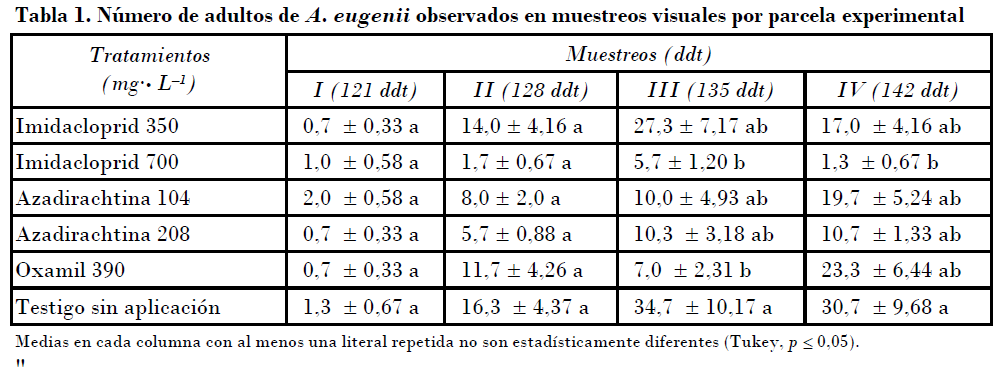
The effectiveness of a botanical insecticide azadirachtine and two chemical insecticides imidacloprid and oxamil, were compared to determine if azadirachtine represents an alternative to manage this pest. On field evaluation, two commercial rates of imidacloprid and azadirachtine were evaluated; in addition oxamyl was also evaluated as regional control. There was lower population density of A. eugenii and lower percentage of damaged fruits on plots treated with imidacloprid 700 mg • L–1 compared to the control plots. Azadirachtine 104 and 208 mg • L–1 had intermediate effects on suppression of A. eugenii adults and damaged fruits. Fruit yield was not significantly different among insecticides treatments and the control. It is concluded that azadirachtine is a good alternative to control A. eugenii and this botanical insecticide might replace the use of oxamyl and imidacloprid to manage this pest.
Article Details

This work is licensed under a Creative Commons Attribution-NonCommercial 4.0 International License.
Those authors who have publications with this journal accept the following terms of the License Attribution-NonCommercial 4.0 International (CC BY-NC 4.0):
You are free to:
- Share — copy and redistribute the material in any medium or format
- Adapt — remix, transform, and build upon the material
The licensor cannot revoke these freedoms as long as you follow the license terms.
Under the following terms:
- Attribution — You must give appropriate credit, provide a link to the license, and indicate if changes were made. You may do so in any reasonable manner, but not in any way that suggests the licensor endorses you or your use.
- NonCommercial — You may not use the material for commercial purposes.
- No additional restrictions — You may not apply legal terms or technological measures that legally restrict others from doing anything the license permits.
The journal is not responsible for the opinions and concepts expressed in the works, they are the sole responsibility of the authors. The Editor, with the assistance of the Editorial Committee, reserves the right to suggest or request advisable or necessary modifications. They are accepted to publish original scientific papers, research results of interest that have not been published or sent to another journal for the same purpose.
The mention of trademarks of equipment, instruments or specific materials is for identification purposes, and there is no promotional commitment in relation to them, neither by the authors nor by the publisher.
How to Cite
References
Aguilar, F. J.: «Hongos entomopatógenos para el control del picudo del chile (Anthonomus eugenii Cano)», tesis profesional, Instituto Tecnológico Agropecuario no. 2, Conkal, Yucatán, México, 2001.
Bayer Crop Sienés: «Laverage. Datos generales del producto». Productos fitosanitarios, s/f.
Capinera, J. L.: «Pepper weevil, Anthonomus eugenii Cano (Insecta: Coleoptera: Curculionidae)». Document EENY-278, Florida, Cooperative Extensión Service, Institute of Food and Agricultural Science, University of Florida, EE.UU., 2002.
Coudriet, D. L.; A. N. Kishaba: «Bioassay Procedure for an Attractant of the Pepper Weevil (Coleoptera: Curculionidae)», Journal of Economic Entomology 81(5):1499-1502, EE.UU., 1988.
Di Illo, V.; M. Cristofaro; D. Marchini; P. Nobili; R. Dallai: «Effects of Neem Compound on the Fecundity and Longevity of Ceratitis capitate (Diptera: Tephritidae)», Journal of Economic Entomology 92(1):76-81, EE.UU., 1999.
Gajbhiye, V. T.; S. Gupta; R. K Gupta: «Persistence of Imidacloprid in/on Cabbage and Coliflower», Bulletin of Environmental Contamination and Toxicology 72:283-288, EE.UU., 2004.
Gómez, B. Y.; J. V. Ramírez; B. Sandoval; A. Bolaños: «Alternativas biológicas y orgánicas en el control de Anthonomus eugenii en chile picante», Revista Manejo Integrado de Plagas y Agroecología 57:74-77, Costa Rica, 2000.
Gutiérrez, C.: «Evaluación de la asociación maíz-chile para el manejo de Anthonomus eugenii en Nicaragua», Revista Manejo Integrado de Plagas no. 54, Costa Rica, 1999.
Guzmán, O.; A. Vargas; X. Mata: «Control biológico del picudo en el chile», Tecnia 5:10-14, Instituto Nacional de Aprendizaje, Costa Rica, 2001.
Isman, M. B.: «Botanical Insecticides, Deterrents, and Repellents in Modern Agriculture and Increasingly Regulated World», Annual Review of Entomology 51:45-66, EE.UU., 2006.
Kilpatrick, A. L.; A. M. Hagerty; S. G. Turnipseed; M. J. Sullivan; W. C. Bridges Jr.: «Activity of Selected Neonicotinoids and Dicrotophos on Nontarget Arthropods in Cotton: Implications in Insect Management», Journal of Economic Entomology 98(3):814-820, EE.UU., 2005.
Marquini, F.; M. C. Picanco; R. N. C. Guedes; P. S. F. Ferreira: «Imidacloprid Impact on Arthropods Associated with Canopy of Common Beans», Neotropical Entomology 32(2):335-342, Brasil, 2003.
Quiñones, F.; M. Luján: «Diferencial Response of jalapeño Genotypes to the Damage for Pepper Weevil Anthnomus eugenii Cano (Coleptera: Curculionidae)», Proceedings of the 16th International Pepper Conference, Tamaulipas, México, del 10 al 12 de noviembre del 2002.
Rodríguez, L.; M. Carballo: «Patogenicidad de diferentes hongos entomopatógenos en el combate del picudo del chile (Anthonomus eugenii) en condiciones de laboratorio», XI Congreso Nacional Agronómico / V Congreso Nacional de Entomología, San José, Costa Rica, del 19 al 23 de julio de 1999.
Showler, A. T.; S. M. Greenberg; J. T. Arnason: «Deterrent Effects of Four Neem-Based Formulations on Gravid Female Boll Weevil (Coleoptera: Curculionidae) Feeding and Oviposition on Cotton Squares». Journal of Economic Entomology, 97(2):414-421, EE.UU., 2004.
Smith, S. F.; V. A. Krischik: «Effects of Biorational Pesticides on four Coccinellid Species (Coleoptera: Coccinellidae) Having Potential as Biological Control Agents in Interiorscapes». Journal of Economic Entomology 93(3):732-736, EE.UU., 2000.
Soria, M. J.; J. M. Tun; J. A. Trejo; R. Terán: Tecnología para producción a cielo abierto en la península de Yucatán, CIGA-Instituto Tecnológico Agropecuario no. 2, Conkal, Yucatán, México, 1996.