
Establecimiento de los términos de carencia de plaguicidas comerciales y precomerciales en el cultivo del tomate
Article Sidebar
Main Article Content
Abstract
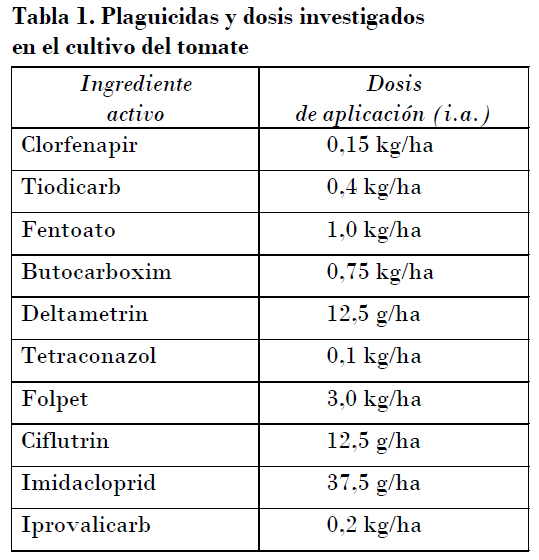
With the purpose of determining the behavior of commercial and pre commercial pesticides used in tomato cultivation, insecticides chlorfenapyr, thiodicarb, cyfluthrin, imidacloprid, phenthoate, butocarboxim and deltamethrin, as well as fungicides iprovalicarb, tetraconazole and folpet were applied, at the maximum dose recommended for tomato, on 200 m2 cultivation plots just in production. The experiments were carried out in Cuban provinces of La Habana and Ciego de Avila. Immediately the applications and close to harvest time, samples were taken for determination of pesticides residues. The analysis of chlorphenapyr, cyflutrin, phenthoate, butocarboxim, deltamethrin, tetraconazole and folpet were carried out by gas-liquid chromatography, while thiodicarb, imidacloprid and iprovalicarb were analyzed by HPLC. No residue over detection limit of deltamethrin, cyfluthrin, imidacloprid and iprovalicarb were found in any moment after application, while for phenthoate this was the case after five days. The residues of butocarboxim and chlorfenapyr were below their detection limit after 10 and 15 days after application, respectively. Residues of thiodicarb were below National Maximum Residue Level (NMRL= 0,3 mg/kg) 10 days after application, and folpet did not exceed that level (NMRL = 1 mg/kg) at any time after treatment.
Article Details

This work is licensed under a Creative Commons Attribution-NonCommercial 4.0 International License.
Those authors who have publications with this journal accept the following terms of the License Attribution-NonCommercial 4.0 International (CC BY-NC 4.0):
You are free to:
- Share — copy and redistribute the material in any medium or format
- Adapt — remix, transform, and build upon the material
The licensor cannot revoke these freedoms as long as you follow the license terms.
Under the following terms:
- Attribution — You must give appropriate credit, provide a link to the license, and indicate if changes were made. You may do so in any reasonable manner, but not in any way that suggests the licensor endorses you or your use.
- NonCommercial — You may not use the material for commercial purposes.
- No additional restrictions — You may not apply legal terms or technological measures that legally restrict others from doing anything the license permits.
The journal is not responsible for the opinions and concepts expressed in the works, they are the sole responsibility of the authors. The Editor, with the assistance of the Editorial Committee, reserves the right to suggest or request advisable or necessary modifications. They are accepted to publish original scientific papers, research results of interest that have not been published or sent to another journal for the same purpose.
The mention of trademarks of equipment, instruments or specific materials is for identification purposes, and there is no promotional commitment in relation to them, neither by the authors nor by the publisher.
How to Cite
References
American Cyanamid Company: «Agricultural Research Division. Human and Environmental Safety. GC Method for the Determination of CL 303,630 Residues in Potatoes, Lettuce, Cabbage and Various Tomato Commodities. M 2413». Dosier para el Registro en Cuba del clorfenapir. Registro Central de Plaguicidas, CNSV, Cuba, 1994.
Bayer AG: «PF-E/MR no. 00425 (adaptada en el Laboratorio de Residuos de Plaguicidas y Contaminación Ambiental del Inisav. Dosier para el Registro en Cuba del iprovalicarb, Registro Central de Plaguicidas, CNSV, Cuba, 1998.
CNSV: Lista oficial de plaguicidas autorizados, Registro Central de Plaguicidas, Minag, La Habana, 2006.
Codex Alimentarius: «Guía de recomendaciones del Codex sobre residuos de plagicidas», Comisión del Codex Alimentarius, Parte 1, Notas Generales. CAC/PR, 1984.
––––: «Portion of Commodities to which Codex MRLS Apply and which is Analyzed», Comisión del Codex Alimentarius, Codex Alimentarius Vol. 2, Section 4.1, Roma, 1992.
––––: Residuos de plaguicidas en los alimentos, Comisión del Codex Alimentarius, Vol. 2, 2.a ed., 1994.
Codex Alimentarius: «Revisión de los métodos recomendados de muestreo para la determinación de residuos de plaguicidas», Comisión del Codex Alimentarius, CX/PR 96/7, 1996.
FAO/UNEP: «Panel of Experts on Integrated Pest Control in Agriculture», Roma, 1994.
Minag: «Instructivo técnico del cultivo del tomate», Ministerio de la Agricultura, La Habana, 1985.
Ministry of Public Health: Analytical Methods for Pesticide Residues in Foodstuffs, Welfare and Sport, Part I. Multi-Residue Methods. Sixth Edition. Holanda, 1996, pp 1-21.
Pesticide Analytical Manual: Gas Chromatographic Determination of Thiodicarb Residues in Soybean Seed, FDA, Vol. II. 3rd Edition, 1994, pp. 2640-2647.
Placke, F. J.; E. Weber: «Method of Determining Imidacloprid Residues in Plant Material», Pflanzenschutz-Nachrichten Bayer 46(2):109-182, 1993.
Ricardo, Caridad: Métodos de análisis de residuos de plaguicidas, Instituto de Investigaciones de Sanidad Vegetal, Ed. Cidisav, La Habana, 2000.
The Pesticide Manual: A World Compendium, 12th Edition, Version 2.2, British Crop Protection Council, C.D.S., Inglaterra, 2003.