
Patogenicidad y virulencia de cepas de Pectobacterium carotovorum y Dickeya chrysanthemi en papa (Solanum tuberosum l.)
Article Sidebar
Main Article Content
Abstract
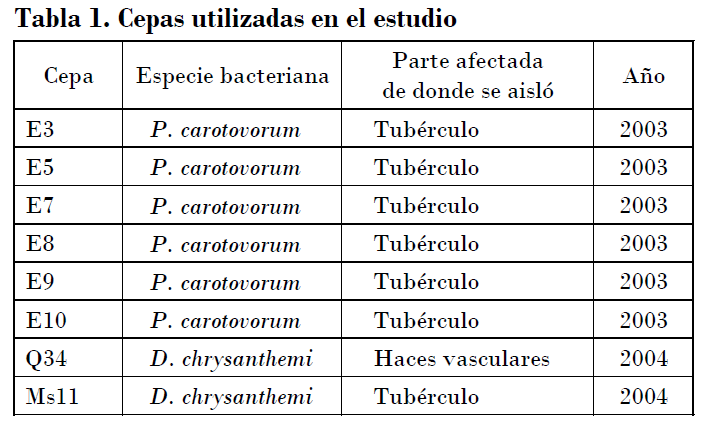
Soft rot caused by pectobacterias is one of the most important diseases that affect potato crop causing significant loses that can reach 100%. During potato seasons from the end of 2002 until 2004, in Cuba, considerable soft rot of tubers occurred and it was obtained several isolates of Pectobacterium carotovorum and Dickeya chrysanthemi. The aim of this work was to study the pathogenicity and maceration ability of six P. carotovorum and two D. chrysanthemi isolates in Spunta and Chieftain potato cultivars. Tubers of both cultivars were weight and then inoculated, under laboratory conditions, with 200 µL of the bacterial suspension adjusted to a concentration of 108 ufc/mL. In evaluations at three, seven and ten days, tubers were washed to eliminate the decayed tissue and weighed again to determine the reduction of weight. Results were analyzed statistically. All the strains studied were pathogenic and they caused soft rot in the inoculated tubers but they differed in virulence. After 10 days the strains Q34 and Ms11 of D. chrysanthemi produced reductions of the inoculated tubers of 5.2 and 15.7% respectively. Strains of P. carotovorum caused higher lose with values between 48 and 64% for the same period of evaluation. This last species showed a higher variability in virulence.
Article Details

This work is licensed under a Creative Commons Attribution-NonCommercial 4.0 International License.
Those authors who have publications with this journal accept the following terms of the License Attribution-NonCommercial 4.0 International (CC BY-NC 4.0):
You are free to:
- Share — copy and redistribute the material in any medium or format
- Adapt — remix, transform, and build upon the material
The licensor cannot revoke these freedoms as long as you follow the license terms.
Under the following terms:
- Attribution — You must give appropriate credit, provide a link to the license, and indicate if changes were made. You may do so in any reasonable manner, but not in any way that suggests the licensor endorses you or your use.
- NonCommercial — You may not use the material for commercial purposes.
- No additional restrictions — You may not apply legal terms or technological measures that legally restrict others from doing anything the license permits.
The journal is not responsible for the opinions and concepts expressed in the works, they are the sole responsibility of the authors. The Editor, with the assistance of the Editorial Committee, reserves the right to suggest or request advisable or necessary modifications. They are accepted to publish original scientific papers, research results of interest that have not been published or sent to another journal for the same purpose.
The mention of trademarks of equipment, instruments or specific materials is for identification purposes, and there is no promotional commitment in relation to them, neither by the authors nor by the publisher.
How to Cite
References
Bains, P.; V. Bishit; D. Lynch; L. Kawchuk; J. Helgeson: «Identification of Stem Soft Rot (Erwinia carotovora subsp. atroseptica) Resistance in Potato», American Journal of Potato Research 76:137-141, 1999.
Bellini, A.; N. Denardin; C. Forcelini; V. Duarte: «Reação de cultivares de batata à podridão mole causada por Pectobacterium carotovorum subsp. atrosepticum, por Pectobacterium carotovorum subsp. carotovorum e por P. chrysanthemi», Fitopatol. Bras., 29(2):155-159, 2004.
Collmer, A.; J. L. Ried: «Comparison of Pectic Enzymes Produced by Erwinia chrysanthemi, Erwinia carotovora subsp. carotovora and Erwinia carotovora subsp. Atroseptica», Appl. Environ. Microbiol., 52: 305-310, 1986.
Duarte, V.; S. de Boer; L. Ward; A. de Oliveira: «Characterization of Atypical Erwinia carotovora Strains Causing Blackleg of Potato in Brazil», Journal of Applied Microbiology, 96: 535-545, 2004.
Elphistone, J.: «La pudrición blanda y la pierna negra de la papa Erwinia spp.», Boletín de información Técnica, no. 21, CIP, Lima, 1987, pp. 1-18.
Franco, Yuliet; Marusia Stefanova; María F. Coronado: «Patogenicidad y virulencia de aislamientos de Erwinia sp. de semillas de papa de importación», Fitosanidad 8(4):45-47, 2004.
Gardan, L.; C. Gouy; R. Christen; R. Samson: «Elevation of Three Subspecies of Pectobacterium carotovorum to Species Level: Pectobacterium atrosepticum sp. Nov., Pectobacterium betavasculorum sp. Nov. and Pectobacterium wasabiae sp. nov», Int. J. Syst. Evol. Microbiol 53:381-391, 2003.
Lelliot, R. A.; D. E. Stead: «Methods for the diagnosis of Bacterial Diseases of Plants», Methods in Plant Pathology, vol. 2. Blackwell Scientific Publications, Preece, Oxford, Inglaterra,1987.
Mayea, S.; H. Sánchez: «Resistencia de 10 cultivares de papa», Cuadernos de Fitopatología, año XII (45), 2.o trimestre, 1995, pp. 45-49.
Morales, Yolanda: «Estudios realizados sobre el género Erwinia en el cultivo de la papa», http:// www. monografías. com. 1997. Consultado el 21/05/06.
Oliveira, A.: «Incidencia e variabilidade genética de erwinias pectolíticas asociadas a canela preta em lavouras de batata no Estado do Río Grande do Sul. Porto Alegre», Tese Doutorado em Fitotecnia, Porto Alegre, Universidad Federal do Río Grande do Sul, Brasil, 2001.
Pérombelon, M. C. M.: «Potato Diseases Caused by Soft Rot erwinias: An Overview of Pathogenesis», Plant Pathol. 51:1-12, 2002.
Rodríguez, F.; M. Stefanova: «Control biológico del tizón temprano (Alternaria solana Sorauer) en el cultivo de la papa (Solanum tuberosum L.) en condiciones de campo», Fitosanidad 9(4):35-37, 2005.
Samson, R.; J. B. Legendre; R. Christen; W. Achouak; L. Gardan: «Transfer of Pectobacterium chrysanthemi [Brenner et al., 1973] [Hauben et al., 1998] and Brenneria paradisiaca to the Genus Dickeya Gen. Nov. As Dickeya chrysanthemi Comb. Nov. and Dickeya paradisiaca Comb. Nov. and Delineation of Four Novel Species: Dickeya dadantii sp. Nov., Dickeya dianthicola sp. Nov., Dickeya dieffenbachiae sp. Nov. and Dickeya zeae sp. Nov.», International Journal of Systematic and Evolutionary Microbiology 54:1-13, 2004.
SPSS para Windows, versión 12.0.1 Inc., 2003.