
Vegetative development of Plectranthus ornatus Codd under two growth environments, three fertilization doses and in vitro effect of its ethanolic extract on plant pathogenic fungi
Article Sidebar
Main Article Content
Abstract
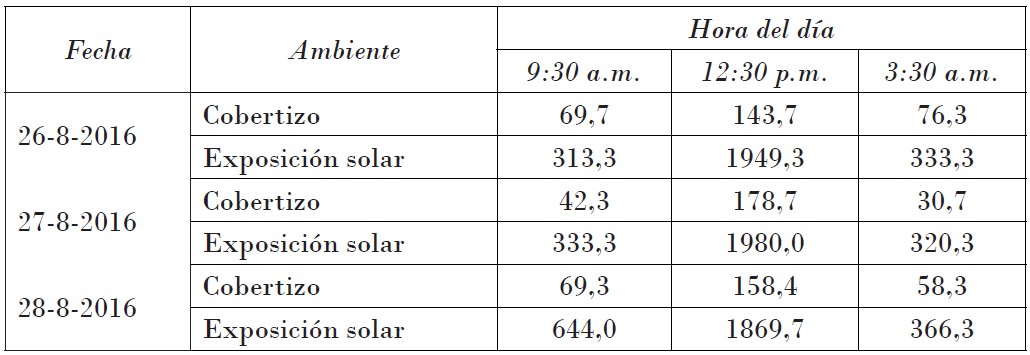
Looking for alternative methods to control plan pathogens includes, not only to study the effectiveness of plant extracts, but also to evaluate the propagating conditions, to guarantee the supply of enough plant material for the extracts production. To study the effect of light on vegetative development of P. ornatus, an experiment was conducted using shoot-propagated plants, grown in 2 kg poliethilene bags, placed under two environments: transparent-roof canopy and total sun light exposure. In each environment, three doses of a 15-15-15 fertilizer were applied to the plants: 0, 5 y 10 g·plant-1. Ten plants per treatment and a complete randomized design were used. Evaluations were performed at days 0 and 37 of the following variables: length of main stem, number and length of branches; and at day 45 leaf thickness. The amount of light received was measured at the beginning of the experiment. Secondary metabolite groups were determined and the effect of the ethanolic extract was evaluated on the mycelial growth of the fungi Fusarium oxysporum f. sp. phaseoli, Macrophomina phaseolina and Colletotrichum gloeosporioides. Significant differences were found between environments but not fertilizing doses for branch length and leaf thickness. Alkaloids were higher in plants growing under transparent-roof canopy, while anthraquinones, phenols and flavonoids were higher under total sun light exposure. The three fungi were fully susceptible to 10 % concentration of the plant extract; only C. gloeosporioides was susceptible to 5 and 2.5 % concentration. Results show that P. ornatus plants should be grown under total sun light exposure for a better green mass and MS production.
Article Details

This work is licensed under a Creative Commons Attribution-NonCommercial 4.0 International License.
Those authors who have publications with this journal accept the following terms of the License Attribution-NonCommercial 4.0 International (CC BY-NC 4.0):
You are free to:
- Share — copy and redistribute the material in any medium or format
- Adapt — remix, transform, and build upon the material
The licensor cannot revoke these freedoms as long as you follow the license terms.
Under the following terms:
- Attribution — You must give appropriate credit, provide a link to the license, and indicate if changes were made. You may do so in any reasonable manner, but not in any way that suggests the licensor endorses you or your use.
- NonCommercial — You may not use the material for commercial purposes.
- No additional restrictions — You may not apply legal terms or technological measures that legally restrict others from doing anything the license permits.
The journal is not responsible for the opinions and concepts expressed in the works, they are the sole responsibility of the authors. The Editor, with the assistance of the Editorial Committee, reserves the right to suggest or request advisable or necessary modifications. They are accepted to publish original scientific papers, research results of interest that have not been published or sent to another journal for the same purpose.
The mention of trademarks of equipment, instruments or specific materials is for identification purposes, and there is no promotional commitment in relation to them, neither by the authors nor by the publisher.
How to Cite
References
Carrasco Ríos, L. 2009. “Efecto de la radiación Ultravioleta-B en plantas”, Idesia (Chile) 27(3): 59-76.
Carrillo, M .2006. “Regulación de la síntesis de alcaloides en cultivos in vitro de Argemone mexicana. Yucatán, México”. Centro de Investigación Científica de Yucatán Tesis de Maestría en Ciencias y Biotecnología de Plantas.
Freitas, M. A.; Amorim A.; Becerra A. M.; Pereira M. S.; Bessa M. C.; Nogueira Filho F. P.; Lacerda C. F. 2014. “Crescimento e tolerância à salinidade em três espécies medicinais do gênero Plectranthus expostas a diferentes níveis de radiação”. Rev. Bras. Pl. Med., Campinas, 16(4):839-849.
Galvão, F.; Costa, J.; Fernandes, F.; Campos, A. 2013. “Study of the Interference between Plectranthus Species Essential Oils from Brazil and Aminoglycosides”. Evidence based complementary and alternative medicine: eCAM. 24161. 10.1155/2013/724161. https://www.research-gate.net/publication/236676229. Consultada 23/6/2019.
Infante, R.; Rodríguez, D.; Sanabria, M.; Ulacio, D. 2015. “Efecto del tiempo y la temperatura de almacenamiento en la actividad de extractos etanólicos de Lantana camara L. y Heliotropium indicum L. sobre Colletotrichum gloeosporioides”. Acta Agronomica. 64(4):363-367.
Lima, N. R.; Sodré G. A.; Lima H. R.; Paiva S. R.; Lobão A. Q.; Coutinho A. J. 2017. “Plasticidade fenotípica”, Rev. Ciência Elem. 5(02):017. http://doi.org/10.24927/rce2017.017. Consultada 20/6/2018.
Lukhoba, C. W.; Simmondsb, M. S.; Patonb A. J. 2006. “Plectranthus: A review of ethnobotanical uses”. Journal of Ethnopharmacology 103:1-24.
Matusalén, J. 2016. “Perfil fitoquímico y estudio de la toxicidad aguda y actividad analgésica del extracto acuoso liofilizado de las hojas secas de la especie Plectranthus neochilus Schltr (Lamiaceae)”. Caracas, Venezuela. Universidad Central de Venezuela. Trabajo especial de grado para Licenciatura en Química, 174 p.
Marcano, D.; Hasegawa, M. 2002. Fitoquímica Orgánica. Universidad Central de Venezuela. Consejo de Desarrollo Científico y Humanístico. Caracas, Venezuela. Ed. Torino, 588 p.
Ortiz, F.; Rodríguez, D.; Sanabria, M.; Pineda, J. 2016. “Manejo del tizón tardío del celery (Apium graveolens L. var. Dulce) usando extractos vegetales bajo condiciones controladas”. Bioagro 28(2):87-94.
Rijo, P.; Faustino, C.; Simões, M. F. 2013. “Antimicrobial natural products from Plectranthus plants. Microbial pathogens and strategies for combating them: science, technology and education” (A. Méndez-Vilas, Ed.) FORMATEX doi: http://dx.doi.org/10.15446/acag.v64n2.43358. Consultada 15/05/2018.
Sepúlveda-Jiménez, G.; Porta-Ducoing, H.; Rocha-Sosa, M. 2003. “La participación de los metabolitos secundarios en la defensa de las plantas”. Revista Mexicana de Fitopatología, 21(3):355-363.
Vásquez, C.; Aponte, O.; Morales J.; Sanabria M. E.; García, G. 2008. “Biological studies of Oligonichus punicae (Acari: Tetranichidae) on grapevine cultivars”. Exp. Appl. Acarol. 45:59-69.
Vázquez-Ovando A.; Ovando-Medina, I.; Adriano-Anaya, L.; Betancur-Ancona, D.; Salvador-Figueroa, M. 2016. “Alcaloides y polifenoles del cacao, mecanismos que regulan su biosíntesis y sus implicaciones en el sabor y aroma”. Archivos Latinoamericanos de Nutrición. Órgano Oficial de la Sociedad Latinoamericana de Nutrición. 66(3):239-254.
Villa-Martínez, A.; Pérez-Leal R.; Morales-Morales H. A.; Basurto-Sotelo M.; Soto-Parra J. M.; Martínez-Escudero, E. 2015. “Situación actual en el control de Fusarium spp. y evaluación de la actividad antifúngica de extractos vegetales”. Acta Agronómica. 64 (2):194-205. doi: http:// dx.doi.org/10.15446/acag.v64n2.43358. Consultada 15/5/2018.