
Influencia de la composición de diferentes medios de cultivo en la reproducción de Photorhabdus luminescens
Article Sidebar
Main Article Content
Abstract
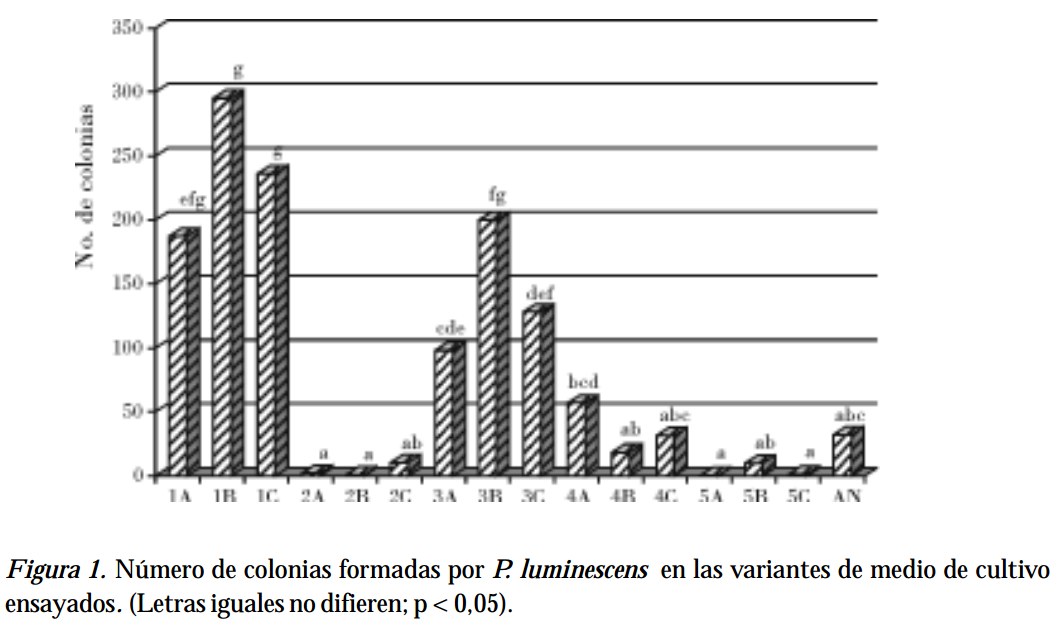
The reproduction in vivo of entomopathogenic nematodos becomes expensive and laborious. Due to this shortcomings, it’s necessary to implement more economical mass production methods. However, one critical step to achieve this goal is to assure the development of the specific symbiotic bacterium associated to the nematode to be massively produced. The growth of P. luminescens was assessed in 15 different culture agar media prepared from pork broth, chicken broth and beef broth supplemented with corn starch, rice powder and sugarcane molasses independently. The colours of the colony in Mc Conkey Agar and NBTA agar as well as the bioluminescence were determined in order to detect the bacterial culture phase. Media prepared from pork liver and the one prepared from chicken liver and corn starch exhibited the greater number of colony forming units. Biochemical tests and morphological characteristics revealed the presence of the primary phase of P. luminescens.
Article Details

This work is licensed under a Creative Commons Attribution-NonCommercial 4.0 International License.
Those authors who have publications with this journal accept the following terms of the License Attribution-NonCommercial 4.0 International (CC BY-NC 4.0):
You are free to:
- Share — copy and redistribute the material in any medium or format
- Adapt — remix, transform, and build upon the material
The licensor cannot revoke these freedoms as long as you follow the license terms.
Under the following terms:
- Attribution — You must give appropriate credit, provide a link to the license, and indicate if changes were made. You may do so in any reasonable manner, but not in any way that suggests the licensor endorses you or your use.
- NonCommercial — You may not use the material for commercial purposes.
- No additional restrictions — You may not apply legal terms or technological measures that legally restrict others from doing anything the license permits.
The journal is not responsible for the opinions and concepts expressed in the works, they are the sole responsibility of the authors. The Editor, with the assistance of the Editorial Committee, reserves the right to suggest or request advisable or necessary modifications. They are accepted to publish original scientific papers, research results of interest that have not been published or sent to another journal for the same purpose.
The mention of trademarks of equipment, instruments or specific materials is for identification purposes, and there is no promotional commitment in relation to them, neither by the authors nor by the publisher.
How to Cite
References
Arteaga, E.; M. Montes; E. Fernández; B. Chang; V. Calzadilla; O. Vázquez; O. Vázquez; G. Plumas; V. García: «Organization of the Work with Entomopathogenic Nematodos in Cuba». Third Internacional Nematology Congress, Grosier, Guadalupe Antilles, French West Indies, 181, 1996.
Bedding, R. A.: «Large Scale Production, Storage and Transport of the Insect-Parasitic Nematode Neoaplectana spp. and Heterorhabditis spp.», Ann. Appl. Biol. 104:117-120, 1984.
Boemare, N. E.; R. J. Akhurst; R. G. Mourant: «DNA Relatedness Between Xenorhabdus ssp. (Enterobacteriaceae) Simbiotic Bacteria of Entomopathogenic Nematodes and a Proporsal to Transfer Xenorabdus luminescens to a New Genus, Photorhabdus gen. Nov. Int.», J. Helminthol. Soc. Wash. 1993, pp. 249-255.
Boemare, N. E.; A. Givaudan; M. Brehélin; C. Laumond: «Symbiosis and Pathogenicity of Nematode-Bacterium Complexes», Symbiosis 22:21-45, 1997.
Boemare, N. E.; J. O. Thaler; A. Lanois: «Simple Bacteriological Test for Phenotypic Characterization of Xenorhabdus and Photorhabdus Phase Variants», Symbiosis 22:167-175, 1997.
Boemare, N. E.: «Biology, Taxonomy and Systematics of Photorhabdus and Xenorhabdus», Entomopathogenic Nematology, CABI Publishing, New York, 2002, pp. 35-56.
Daborn, P. J.; N. Waterfield, M. A. Blight; R. H. Ffrench-Constant: «Measuring Virulence Factor Expression by the Pathogenic Bacterium Photorhabdus luminescens in Culture and During Insect Infection», Journal of Bacteriology 183:5834-5839, 2001.
Forst, S.; D. Clarke: «Bacteria-Nematode Symbiosis», Entomopathogenic Nematology, CABI Publishing, New York, 2002, pp. 57-77.
Gerritsen, L. J. M.; P. H. Smits: «Variation in Pathogenicity of Recombinations of Heterorhabditis and Xenorhabdus luminescens Strain», Fundam. Appl. Nematol. 16:367-373, 1993.
Lunau, S.; S. Stoessel; A. J. Schmidt-Peisker; R. U. Ehlers: «Establishment of Monoxenic Inocula for Scaling Up for in Vitro Culture of Entomopathogenic Nematodes Steinernema spp. and Heterorhabditis spp.», Nematologica 39:385-399, 1993.
Márquez, M. E.; O. Fernández-Larrea; E. Arteaga: «Indicadores para determinar la fase primaria de Photorhabdus luminescens», Rev. Protección Vegetal 12 (2):85-88, 1997.
Thaler, J. O.; M. H. Boyer-Giglio; N. E. Boemare: «New Antimicrobial Barriers Produced by Xenorhabdus spp. and Photorhabdus spp. to Secure the Monoxenic Development of Entomopathogenic Nematodes», Symbiosis 22:205-215, 1997.