
Capacidad depredadora de nodita firmini navás (neuróptera:chrysopidae) sobre tres fitófagos en condiciones de laboratorio
Article Sidebar
Main Article Content
Abstract
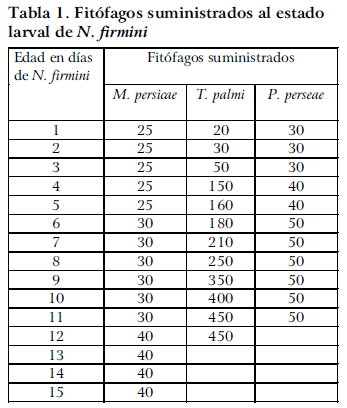
The depredatory capacity of Nodita firmini Navás was evaluated in laboratory conditions against Myzus persicae Sulzer, Trips palmi Karny and Pseudacysta perseae Heidermann, insects plagues that impact in the national economy. The first two species were obtained of a laboratory breeding and the last one was collected in plants of avocados exempt of chemical treatments. A rehearsal was carried out for each pest, replied three times and each replies it was constituted by 40 larvae’s biological regulator. The consumed insects were counted and new preys were incorporated daily, the duration of each larval state and the percentage of formed pupae and emerged adults was measured too. The registrations of dead plant eater of each essay were subjected to the transformation and means were calculated, as well as the dependability limit. It was determined that N. firmini during their larval development depredated 279 M. persicae of the last nymph state; 1767.7 larvae-1 of T. palmi and 166.9 juvenile states of P. perseae and the duration of larval state of the depredator was respectively of 15, 12 and 11 days and the 85, 90 and 87% of the larvae fed respectively with aphids, trips and bugs, were passed to pupae and normal adults emerged of these later.
Article Details

This work is licensed under a Creative Commons Attribution-NonCommercial 4.0 International License.
Those authors who have publications with this journal accept the following terms of the License Attribution-NonCommercial 4.0 International (CC BY-NC 4.0):
You are free to:
- Share — copy and redistribute the material in any medium or format
- Adapt — remix, transform, and build upon the material
The licensor cannot revoke these freedoms as long as you follow the license terms.
Under the following terms:
- Attribution — You must give appropriate credit, provide a link to the license, and indicate if changes were made. You may do so in any reasonable manner, but not in any way that suggests the licensor endorses you or your use.
- NonCommercial — You may not use the material for commercial purposes.
- No additional restrictions — You may not apply legal terms or technological measures that legally restrict others from doing anything the license permits.
The journal is not responsible for the opinions and concepts expressed in the works, they are the sole responsibility of the authors. The Editor, with the assistance of the Editorial Committee, reserves the right to suggest or request advisable or necessary modifications. They are accepted to publish original scientific papers, research results of interest that have not been published or sent to another journal for the same purpose.
The mention of trademarks of equipment, instruments or specific materials is for identification purposes, and there is no promotional commitment in relation to them, neither by the authors nor by the publisher.
How to Cite
References
Agrobiosol. «Manual de referencia», Centro Culiacán, Sinaloa, México, 1997.
Arroyo Najar, J. M.; M. Ortiz Catón: «Duración del ciclo biológico y depredación sobre mosquita blanca y pulgones de una especie de crisópido». XIX Congreso Nacional de Control Biológico, Centro de Ciencias de Sinaloa, México, Memorias, 1996, pp. 56-58.
Burke, H.; F. Martín: «The Biology of Three Chrysopid Predators of the Cotton Aphid», J. Econ. Ent. 49(5):698-700, 1956.
Chesson, J.: «The Effect of Alternative Prey on the Functional Response of Notonecta hoffimani», Ecology 70 (5):1227-1235, 1989.
Dagnelie, P.: «Theorie al metodes statisques», Les presses agronomiques de Gremblouv 2: 242-250, 1984.
García Masí, F.; J. Costa Camelles; F. Ferragut Pérez; J. M. Llorens Climent: Ácaros de las plantas cultivadas y su control biológico, Pisa Ediciones, Valencia, España, 1991.
Grassé, P.: Traité de zoologie, t. 10 f. 2, Mason et Cie, Paris, 1951, p. 58.
Greenberg, S. M.; D. A. Nordlund; E. G. King: «Influence of Different Larval Feeding Regimenes Diet Presentation Methods on Chrysoperla carnea (Neuroptera:Chrysopidae)», J. Entomol. Sci. 29(3):513-522, 1994.
Huao-Wen Yang, Fang-Hao Wan, Zhu Enlin, Wang Bing Yong: «Informe sobre el control de la plaga Thrips palmi Karny con predadores en la República China», Instituto de Control Biológico de la Academia de Ciencias Agrícolas de China, 1997.
Ikankulieva, T.: «Use of Chrysopa carnea Larvae to Control Cotton Pest», Ser. Biol. Nauk. 1:17-21, 1979.
Lerch, G.: La experimentación en las ciencias biológicas y agrícolas, Ed. Científico-Técnica, La Habana, 1977.
Rijo Camacho, Esperanza: «Capacidad depredadora de Chrysopa exterior (Neuroptera:Chrysopidae) en condiciones de laboratorio», Ciencia Tec. Agric. Protección de Plantas. 3(1):19-28, 1980.
Rijo Camacho, Esperanza; Nidia Acosta Amador: «Biología de cuatro especies de la familia Chrysopidae en Cuba», Resúmenes. Tercer Seminario Científico Internacional de Sanidad Vegetal, La Habana, pp. 177, 23-27, jun. de 1997.
Scope, N. E. A.: «The Potencial of Chrysoperla carnea As Biological Control Agent of Myzus persicae on Glasshouse Chrysanthemums», Ann. App. Biol. 64 (3): 433-439, 1969.
Taddei-Moreno, H.; J. L. Leyva-Vázquez; H. C. Arredondo-Bernal: «Influencia de la dieta sobre el desarrollo y reproducción de Chrysoperla carnea (Neuroptera:Chrysopidae)», Vedalia. 3:11-19, 1996.
Wildermuth, V. L.: «Californis Green Lacewing Fly», Jour.Agric. 6 (14): 515-525, 1950.
Wister Barclay, W.: «Role of Chrysoperla externa As a Biology Control Agent of Insect Pest in Mesoamerican Agricultural Habitats». Thesis B. S. Cornell University. Degree of Master of Science in Entomology in the graduate division of the University of California at Berkeley, 1990.
Zengh, Y. K.; K. S. Hagan; K. M. Daane; T. E. Mittlar: «Influence of Larval Dietary Supply on the Food Consumption, Food Utilization Efficiency, Growth and Development of the Lacewing Chrysoperla carnea», Entomol. Exp. Appl. 67:1-7, 1993.