
Comprobación de la aplicabilidad de la metodología para la regionalización fitosanitaria
Article Sidebar
Main Article Content
Abstract
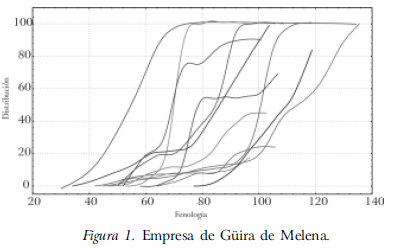
Regionalisation studies of different diseases and pests have been made using several statistical techniques which required use of some statistical parameter that summarize information to come of sampling permanent places of injurious organisms or involved stationary fields. These parameters have the inconvenient not ever reflex reality. With the objective to verify applicability of phytosanitary regionalization methodology was made in Alternaria porri L. in garlic (Allium sativum) considering modelation studies made by Gomez and Cortiñas (2000). Data of 45 permanent sampling fields placed in 5 Enterprises of Havana: Alquízar, Batabanó, Güira, Güines and Melena were taken. Values of climatic variables associated to territories studied were taken also, considering those results effective in modelation study. Soil types associated to each fields were identified, as well as its relief. As result of application of methodology was demonstrated that territories of studied enterprises present two behavior groups of disease produced by A. porri in garlic (Güines and Melena as group 1 and Alquízar, Batabanó and Güira as group 2), characterizing in particular form by high and low temperatures, relative humidity medium as well as precipitation days.
Article Details

This work is licensed under a Creative Commons Attribution-NonCommercial 4.0 International License.
Those authors who have publications with this journal accept the following terms of the License Attribution-NonCommercial 4.0 International (CC BY-NC 4.0):
You are free to:
- Share — copy and redistribute the material in any medium or format
- Adapt — remix, transform, and build upon the material
The licensor cannot revoke these freedoms as long as you follow the license terms.
Under the following terms:
- Attribution — You must give appropriate credit, provide a link to the license, and indicate if changes were made. You may do so in any reasonable manner, but not in any way that suggests the licensor endorses you or your use.
- NonCommercial — You may not use the material for commercial purposes.
- No additional restrictions — You may not apply legal terms or technological measures that legally restrict others from doing anything the license permits.
The journal is not responsible for the opinions and concepts expressed in the works, they are the sole responsibility of the authors. The Editor, with the assistance of the Editorial Committee, reserves the right to suggest or request advisable or necessary modifications. They are accepted to publish original scientific papers, research results of interest that have not been published or sent to another journal for the same purpose.
The mention of trademarks of equipment, instruments or specific materials is for identification purposes, and there is no promotional commitment in relation to them, neither by the authors nor by the publisher.
How to Cite
References
Agresti, A.: An Introduction to Categorical Data Analysis, John Wiley & Sons, Inc., New York, E.U., 1996.
Cortiñas, J.: «Metodología para la regionalización fitosanitaria». Infor- me de Etapa 238.03 PR MIP Sanidad Vegetal, MINAGRI, La Habana, 2000
Gómez, G.; J. Cortiñas; L. Llanes: «Una propuesta de modelo matemá- tico no lineal de la probabilidad de dispersión de la mancha púrpura del ajo en La Habana». Informe de Etapa 239.03 PR MIP Sanidad Vegetal,MINAGRI, La Habana, 2000.
Verbeke, G.; y G. Molenberghs: Linear Mixed Models in Practice. A SAS-Oriented Approach, Springer-Verlag, New York, Inc., E.U., 1997.