
Aspectos de la biología de colletotrichum musae (berk. & curt.) V. Arx y fusarium pallidoroseum (cooke) saccardo, agentes causales de la pudrición de la corona de los bananos (musa sp.) En cuba
Article Sidebar
Main Article Content
Abstract
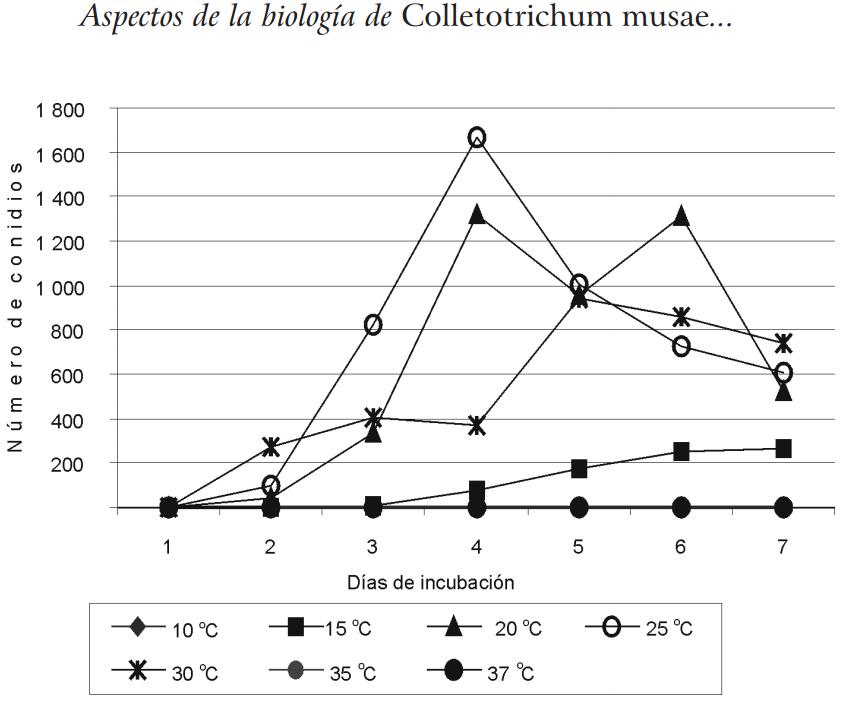
The effect of temperature on conidial germination, colony growth, sporulation in vitro, incubation period and development of crown rot on artificially inoculated Giant Cavendish banana fruits was studied. It was obtained quadratic regression equations to fit the values of germination and colony growth as a function of temperature and to determine the optimal temperature for germination and colony growth. The optimal temperature for F. pallidoroseum and C. musae conidial germination and colony growth was 27 °C. At temperatures below 15 °C, germination and colony growth were strongly inhibited. Crown rot development on artificially inoculated fruits, was strongly delayed at temperatures below 15 °C with regard to development on fruits incubated at 25-27 °C. Conidia of both species requires the presence of free water laminae for germination. C. musae growth abundantly on Saboreaud agar, PDA y and malt agar; but on malt agar the sporulation was higher. C. musae growths and sporulates optimally at temperatures in the range de 25-30 °C in pH on the range of 5-6. The results show the importance of fruit refrigeration at temperature between 13-14°C as short as possible after harvesting and boxing.
Article Details

This work is licensed under a Creative Commons Attribution-NonCommercial 4.0 International License.
Those authors who have publications with this journal accept the following terms of the License Attribution-NonCommercial 4.0 International (CC BY-NC 4.0):
You are free to:
- Share — copy and redistribute the material in any medium or format
- Adapt — remix, transform, and build upon the material
The licensor cannot revoke these freedoms as long as you follow the license terms.
Under the following terms:
- Attribution — You must give appropriate credit, provide a link to the license, and indicate if changes were made. You may do so in any reasonable manner, but not in any way that suggests the licensor endorses you or your use.
- NonCommercial — You may not use the material for commercial purposes.
- No additional restrictions — You may not apply legal terms or technological measures that legally restrict others from doing anything the license permits.
The journal is not responsible for the opinions and concepts expressed in the works, they are the sole responsibility of the authors. The Editor, with the assistance of the Editorial Committee, reserves the right to suggest or request advisable or necessary modifications. They are accepted to publish original scientific papers, research results of interest that have not been published or sent to another journal for the same purpose.
The mention of trademarks of equipment, instruments or specific materials is for identification purposes, and there is no promotional commitment in relation to them, neither by the authors nor by the publisher.
How to Cite
References
Al -Zaemey, A. B., N. Magan; A. K. Thompson: «In vitro Studies of the Effect of Environmental Conditions on the Anthracnose Pathogen of Bananas, Colletotrichum musae», International Biodeterioration and Biodegradation 33 (4): 369-381, 1994.
Anónimo: «Plant Pathologist’s pocketbook», CMI-FAO, 1985.
Badger, A. M.: «Influence of Relative Humidity on Fungi Causing Crown Rot of Boxed Bananas», Phytopathology 55: 688-692, 1965.
Booth, C.; B. C. Sutton: «Fusarium pallidoroseum the Correct Name for Fusarium semitectum Auct», Transaction of the British Mycological Society 83 (4): 702 -704, 1984.
Burden, O. J.: «Report on Banana Fruit Quality Research Project», Windward Island Banana Research Scheme. 1970-1973. Tropical Products Institute. Ministry of Overseas Development, Londres, 1974.
Goos, R. D.; M.Tschirsch: «Effects of Environmental Factors on Spore Germination Spore Survival and Growth of Gloeosporium musarum», Mycology 54: 353-367, 1962.
Greene, C. L.; R. D. Goos: «Fungi Associated with Crown Rot of Boxed Bananas», Phytopathology 53: 271-275, 1963.
Griffee, P. J.; O. J. Burden: «Incidence and Control of Colletotrichum musae on Bananas in the Windward Islands», Annals of Applied Biology, 77 (1): 1-16, 1974.
Lapeyre de Bellaire, L.; X. Mourichon: «The Pattern of Fungal Contamination of the Banana Bunch During its Development and Potential Influence on Incidence of Crown Rot and Anthracnose Diseases», Plant Pathology, 46 (4): 481-489, Inglaterra, 1997.
Lukesic, F. L.; W. J. Kaiser; M. Martínez: «The Incidence of Crown Rot of Bananas in Relation to Microbial Populations of the Crown Tissue», Canadian Journal of Botany 45: 413-421, 1967.
Marín, D. H.; T. B. Sutton; S. M. Blakenship; W. H. Swallow: «Pathogenicity of Fungi Associated With Crown Rot of Bananas in Latin America», Plant Disease 80 (5) 525-528, 1995.
Pérez, L., M. Sáenz; M. Milanés; M. O. López: «Pudrición de la corona de los bananos en Cuba. Etiología y dinámica de las especies de hongos asociadas», informe final de Proyecto, INISAV, 1990.
Slabaugh, W. R.: «Crown Mold, Crown Rot and Pedicel Rot», Compendium of tropical fruit diseases, APS Press, St. Paul, MN, Estados Unidos, 1994, pp. 8- 9.
Slabaugh, W. R.; M. D. Grove: «Postharvest Diseases of Bananas and their Control», Plant Disease 66 (8): 747-750, 1982.