
Efectividad biológica de los herbicidas imazethapyr y clorimuron etyl contra arvenses en el cultivo de la soya (Glycine max)
Article Sidebar
Main Article Content
Abstract
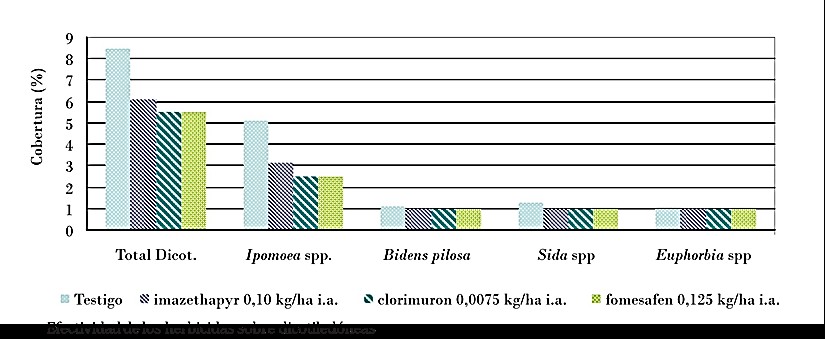
Biological effectiveness on weeds of imazethapyr 10 % CE (0.08-0.15 kg/ha a.i.) and chlorimuron 25 % GD (0.0075-0.0125 kg/ha a.i.) were evaluated in experiment and extension phases on direct sowing of soybean, and residual effect by indicative plants method. In both experiments treatments applications were executed in post-emergent on broadleaves weeds of 2-4 leaves stage on Red Ferralític soil, during rainy season. Both herbicides were selective to soybean and effective against broadleaves weeds and some annual grasses in their first stage, without affecting yield and with similar behavior that production standard fomesafen 0.125 kg/ha a.i. Residual analyses carried out with indicative plants one week before cropping detected affectation levels from middle to high, which indicates the possibility to define posible cultivations to alternate in function of residuals levels persistent in soil.
Article Details

This work is licensed under a Creative Commons Attribution-NonCommercial 4.0 International License.
Those authors who have publications with this journal accept the following terms of the License Attribution-NonCommercial 4.0 International (CC BY-NC 4.0):
You are free to:
- Share — copy and redistribute the material in any medium or format
- Adapt — remix, transform, and build upon the material
The licensor cannot revoke these freedoms as long as you follow the license terms.
Under the following terms:
- Attribution — You must give appropriate credit, provide a link to the license, and indicate if changes were made. You may do so in any reasonable manner, but not in any way that suggests the licensor endorses you or your use.
- NonCommercial — You may not use the material for commercial purposes.
- No additional restrictions — You may not apply legal terms or technological measures that legally restrict others from doing anything the license permits.
The journal is not responsible for the opinions and concepts expressed in the works, they are the sole responsibility of the authors. The Editor, with the assistance of the Editorial Committee, reserves the right to suggest or request advisable or necessary modifications. They are accepted to publish original scientific papers, research results of interest that have not been published or sent to another journal for the same purpose.
The mention of trademarks of equipment, instruments or specific materials is for identification purposes, and there is no promotional commitment in relation to them, neither by the authors nor by the publisher.
How to Cite
References
Anzalone, A.; M. Ruiz; C. Zambrano; A. Ortiz: «Evaluación de Zea mays L. y Phaseolus vulgaris L. como bioindicadores de herbicidas imidazolinonas en suelo», Bioagro 23 (2): 121-128, Venezuela, 2011.
CNSV: «Lista oficial de plaguicidas autorizados», Registro Central de Plaguicidas, Centro Nacional de Sanidad Vegetal, Minag, La Habana, 2010.
Cruz, R. de la; K. Ampong-Nyarko; R. Labrada; A. Merayo: Manejo de malezas en leguminosas y hortalizas: El control de malezas en el contexto del manejo integrado de plagas. Estudio, Producción y Protección Vegetal FAO, Roma 1996, http://www.fao.org/docrep/ t1147s/t1147s0e.htm (consulta: 12/3/10).
Faccini, Delma; Luisa Nisensohn: «Control de amaranthus quitensis H.B.K. en el cultivo de soja y empleo de dosis reducidas clorimuronetil e imazethapyr», Revista de Investigaciones de la Facultad de Ciencias Agrarias. UNR, no. I, Argentina, 2001, http://www. fcagr.unr.edu.ar/Investigacion/revista/rev1/3.htm (consulta: 12/3/12).
Gunsolus, J. L.; W. S. Curran: «Herbicide Mode of Action and Injury Symptoms». Communication and Educational Technology Services, University of Minnesota Extension Service, EE. UU., 2002.
Hager, G.; N. Dawn: «Herbicide Persistence and How to Test for Residues in Soils», Agricultural Pest Management Handbook, cap. 15, Illinois, EE. UU., 2007.
Labrada. R.; E. Paredes; R. Morales: «Lucha contra Sorghum halepense (L.) Pers. con herbicidas de incorporación al suelo en frijol y soya», Rev. Ciencia y Técnica en la Agricultura. Protección de Plantas 10: 29-39, Cuba, 1987.
Lazo, J. V.; J. A. Martínez; A. Escalona: «Evaluación de la eficacia y selectividad del herbicida imazethapyr en soya (Glycine max (L.) Merr. Posible caso de resistencia a Eleusine indica», XII Congreso Sociedad Española de Malherbología / XIX Congreso ALAM/ II Congreso Ibérico de Ciencias de la Malezas, Lisboa, Portugal, 10-13 de noviembre de 2009. vol. 2, pp. 493-500.
Paredes, E.; M. E. Benítez; R. C. García: «Evaluación de herbicidas contra malezas en maní», Fitosanidad 1 (1-4): 32-37, Cuba, 1997.
Pérez, E.; E. Paredes; Lérida Almaguel; L. Vázquez; Marlen Veitía; Marlene González; Yamilka Pérez; R. Hernández; R. García; M. Matamoros: «Metodologías de pruebas biológicas para la determinación de organismos nocivos y residuos fitotóxicos en suelo, sustrato y materia orgánica», Boletín Fitosanitario 14 (1), Inisav, Cuba, 2009.