
Modelo de efectos principales aditivos e interacción multiplicativa aplicado a la evaluación de la roya parda de la caña de azúcar
Article Sidebar
Main Article Content
Abstract
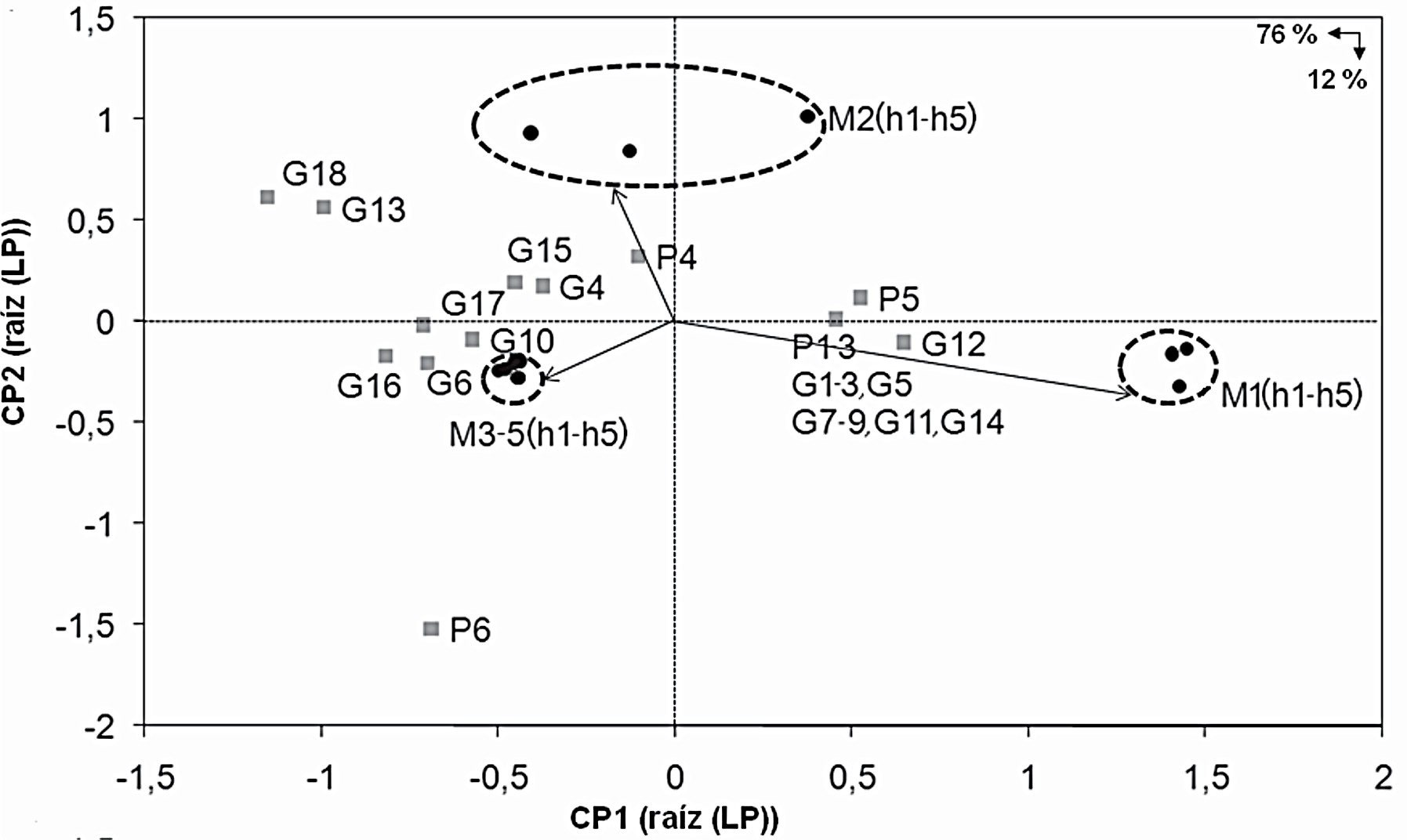
The aim of this study consisted in laying down new criteria used to evaluate the resistance of sugar cane varieties to brown rust, through the efficacy of the Additive Main Effects and Multiplicative Interaction (AMMI) model, as a statistical tool in the evaluation of those variables with the greatest incidence on the damage caused by the disease. The data corresponding to two strains of plant cane from two studies by infection substrate of brown rust, planted in Santiago de Cuba province in September 2007 and 2008, were used. The most frequent size of pustules (LP) and the size of the biggest pustule (TPM) on leaves +1, +3 and +5, as well as, five evaluation times (at 3, 4, 5, 6 and 9 months after planting), were determined. The analysis of variance for variables (LP and TPM) found significant differences between cultivars, time of evaluation and evaluated leaf number, as well as in the first and second order interactions of factors. The AMMI model application through the Biplot representation made it possible to appreciate similarities and differences among evaluation times, leaf number and genotypes, also viewing those with the greatest contribution to the environment-genotype interaction, highest susceptibility and the most stable ones in the level of response reaction to the brown rust disease.
Article Details

This work is licensed under a Creative Commons Attribution-NonCommercial 4.0 International License.
Those authors who have publications with this journal accept the following terms of the License Attribution-NonCommercial 4.0 International (CC BY-NC 4.0):
You are free to:
- Share — copy and redistribute the material in any medium or format
- Adapt — remix, transform, and build upon the material
The licensor cannot revoke these freedoms as long as you follow the license terms.
Under the following terms:
- Attribution — You must give appropriate credit, provide a link to the license, and indicate if changes were made. You may do so in any reasonable manner, but not in any way that suggests the licensor endorses you or your use.
- NonCommercial — You may not use the material for commercial purposes.
- No additional restrictions — You may not apply legal terms or technological measures that legally restrict others from doing anything the license permits.
The journal is not responsible for the opinions and concepts expressed in the works, they are the sole responsibility of the authors. The Editor, with the assistance of the Editorial Committee, reserves the right to suggest or request advisable or necessary modifications. They are accepted to publish original scientific papers, research results of interest that have not been published or sent to another journal for the same purpose.
The mention of trademarks of equipment, instruments or specific materials is for identification purposes, and there is no promotional commitment in relation to them, neither by the authors nor by the publisher.
How to Cite
References
Alfonso, Isabel; R. González; J. Rodríguez; J. Montalbán: E. Alfonso: «La roya de la caña de azúcar en el programa de obtención y selec- ción de variedades», XV Congreso Científico, III Taller de Mejora- miento y Conservación de Recursos Filogenéticos, Instituto de In- vestigaciones de la Caña de Azúcar, Cuba, 2006.
Alfonso, Isabel: «Informe del proyecto del programa agroindustria azucarera. Optimización del procedimiento metodológico para evaluar la enfermedad de la roya de la caña de azúcar», Instituto de Investiga- ciones de la Caña de Azúcar, Cuba, 2008.
Cochran, W. G.; G. M. Cox: Diseños experimentales, Ed. F. Trillas 4.a reimpresión, México, D.F., 1965.
Gauch, H. G. Jr.; R. W. Zobel: «Predictive and Postdictive Success of Statistical Analyses of Yield Trials», Theor. Appl. Genet. 76 (1): 1- 10, Alemania, 1988.
Gauch, H. G.: «Statistical Analysis of Yield Trials by AMMI and GGE», Crop Sci.; 46: 1488-1500, EE. UU., 2006.
Infante, D.; B. Martínez; E. González; Noyma González: «Puccinia kuehnii (Krüger) Butler y Puccinia melanocephala H. Sydow y P. Sydow. en el cultivo de la caña de azúcar», Rev. Protección Veg. 24 (1): 22-28, Cuba, 2009.
Jorge, H.; R. González; M. Casas; Ibis Jorge: «Normas y procedimiento del programa de mejoramiento genético de la caña de azúcar en Cuba», Boletín Cuba-Caña, Inica, 2002.
Jorge, H.: «Informe Central de Variedades. Informe a XVIII Reunión Nacional de Variedades Semilla y Sanidad Vegetal», Documento Interno del Instituto de Investigaciones de la Caña de Azúcar, Cuba, 2010.
Nayak, D.; L. K. Bose; S. Singh; P. Nayak: «Additive Main Effects and Multiplicative Interaction Analysis of Host-Pathogen Relationship in Rice-Bacterial Blight Pathosystem», Plant Pathol. J. 24 (3): 337-351, EE. UU., 2008.
Rodríguez, O.; Mónica Tamayo: «Monitoreo del Sefit en la provincia de Santiago de Cuba», Informe Técnico, Instituto de Investigaciones de la Caña de Azúcar, Cuba, 2008.
Rodríguez, R.: «Perfeccionamiento del programa de mejora genética de la caña de azúcar para la obtención de nuevos genotipos tolerantes al estrés por sequía», Tesis de Doctorado, Instituto de Investigaciones de la Caña de Azúcar, Cuba, 2010.
Smith, E. P.: «Biplot program 2002. Statistics Department of Virginia Tech.», http://www.stat.vt.edu-/facstff/epsmith.html (consulta: 15 de enero de 2010).
StatSoft, Inc. 2007. Statistica (Data Analysis Software System), versión 8.0. www.statsoft.com.
Varela, M.; J. Crossa; A. Kumar; J. Paul; L. Cornelius; Y. Manes: «Generalizing the Sites Regression Model to Three-Way Interaction Including Multi-Attributes», Crop Science 49: 1-15, EE. UU., 2009.