
Efectos provocados por Bacillus thuringiensis cepa-13 sobre Chrysopa exterior en condiciones de laboratorio
Article Sidebar
Main Article Content
Abstract
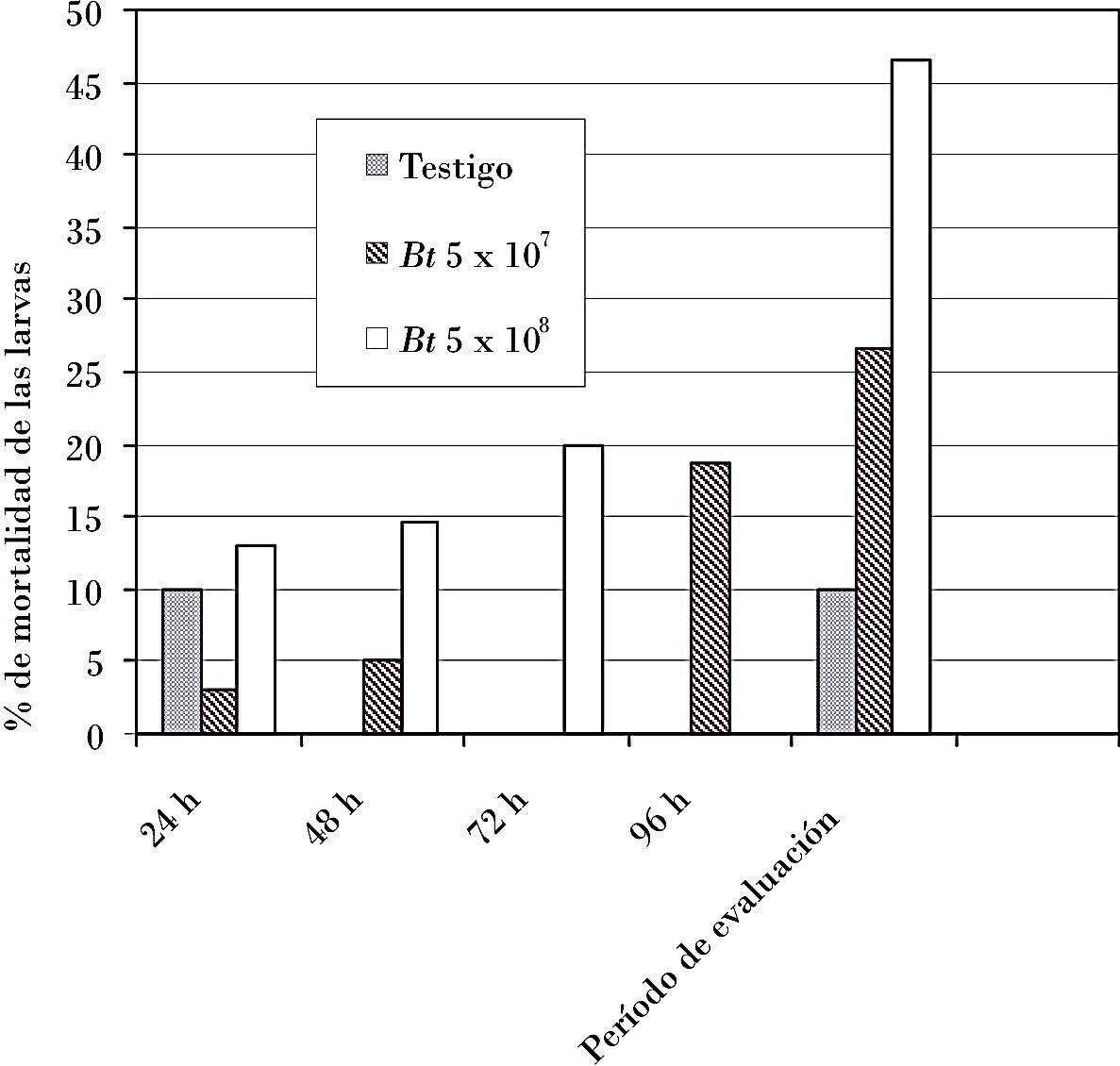
The strain effect of Bacillus thuringiensis Berliner strain-13 on Chrysopa exterior Navas larval mortality and larval and pupae development period, was evaluated under laboratory conditions by the food immersion method of Corcyra cephalonica Stainton eggs in a Bt strain-13 suspension at concentrations of 5 x 10⁷ and 5 x 10⁸ espores/mL, control group was treated with distilled water. Mortality was recorded daily till four days of larvae exposure to Bt. strain-13 in contaminated food. The length of predator stages development was determined by daily observations. Larvae mortality caused by Bt. strain-13 applications at concentrations of 5 x 10⁷ and 5 x 10⁸ spores/mL did not showed significant difference respect to the control; however the suspension concentration of 5 x 10⁸ spores/mL was classified as slightly toxic. Larvae development period was significantly different between control with 5 days, and treatments with 6 and 6.3 days, respectively. No significant differences were observed in pupae stage. Therefore, it was conclude that Bt. strain has effects on C. exterior larval mortality and larval development duration under laboratory conditions.
Article Details

This work is licensed under a Creative Commons Attribution-NonCommercial 4.0 International License.
Those authors who have publications with this journal accept the following terms of the License Attribution-NonCommercial 4.0 International (CC BY-NC 4.0):
You are free to:
- Share — copy and redistribute the material in any medium or format
- Adapt — remix, transform, and build upon the material
The licensor cannot revoke these freedoms as long as you follow the license terms.
Under the following terms:
- Attribution — You must give appropriate credit, provide a link to the license, and indicate if changes were made. You may do so in any reasonable manner, but not in any way that suggests the licensor endorses you or your use.
- NonCommercial — You may not use the material for commercial purposes.
- No additional restrictions — You may not apply legal terms or technological measures that legally restrict others from doing anything the license permits.
The journal is not responsible for the opinions and concepts expressed in the works, they are the sole responsibility of the authors. The Editor, with the assistance of the Editorial Committee, reserves the right to suggest or request advisable or necessary modifications. They are accepted to publish original scientific papers, research results of interest that have not been published or sent to another journal for the same purpose.
The mention of trademarks of equipment, instruments or specific materials is for identification purposes, and there is no promotional commitment in relation to them, neither by the authors nor by the publisher.
How to Cite
References
Ave, D. A: «Stimulation of Feeding: Insect Control Agents», Regulatory Mechanism in Insect Feeding. Chapman, R. F.; De Boer, G. (eds.). Chapman & Hall, Inc. New York, EE. UU., 1995, pp. 345-363.
Claydon, N.; J. Grove: «Insecticidal Secondary Metabolic Products from the Entomopatogenous Fungus Verticillium lecanii», Journal of Invertebrate Pathology 40: 413-418, EE. UU., 1982.
Croft, B. A: Arthropod Biological Control Agents and Pesticides, Wiley and Sons, pp. 723, New York, 1990.
Dutton, A.; H. Klein; J. Romeis; F. Bigler: «Uptake of Bt-toxin by Herbivores Feeding on Transgenic Maize and Consequences for the Predator Chrysoperla carnea», Ecol. Entomol. 27: 441-447, Reino Unido, 2002.
Fonseca, A. R.; C. Carvalho; B. Souza; C. Ecole: «Functional Response of Chrysoperla externa Fed on Schizaphis graminum», International Congress of Entomology, Brasil, 2000.
Hagley, E.; N. Miles: «Release of Chrysoperla carnea Stphen (Neuroptera Chrysopidae for Control of Tetranichus urticae Koch, (Aracnida: Tetraniquidae) on Peach Growm in a Protected Environment Structure», Entomol. 119: 205-206, Canadá, 1987.
Hilbeck, A.; M. Baumgartner; P. M. Fried; F. Bigler: «Effects of Transgenic Bacillus thuringiensis Corn Fed Prey on Mortality and Development Time of Immature Chysoperla carnea (Neuroptera: Chysopidae)», Environmental Entomology 27: 460-487, EE. UU., 1998.
Hilbeck, A.; W. J. Moar; M. Puzstai-Carey; A. Filippini; F. Bilgler: «Prey Mediated Effects of CryI 1Ab Toxin and Protoxin and Cry 2A Protoxin on Depredator Chrysoperla carnea», Entomología experimentalis et Aplicata 91: 305-316, Holanda, 1999.
Iannacone, J.; G. Lamas: «Efecto de dos extractos botánicos y un insecticida convencional sobre el depredador Chrysoperla externa», Manejo Integrado de Plagas y Agroecología 65: 92-101, Costa Rica, 2002.
Iannacone, J.; G. Lamas: «Efectos toxicológicos de extractos de Molle (Schinus molle) y Lantana (Lantana camara) sobre Chrysoperla externa (Neuroptera: Chrysopidae) en Perú», Agricultura técnica 63 (4): 347-360, Chile, 2003.
Icoz, I.; G. Stotzky: «Fate and Effects of Insect-Resistant Bt Crops in Soil Ecosystems», Soil Biology and Biochemistry 40: 559-586, EE. UU., 2008.
Kershaw, M.; E. Moorhouse; R. Bateman; S. Reynols; A. Charnley: «The Role of Dextruxins in the Pathogenicity of Metarhizium anisopliae for Three Species of Insects», Entomología experimentalis et Aplicata 74: 213-233, Holanda, 1999.
Massó, E.; R. Gómez: «Producción y uso de entomófagos en Cuba», Fitosanidad 12 (4): 253, La Habana, 2008.
Medina, P.; F. Budia; H. Vogt; P. del Estal; E. Viñuela: «Influencia de la gestión de presa contaminada con tres modernos insecticidas en Chrysoperla carnea (Stphens) (Neuroptera: Chrysopidae)», Bol. San.,Veg. Plagas 28: 376, España, 2002.
Mohan, M.; S.,N. Sushi; J.,C. Bhat; H.,S. Gupta: «Synergistic Interaction Between Sublethal Doses of Bacillus thuringiensis and Campoletis chlorideae in Managing Helicoverpa armigera», Biocontrol 53 (2): 375-386, Alemania, 2007.
Muck, O.; S. Hassan; A. Huger; A. Krieg: «The Effect of Bacillus thurin- giensis Berliner on the Parasitic Hymenopterans Apanteles glomeratus L. (Braconidae) and Pimpla thurionella (L.) Ichnuemonidae», Entomol. 92: 303-314, Canadá, 1981.
Núñez, E.: «Chrysopidae (Neuróptera) del Perú y sus especies más comunes», Revista Peruana de Entomología 31: 69-75, Perú, 1988.
Pérez, R.; J. García; A. Cotes: «Efecto de un bioplaguicida sobre algunos parámetros poblacionales del depredador Delphastus pusillus (Coleoptera: Coccinellidae)», Revista Colombiana de Entomología 33 (2): 116-123, Colombia, 2007.
Perry, J. N.; Y. Devos; S. Arpaia; D. Bartsch; A. Gathmann; R. S. Hails; J. Kiss: «A Mathematical Model of Exposure of Non-Target Lepidoptera to Bt-Maize Pollen Expressing Cry1Ab Within Europe», Proceedings of the Royal Society B 6: 5-7, Reino Unido, 2010.
Pilcher, C.; M. Rice; J. Obrycki: «Impact of Transgenic Bacillus thuringiensis Cor and Crop Phenology on Five Notarget Artropods», Envairomental Entomology 34, 1302-1316, EE.UU., 2005.
Romeis, J.; M. Meissle; F. Bigler: «Transgenic Crops Expressing Bacillus thuringiensis Toxins and Biological Control», Nature Biotechnology 24: 63-71, EE. UU., 2006.
Montiel, A; M. Ruiz: «Efectos de aplicaciones de Bacillus thuringiensis var. Kurstaki sobre la entomofauna del olivar en la provincia de Jaén», Boletín de Sanidad Vegetal. Plagas, 31 (1): 89-110, España, 2005.
Sauka, D.; G. Benintende: «Bacillius thuringiensis. Generalidades. Un acercamiento a su empleo en el biocontrol de insectos lepidópteros que son plagas agrícolas», Revista Argentina de Microbiología 40: 124-140, Argentina, 2008.
StatSoft, Inc: Statistica for Windows 6.0. Sn-sws 8085, Alemania, 1998.
Staples, J. A.; R.,J. Milner: «A Laboratory Evaluation of the Repellency of Metarhizium anisopliae Conidia to Coptotermes lacteus (Isoptera: Rhinotermitidae)», Sociobiology 36: 133-148, Brasil, 2000.
Viñuela, E.; J. A. Jacas; V. Marco; A. Adan; F. Budia: «Los efectos de los plaguicidas sobre los organismos beneficiosos en agricultura. Grupo de trabajo de OILB plaguicidas y organismos beneficiosos. I. Insecticidas y acaricidas», Phytoma 45:18-25, España, 1993.
Yang, Y. Z.; Y. Yu; L Ren; Y. Shao; K. Qian; P. Myron: «Possible Incompatibility Between Transgenic Cottons and Parasitoids», J. Entomol. 44: 442-445, Australia, 2005.