
Incremento de la calidad sanitaria y fisiológica en semilla de chile poblano (Capsicum annuum L.)
Article Sidebar
Main Article Content
Abstract
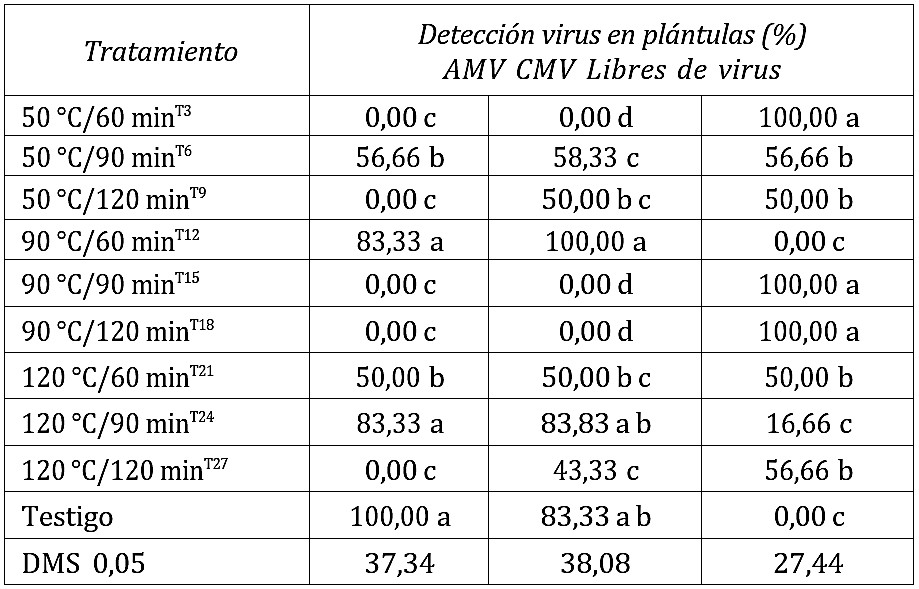
San Luis Potosi participates with 45 % of the national production of poblano chile Capsicum annuum L; however they have low yields because 80 % of the seed used is Creole, produced by farmers, resulting from poor physical, physiological, genetic and sanitary quality, as the AMV and CMV viruses are transmitted by this route, hence it requires 1.2 kg of seed to establish an hectare with 30 000 plants. In this paper thermotherapy and priming was applied to inactivate the AMV and CMV virus after these treatments the seeds were sown in the greenhouse free of insect vectors and virus detection test was performed on seedlings. The results indicate that applying thermotherapy to 90 °C for 120 minutes at -20atm for 48 hours, showed a higher germination percentage (42 %), which indicates greater physiological quality compared to the absolute control without application of priming, the germination percentage was 12 %, demonstrating the poor physiological quality of harvested seed, which also does not meet the standards set by the SNICS. In the test for virus in seedlings, thermotherapy was applied in the seed values of 50 °C for 60 min, 90°C for 90 min and 90 °C for 120 minutes, which we were able to inactivate both viruses AMV and CMV obtaining free plants from these pathogens.
Article Details

This work is licensed under a Creative Commons Attribution-NonCommercial 4.0 International License.
Those authors who have publications with this journal accept the following terms of the License Attribution-NonCommercial 4.0 International (CC BY-NC 4.0):
You are free to:
- Share — copy and redistribute the material in any medium or format
- Adapt — remix, transform, and build upon the material
The licensor cannot revoke these freedoms as long as you follow the license terms.
Under the following terms:
- Attribution — You must give appropriate credit, provide a link to the license, and indicate if changes were made. You may do so in any reasonable manner, but not in any way that suggests the licensor endorses you or your use.
- NonCommercial — You may not use the material for commercial purposes.
- No additional restrictions — You may not apply legal terms or technological measures that legally restrict others from doing anything the license permits.
The journal is not responsible for the opinions and concepts expressed in the works, they are the sole responsibility of the authors. The Editor, with the assistance of the Editorial Committee, reserves the right to suggest or request advisable or necessary modifications. They are accepted to publish original scientific papers, research results of interest that have not been published or sent to another journal for the same purpose.
The mention of trademarks of equipment, instruments or specific materials is for identification purposes, and there is no promotional commitment in relation to them, neither by the authors nor by the publisher.
How to Cite
References
Ayala, V. M. J.: «Análisis del crecimiento y calidad de semillas de tres tipos de chile (Capsicum annuum L.)», Tesis de Maestro en Ciencias. Montecillo, Texcoco, Estado de México, México, 2012.
Carrillo, E. P.; C. J. A., Mejía; C. A., Carballo; S. G., García; R. V. H., Aguilar; T. T., Corona: «Calidad de semilla en colectas de chile de agua (Capsicum annuum L.) de los Valles centrales de Oaxaca, México», Agricultura Técnica en México 35:257-266, México, 2009.
Córdoba S. M. C.: «El virus del mosaico del pepino dulce (Pepino mosaic virus) afectando al cultivo del tomate (Solanum lycopersicum): Caracterización y Epidemiología», tesis doctoral, Universidad Politécnica de Valencia, España, 2010.
Córdoba S. M. C.; A. R. García; A. A. Fernández; C. J. Gutiérrez: «Seed transmission of pepino mosaic virus and efficacy of tomato seed di- sinfection treatments», Plant Disease 91:1250-1254, EE.UU., 2007.
FAO. http://faostat.fao.org/site/339/default.aspx. 2012. Revisado: 10 de marzo de 2015.
ISTA (International Seed Testing Association): International rules for seed testing, Bassersdorf, CH-Switzerland. 700 p. 2004.
Ling, K. S.: «Effectiveness of chemo- and thermotherapeutic treatments on pepino mosaic virus in tomato seed», Plant Disease 94 (3) 325-328, EE. UU., 2010.
Luna, R. J. J.: Producción, conservación y evaluación de semilla de chile (Manual para productores), Universidad Autónoma de Aguascalientes y Fundación Produce, México, 2010.
Marín, J. M.; C. J. A., Mejía; L. A., Hernández; C. A., Carballo; L. A. Peña: «Acondicionamiento osmótico de semillas de cebolla (Allium cepa L.)», Agricultura Técnica en México 33(1): 63:71. México, 2007.
Paylan, I. C.; S., Erkan; N.; Cetinkaya; M., Ergun; S., Pazarlar: «Effects of different treatments on the inactivation of various seedborne viruses in some vegetables», Ozone: Science & Engineering, (just-accepted), 2014.
Pérez, M. L.; J. E., Rico; P.J. R., Sánchez; I. J. T., Ascencio; P. R., Díaz; B. R. F Rivera: «Identificación de virus fitopatógenos en cultivos hortí- colas de importancia económica en el estado de Guanajuato, México», Revista Mexicana de Fitopatología 22:187-197, México, 2004.
Sepúlveda G.: «Aspectos generales de los virus de las plantas. Virus transmitidos por insectos vectores en tomate en la región de Arica y Paranacota: situación actual de manejo», Ed. Instituto de Investigaciones Agropecuarias del Desierto y Altiplano, México, 2011.
SIAP (Servicio de Información Agroalimentaria y Pesquera), Secretaría de Agricultura, Ganadería, Desarrollo Rural, Pesca y Alimentación (SAGARPA), México. http://siap.gob.mx. México, 2012. Revisado: 10 de marzo de 2015.
Sutula, C. L.; J. M., Gillet; S. M., Morrissey; D. C. Ramsdell: «Interpreting ELISA Data and Establishing the Positive-Negative Threshold», Plant Disease 70 (8): 722-726, EE. UU., 1986.
Tun, S. J. M.; M. E., Zavaleta; M. D. L., Ochoa; G. P., Sánchez; H. M., Soto; J. C. Alejo: «Incidencia del virus mosaico de la alfalfa en semillas y plántulas de chile habanero (Capsicum chinense jacq.) en Yucatán, México», Fitosanidad 11:11-14, México, 2007.
Wang Q.; W. J., Cuéllar; M. L., Rajamaki; Y., Hirata; J. P. Valkonen: «Combined thermotherapy and cryotherapy for efficient virus eradication: relation of virus distribution, subcellular changes, cell survival and viral RNA degradation in shoot tips», Mol. Plant Pathol. 9(2): 237-250, 2008.