
Efecto de la desflora en campo y del lavado del racimo sobre la presencia de Fusarium spp. y Colletotrichum spp. y la cantidad de otros hongos relacionados con enfermedades poscosecha del banano
Article Sidebar
Main Article Content
Abstract
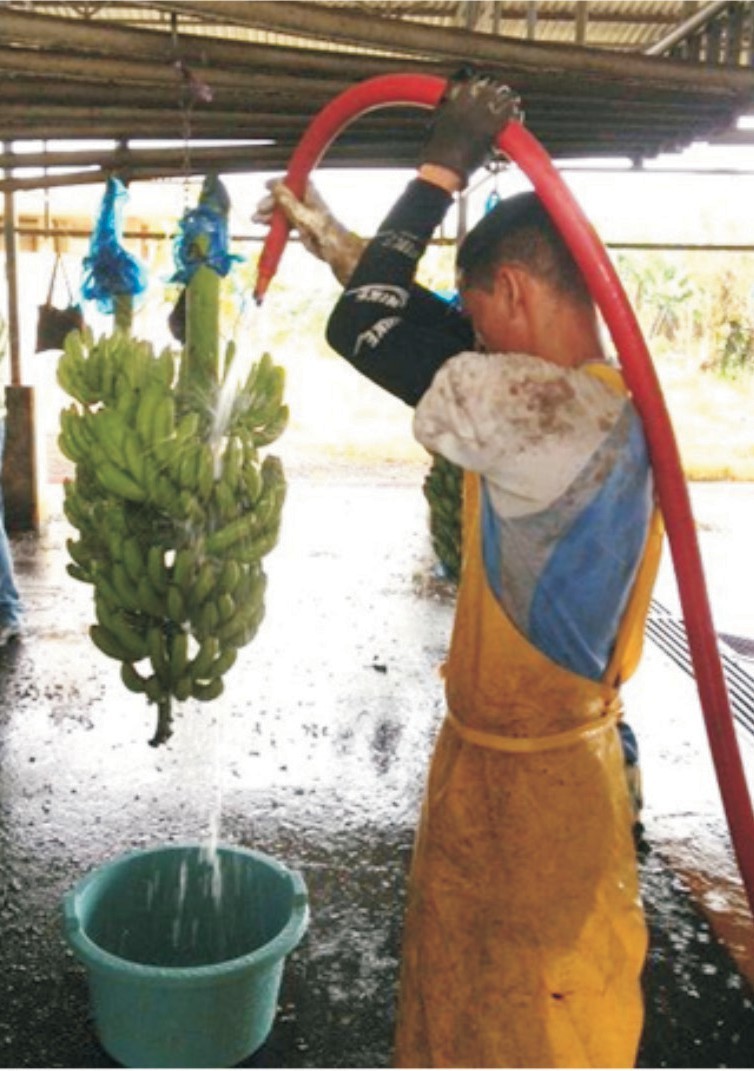
The effect of field deflowering and bunch washing in the packing house on the presence of Fusarium spp. and Colletotrichum spp., as well on the frequency of other fungi related with postharvest diseases of banana were evaluated in a commercial farm located in the Caribbean of Costa Rica. Four experiments that combined deflowering in the field (with and without) and bunch washing (one and two times) on the most important fungi associated with crown rot were conducted. In the experiments 1 and 2 the treatments were: 1) without deflowering and one time washing;
2) without deflowering and two times washes and 3) with deflowers and one time washing and in the experiments 3 and 4 one more treatment was included that consisted with deflowering and two times washes. There was no effect of deflowering on the percentage of bunches with presence of Fusarium spp. (p < 0,0688) and Colletotrichum spp. (p > 0,1034). The number of CFU/mL of those unidentified fungus called ‘Other’ decrease in bunches deflowering at(p < 0,0197) field. In bunches without deflowering (experiments 1 and 2) washing reduced presence of Fusarium spp., Colletotrichum spp. and the number of CFU/ml of Others, but only in the last two was significant (p < 0,0013). Independently of the practice, this also occurred in experiments 3 and 4, where only the last two be reached significant (p < 0,0014). The results indicate that the field deflowering of bunches did not eliminate the presence of Fusarium spp. and Colletotrichum spp., but reduce in 10 % the quantity of other fungi that could be related with postharvest diseases of banana. The washing, previous to the process, diminish significantly the charge of fungi carried by the bunch from the field.
Article Details

This work is licensed under a Creative Commons Attribution-NonCommercial 4.0 International License.
Those authors who have publications with this journal accept the following terms of the License Attribution-NonCommercial 4.0 International (CC BY-NC 4.0):
You are free to:
- Share — copy and redistribute the material in any medium or format
- Adapt — remix, transform, and build upon the material
The licensor cannot revoke these freedoms as long as you follow the license terms.
Under the following terms:
- Attribution — You must give appropriate credit, provide a link to the license, and indicate if changes were made. You may do so in any reasonable manner, but not in any way that suggests the licensor endorses you or your use.
- NonCommercial — You may not use the material for commercial purposes.
- No additional restrictions — You may not apply legal terms or technological measures that legally restrict others from doing anything the license permits.
The journal is not responsible for the opinions and concepts expressed in the works, they are the sole responsibility of the authors. The Editor, with the assistance of the Editorial Committee, reserves the right to suggest or request advisable or necessary modifications. They are accepted to publish original scientific papers, research results of interest that have not been published or sent to another journal for the same purpose.
The mention of trademarks of equipment, instruments or specific materials is for identification purposes, and there is no promotional commitment in relation to them, neither by the authors nor by the publisher.
How to Cite
References
Abd-Alla, M. A.; N. G. El-Gamal; N. S. El-Mougy; M. M. Abdel-Kader: «Post-Harvest Treatments for Controlling Crown Rot Disease of Williams Banana Fruits (Musa acuminata L.)», Plant Pathology & Quarantine 4(1) 1-12, Egipto, 2014.
Cubillo, D.: «Evaluación de fundas de polietileno impregnadas con diferentes sustancias (clorpirifos, clorpirifos + azufre, bifentrina y chile + ajo) y una funda de polipropileno (Agriban) usadas para la protección del racimo del banano», Informe Anual 2003, Corporación Bananera Nacional, Costa Rica, 2004.
Cubillo, D.: Manejo integrado de insectos plagas en el cultivo de banano. Conceptos y aplicaciones, Chemplast International Corporation, Costa Rica, 2013.
Cubillo, D.; W. Meléndez; Ch. Dawson: «Evaluación de diferentes principios activos en el control de insectos plaga en el cultivo del banano», XX Reunión ACORBAT, 9-13 septiembre, Fortaleza, Brasil, 2013.
Coto, D.; J. L. Saunders: Insectos plagas de cultivos perennes con énfasis en frutales en América Central, Centro Agronómico de Investigación y Enseñanza, Manual Técnico / CATIE No. 52, Costa Rica, 2004.
Daudin, J.: «Epistillage des regimenes de bananes sur pied», Fruits, (8) 10: 488-489, Francia, 1953.
Lassois, L.; M. Haïssam; M. Chillet; L. De Lapeyre: «Crown Rot of Bananas: Preharvest Factors Involved in Postharvest Disease Development and Integrated Control Methods», Plant Disease (94): 6, 648-658, EE.UU., 2010.
Marín, D. H.; T. B. Sutton; S. M. Blankenship; W. H. Swallow: «Pathogenicity of Fungi Associated with Crown Rot of Bananas in Latin America on Grande Naine and Disease-Resistant Hybrids Bananas», Plant Disease 80 (5): 525-528, EE. UU., 1996.
Muirhead, I. F.; D. R. Jones: Postharvest diseases, diseases of banana, abaca and enset, CABI Publishing, Inglaterra, 2000.
Pérez, L.; M. Sáenz; F. Mauri: «Control de la pudrición de la corona de los bananos en Cuba, I. Eficacia de benzimidazoles, imidazoles y triazoles», Fitosanidad 5 (4): 31-38, Cuba, 2001.
Rivas, R.; E. Bolaños; M. Ramírez; J. Pineda: «Beneficios en el uso y aplicación del perfil del racimo», Tercer Congreso Científico-Técnico Bananero Nacional, Corporación Bananera Nacional, Costa Rica, 2009.
Robinson, J. Bananas and Plantains, CAB International, Inglaterra, 2010.
Salazar, E.; R. Hernández; A. Tapia; L. Gómez: «Identificación molecular del hongo Colletotrichum spp., aislado de banano (Musa spp.) de altura en la zona de Turrialba y determinación de su sensibilidad a fungicidas poscosecha», Agronomía Costarricense 36(1): 53-68, Costa Rica, 2012.
Serrano, E.; M. Guzmán; M. Mora; M. Araya; M. González; R. Segura; R. Ortega; J. Sandoval: «Efecto de la periodicidad o estacionabilidad climatológica en las plantaciones de banano de la Zona Caribe de Costa Rica», Informe Anual 2008, Corporación Bananera Nacional, Costa Rica, 2009.
Uquillas, C. M.: «Caracterización de Pyroderces sp. (Lepidoptera: Cosmopterigidae) en banano de Ecuador», XV Reunión Internacional ACORBAT, 27 octubre-2 noviembre, Cartagena de Indias, Colombia, 2002.
Umaña, G.: «Estudio de la podredumbre de corona en poscosecha de plátano de producción convencional y ecológica en la región del Caribe de Costa Rica», Tesis Ph. D. Escuela Técnica Superior de Ingenieros Agrónomos. Universidad Politécnica de Valencia, España, 2009.
Umaña, G; J. García: «Frecuency of Organisms Associated with Crown Rot of Bananas in Integrated and Organic Production Systems», International Conference on Postharvest and Quality Management of Horticultural Products of Interest for Tropical Regions. Acta Hort. (ISHS) 906:211-217, Costa Rica, 2011.
Vargas, A.; D. Cubillo; E. Mora: «Evaluación de la desflora en el campo y de fundas impregnadas con bifentrina o clorpirifos sobre el desarrollo del racimo de banano (Musa AAA, cv. Grande Naine) y la incidencia de plagas del fruto», CORBANA 26 (56): 39-52, Costa Rica, 2003.
Vargas, A.: «Efecto de laminillas protectoras de polietileno sobre la productividad de banano sin desflora de frutos», Revista Mexicana de Ciencias Agrícolas 2 (3): 345-348, México, 2011.
Vargas, A.: «Evaluación de prácticas asociadas a la remoción de flores, frutos laterales o centrales y/o de la primer mano basal en el racimo de banano», Agronomía Costarricense 37 (1): 71-90, Costa Rica, 2013.