
Actividad antifúngica de sales de quitosana in vitro sobre hongos causantes de enfermedades poscosecha en papaya (Carica papaya)
Article Sidebar
Main Article Content
Abstract
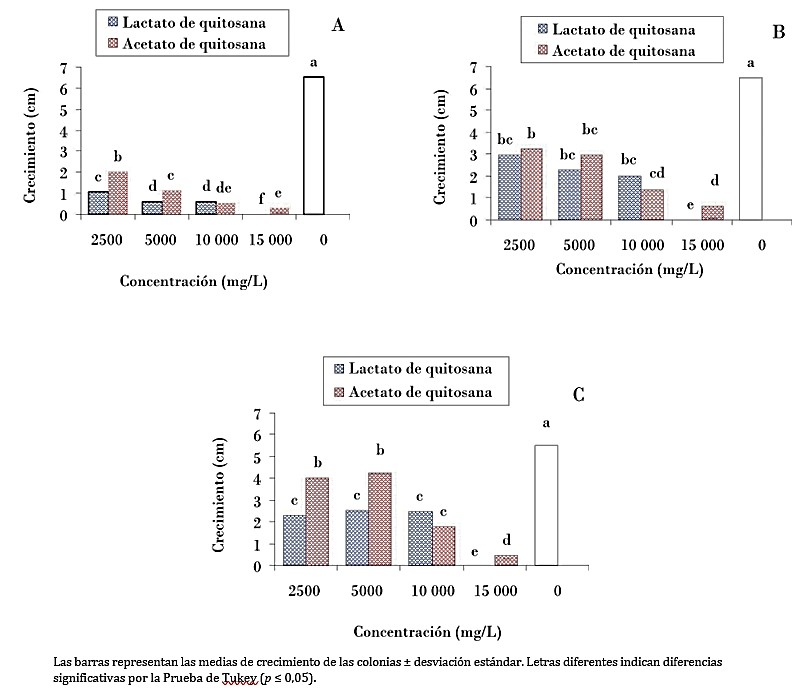
Fungal diseases cause the greatest losses during postharvest of papaya (Carica papaya L). An alternative used for the control is with chemical products, but this method causes great preoccupation to consumers because possible residual levels. Thus other non-polluting methods that do not generate hazardous residues in the fruits are sought. An example is the use of bioactive products as chitosan. The aim of this study was to evaluate the antifungal activity of chitosan lactate and acetate salts on Colletotrichum gloeosporioides, Colletotrichum capsici and Alternaria alternata. Both chitosan salts (30%) were tested at 2500, 5000, 10000 and 15000 mg/L with a control without application. The effect in vitro was determined by measuring the colonies growth diameter (cm) after seven days of incubation at 27 ±1 °C, the sporulation by the concentration (conidia/mL) and the conidia germination percent at four, eight and 24 hours. Chitosan salts showed antifungal activity against C. gloeosporioides, C. capsici and A. alternata. Chitosan acetate at 15000 mg/L reduced the growth of the three fungal colonies with values of 0.47, 0.56 and 0.28 cm, respectively, while the same lactate dose inhibited 100% of growth. Also, both salts reduced germination and sporulation of fungi compared to the control.
Article Details

This work is licensed under a Creative Commons Attribution-NonCommercial 4.0 International License.
Those authors who have publications with this journal accept the following terms of the License Attribution-NonCommercial 4.0 International (CC BY-NC 4.0):
You are free to:
- Share — copy and redistribute the material in any medium or format
- Adapt — remix, transform, and build upon the material
The licensor cannot revoke these freedoms as long as you follow the license terms.
Under the following terms:
- Attribution — You must give appropriate credit, provide a link to the license, and indicate if changes were made. You may do so in any reasonable manner, but not in any way that suggests the licensor endorses you or your use.
- NonCommercial — You may not use the material for commercial purposes.
- No additional restrictions — You may not apply legal terms or technological measures that legally restrict others from doing anything the license permits.
The journal is not responsible for the opinions and concepts expressed in the works, they are the sole responsibility of the authors. The Editor, with the assistance of the Editorial Committee, reserves the right to suggest or request advisable or necessary modifications. They are accepted to publish original scientific papers, research results of interest that have not been published or sent to another journal for the same purpose.
The mention of trademarks of equipment, instruments or specific materials is for identification purposes, and there is no promotional commitment in relation to them, neither by the authors nor by the publisher.
How to Cite
References
Abdelbasset, E. H.; R. Lorne; I. El Hadrami; D. Fouad: «Chitosan in Plant Protection», Mar. Drugs 8 (4): 968-987, Suiza. 2010.
Aranguren, M.; O. Herrera; T. Mulkay; M. E. García; J. Rodríguez: «Efecto de los tratamientos de acondicionamiento a frutos de papayo (Carica papaya L.) cv Maradol Rojo con destino al turismo en los niveles de pudriciones», XIII Congreso Nacional de Ciencia y Tecnología de los Alimentos, sesión Frutas y Hortalizas, Zacatecas 26 y 27 de mayo de 2011. Rev. Salud Pública y Nutrición, RESPYN Ed. especial 12 (6): 555-565, México, 2011.
Bautista, S.; M. Hernández; A. N. Hernández; J. L. Trejo; M. K. Bautista; G. E. Melo: «Effect of Chitosan on in vitro Development and Morphology of Two Isolates of Colletotrichum Gloeosporioides (Penz.) Penz. and Sacc.», Revista Mexicana de Fitopatología 23 (1): 62-67, México, 2005a.
Bautista, S.; A. N. Hernández; M. G. Velázquez del Valle; E. Bosquez; D. Sánchez: «Quitosano: Una alternativa natural para reducir microorganismos postcosecha y mantener la vida de anaquel de productos hortofrutícola», Rev. Iberoamericana de Tecnología Postcosecha 7 (1): 1-6, México, 2005b.
Bautista, C.; M. Hernández; E. Bosquez; C. Wilson: «Effects of Chitosan and Plant Extracts on Growth of Colletotrichum gloeosporioides, Anthracnose Levels and Quality of Papaya Fruit», Crop Protection 22 (9): 1087-1092, México, 2003.
Díaz, R.; A. Casariego; J. Rodríguez; A. Martínez; M. García: «Coberturas de quitosana como método de envasado activo en vegetales enteros y cortados», Ciencia y Tecnologías de Alimentos, 20 (2): 31-36, Cuba, 2010.
Echevarría, A.; M. C. Mirabal; A. Cruz; R. Cárdenas; D. Rivero; A. Rodríguez: «Actividad antifúngica de la quitosana en el crecimiento y esporulación del hongo Pyricularia grisea Sacc.», Memorias XVIII Congreso Científico INCA. Mayabeque, 6-9 de noviembre (PBA-O-04), p.102, Cuba, 2012.
González, D.; A. Cruz; B. Martínez; M. Ramírez; P. Rodríguez: «Actividad antifúngica de la quitosana Sigma frente a hongos fitopatógenos causantes del manchado del grano en el cultivo de arroz (Oryza Sativa L.)», Fitosanidad 13 (2): 101-107, Cuba, 2009.
Hernández, A. N.; S. Bautista; M. G. Velázquez; S. L. Rodríguez; M. L. Corona; A. Solano; E. Bósquez: «Potencial del quitosano en el control de las enfermedades postcosecha», Revista Mexicana de Fitopatología 23 (2): 198-205, México, 2005.
Hernández, A. N.; M. Hernández; M. G. Velázquez; M. G. Guerra; G. E. Melo: «Actividad antifúngica del quitosano en el control de Rhizopus stolonifer (Ehrenb. Fr.) Vuill. y Mucor spp.», Rev. Mexicana de Fitopatología 25 (2): 109-113, México, 2007.
Hernández, I.: «La quitosana: un producto bioactivo de diversas aplicaciones», Cultivos Tropicales 25 (3): 97-110, Cuba, 2004.
Lárez, C.: «Algunas potencialidades de la quitina y el quitosano para usos relacionados con la agricultura en Latinoamérica», Revista UDO Agrícola 8 (1): 1-22, Venezuela, 2008.
Madushani, E.; A. Ali; M. Maqbool; P. Alderson: «Chitosan Controls Postharvest Anthracnose in Bell Pepper by Activating Defense-Related Enzymes», Journal of Science and Technology, DOI 10.1007/ s13197-012-0907-5, India, 2012.
Maqbool, M.; A. Ali; S. Ramanchandran; D. Smith; P. Alderson: «Control of Postharvest Anthracnose of Banana Using a New Edible Composite Coating», Crop Protection. 29: 1136-1141, EE. UU., 2010. DOI: 10.1016/j.cropro.2010.06.005.
Mattiuz, B. H.; M. N. Ducamp; C. F. M. Mattiuz; M. Cissé: «Effects of Chitosan on Growth of Colletotrichum gloeosporioides and Quality of ‘Kent’ Mangoes», International Congress of Postharvest Patology. 11-14 de abril, PC46: 146, España, 2011.
Mulkay, T.; A. Paumier; M. Aranguren; O. Herrera; O. Alonso; J. González; N. Reyes; I. González: «Determinación y control de las enfermedades fungosas de mayor incidencia durante la poscosecha de la papaya (Carica papaya L.)», Memorias I Simposio Internacional de Raíces, Rizomas, Tubérculos, Plátanos, Bananos y Papaya, Recinto Ferial EXPOCENTRO, Complejo Recreativo Arco Iris. Carretera Central. Banda Placetas, Km 303, Santa Clara, Villa Clara, Cuba. 7-10 de noviembre de 2012, MP-0.05.PDF, Cuba, 2011.
Perez, E.; E. M. Yahia: «Effect of Postharvest Hot Airand Fungicide Treatments on the Quality of “Maradol” Papaya (Carica papaya L.)», J. Food Quality 27 (2): 127-139, EE. UU., 2004.
Ramos, L.; T. Montenegro; N. Pereira: «Perspectivas para o uso da quitosana na agricultura», Revista Iberoamericana de Polímeros 12 (4): 195-215, España, 2011.
Romanazzi, G.; F. Mlikota; D. Margosan; B. Mackey; J. Smilanick: «Effect of Chitosan Dissolved in Different Acids on its Ability to Control Postharvest Gray Mold of Table Grape», Phytopathology 99 (9): 1028-1036, EE. UU., 2009.
Saldívar, R.; M. Hernández; F. Hernández: «Activity of Larrea tridentata (D.C.) Coville L. Extracts and Quitosan Against Fungi that Affect Horticultural Crops», Revista Chapingo, serie Horicultura 12 (2): 211-216, México, 2006.
Sánchez, B. M. A.; L. M. J. Zavala; N. M. C. López; B. F. Santamaría: «Fungicidas con aprobación internacional para el control postocecha de la antracnosis en papaya (Carica papaya L.)», Memoria del XIV Congreso Nacional de Ciencias Agronómicas, 25 al 27 de abril de 2012. Chapingo, Estado de México, México, 2012.
Sánchez, D.; S. Bautista; P. Castillo: «Efecto del quitosano en el desarrollo y morfología de Alternaria alternata (Fr.) Keissl», Anales de Biología 29: 23-32, México, 2007.
StatSoft. Inc. Statistica (Data analysis software system) version 6: WWW, StatSof.com., 2001.
Vargas, M.; M. Gillabert; C. Gonzálvez-Martínez; A. Albors; A. Chiralt: «Efecto de la aplicación de un film de quitosano en la calidad de fresas durante el almacenamiento», Actas del III Congreso Español de Ingeniería de Alimentos, Pamplona 15-17 de septiembre, España, 2004, pp. 746-753.
Vázquez, E.; H. Mata; R. Ariza; F. Santamaría: Producción y manejo postcosecha de papaya Maradol en la Planicie Huasteca, Libro técnico, INIFAP-CIRNE/A, Campo Experimental Las Huastecas. INIFAP, México, 2010.