
Community of predatory mites associated with stored products
Article Sidebar
Main Article Content
Abstract
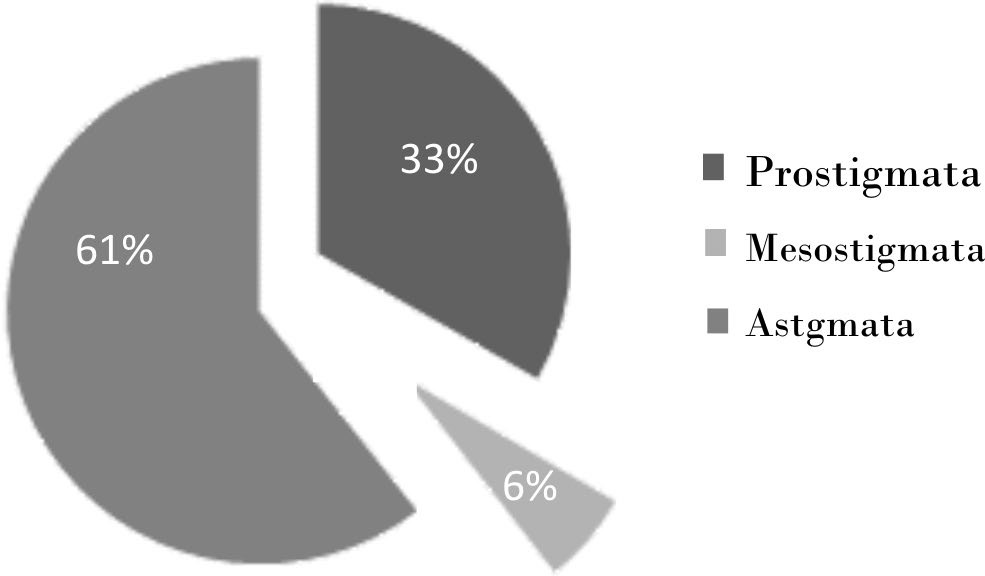
The population growth has meant that the global demand for food will increase substantially. The satisfaction of these will be achieved by increasing production and decreasing losses caused by pests. Mites in stored products gain importance because of its increasing incidence and relation to human health. In this work the association of predatory mites and pests in stored products are determined. Furthermore cluster analysis, where the nearest neighbor method and Euclidean distance was used was applied. To study the species richness and diversity of Margalef structure from Simpson index and Shannon Weiner was used. Predatory five families, four of them in the order of Prostigmata were recorded, the Cheyletidae family with a 76.25 % stands out. Only 12 species of predatory mites were placed to the taxonomic level, Fortis dominated them Cheyletus associated with phytophagous mites and other predators. In the predator-pest interaction, the prevailing association and Suidasia medanensis C. fortis, which can be widely used as a standard study in the context of the stores. Predators were associated with 16 products in storage. The highest number was recorded in rice species, munich malt and annatto; sweepings in as many predatory mites was detected. Stored products have a high diversity of species and low dominance. Furthermore mite communities have little entropic disorder.
Article Details

This work is licensed under a Creative Commons Attribution-NonCommercial 4.0 International License.
Those authors who have publications with this journal accept the following terms of the License Attribution-NonCommercial 4.0 International (CC BY-NC 4.0):
You are free to:
- Share — copy and redistribute the material in any medium or format
- Adapt — remix, transform, and build upon the material
The licensor cannot revoke these freedoms as long as you follow the license terms.
Under the following terms:
- Attribution — You must give appropriate credit, provide a link to the license, and indicate if changes were made. You may do so in any reasonable manner, but not in any way that suggests the licensor endorses you or your use.
- NonCommercial — You may not use the material for commercial purposes.
- No additional restrictions — You may not apply legal terms or technological measures that legally restrict others from doing anything the license permits.
The journal is not responsible for the opinions and concepts expressed in the works, they are the sole responsibility of the authors. The Editor, with the assistance of the Editorial Committee, reserves the right to suggest or request advisable or necessary modifications. They are accepted to publish original scientific papers, research results of interest that have not been published or sent to another journal for the same purpose.
The mention of trademarks of equipment, instruments or specific materials is for identification purposes, and there is no promotional commitment in relation to them, neither by the authors nor by the publisher.
How to Cite
References
Almaguel, L.: «Combate integral contra ácaros fitófagos», en Selección de conferencias sobre Manejo Integrado de Plagas, vol. 11, no. 1. pp. 70-113, La Habana, 2006.
Almaguel, L.; E. Pérez; Z. Martínez; L. R. Machado and A. Suárez: «Mites associated to stored food in Cuba», Abstract Book, 12 Th. Internacional Congreso of Acarology, Edited by Jan Bruin. 21-26 de August, The Netherlands, 2006
Badii, H.; A. E. Flores y L. J. Galán: Fundamentos y perspectivas del control biológico, Universidad Autónoma de Nuevo León, pp. 73-87, México, 2000.
Blanco, D. C.; R. Castillo; N. Ortega; M. Álvarez; C. Arteaga; D. Barber y T. Carrillo: «Los ácaros como trofoalergenos», http://www.alergoaragon.org/1999/primera4.html (Consulta: 27 de junio de 2006).
Cuervo, N.; F. Dusbábek y J. de la Cruz: «Los ácaros (Acarina: Pyroglyphidae, Cheyletidae, Saproglyphidae y Glycyphagidae) de los polvos domésticos de Cuba», Rev. Cub. Med. Trop. 35:83-103, 1983.
Cuervo, N.; J. L. González, M. Reyes y H. Martínez: Lista Alfabética de las especies de ácaros de Cuba (Arachnida: Acari), 21 p. La Habana, Cuba, 1994.
De la Torre, P.; E. Botta y L. Almaguel: «Colectas acarológicas realizadas por la sanidad vegetal en la provincia de La Habana», Fitosanidad 9(3): 3- 11, 2005.
Domínguez, L. D.; A. Mateo; L. Álvarez y L. Alarcón: «Ácaros registrados en las provincias nororientales de Cuba», V Seminario de Sanidad Vegetal, Simposio Latinoamericano y del Caribe. «La biodiversidad acarina: utilización, protección y conservación», Resúmenes (Macromedia CD ROM), 2004.
Ebeling, W.: Urban Entomology. Index for the Interpretive Line Slides for Insects. Stored Product Management. Chapter 13. http://ipmworld. umn.edu/chapters/krischik/index.html. (Consulta: 8 de enero de 2007).
EROSKI: «Riesgos y peligros en los productos lácteos». Disponible en http://www.consumaseguridad.com/web/es/investiga-cion/2004/08/11/13957.php (Consulta: 13 de diciembre de 2006).
FAO: Disponible en http://www.fao.org/docrep/X5041S/x5041S0F.GIF. (Consulta: 11 de diciembre de 2006a).

FAO: «La ingeniería en el desarrollo-manejo y tratamiento de granos poscosecha», disponible en http://www.fao.org/docrep/X5041S/ x5041S00.htm (Consulta: 13 de diciembre de 2006b).
FAO: «Depósito de documentos de la FAO», disponible en http://www. fao.org/docrep/X5037S/x5037S00.HTM (Consulta: 15 de septiembre de 2012).
García L. y D. J. Bergvinson: «Programa integral para reducir pérdidas de postcosecha en maíz», Agricultura Técnica de México, Instituto de Investigaciones de Forestales, Agrícolas y Pecuarias, vol. 33, no. 002, pp. 181-189, mayo-agosto, México, 2007.
Gerson, U.: «Other Predaceus Mites and Spider», Spider Mites, Their biology, Natural Enemies and Control. Elsevier, 205-210, Ámsterdam, 1985.
Gómez, M. E.; L. Almaguel; R. Pérez; Z. Martínez; S. Sierra; C. Cartaya; J. Iglesia; A. Suárez; Grisel Casas y L. R. Machado: Los ácaros de Cuba, publicación interna, INISAV, La Habana, 1978.
Gómez, M. E.: Los ácaros de Cuba, 27 p., La Habana, 1984.
González, N.: Los ácaros de los productos almacenados. Curso de Acarología. IISV, 12 p, La Habana, 1981.
Gulati, R.: Role of acarines during post harvest storage, Department of Entomology, CCS Haryana Agricultural University, Hisar-125 004, 2004.
Gwilymo, E.: Principles of Acarology. Typeset by Lelaper & Gard LTD, Bristol. Printed and bound in the UK at the University Press, 185 p., Cambrige, 1992.
Hughes, A. M.: «The Mites of Stored Food», Tech. Bull. Minist. Agric 9. 1-287, Londres, 1961.
Hughes, A. M.: The Mites of Stored Food and Houses, University of London, 400 p. 1976.
Hurlbert, S. H. «The nonconcept of species diversity: a critique and alternative parameters», Ecology, 52: 577-586, 1971.
Ibge. Instituto Brasileiro de Geografia e Estadística: Disponible en http://www.ibge.gov.br. (Consulta: 13 de diciembre de 2006).
Infoagro: «Manejo de ácaros plagas», disponible en http://www.infoagro.com/hortalizas/acaros plagas.asp. (Consulta: 15 de septiembre de 2008).
Iraola, V.: «Introducción a los ácaros (II): Hábitats e importancia para el hombre», Aracnet 7-Bol. SEA. no 28, pp. 141-148, 2001.
Iraola V.; E. Fernández: «Domestic mites and allergen levels in Spain. Mites associated to stored food in Cuba», Abstract Book, 12 Th. Internacional Congreso of Acarology.. Edited by Jan Bruin. 21-26 de August, The Netherlands, 2006.
Kuznetzov, N. N y I Z. Livshitz: «Jishchine Klesshchine krima (Acariformes: Bdellidae, Cunaxidae, camerobiidae)», Trudi Gos. Nikitskogo Botasad, Jardín Bota. Niñita/Yalta -GNBS. 76 p., Rusia, 1979.
Lande, R.: «Statistics and partitioning of species diversity, and similarity among multiple communities», Oikos, 76: 5-13, 1996.
Lorini, I.: «Controle integrado de pragas de grãos armazenados», Passo Fundo, EMBRAPA-CNPT, 52 p. (EMBRAPA-CNPT. Documentos, 48), 1998.
Martínez, Z.; P. de la Torre y S. A García: «Principales ácaros detectados en la provincia de Villa Clara», Fitosanidad, 8 (1): 3-17, La Habana, 2004.
Paquete Estadístico Statgraphics Plus versión 5.1, abril, 2002
Pérez E.: L. Miralles; L. Almaguel; L. Vázquez; F. Piedra; A. Navarro; G. Hernández y J. Piedrahita: Manejo integrado de plagas en alma- cenes, silos, instalaciones de la industria molinera y transportación de alimentos, Ed. CIDISAV. Impreso Editora Centenário, 69 pp., La Habana, 2010.
Puerta L.; D. Mercado y L. Caraballo: «Establecimiento de cultivos en el laboratorio del ácaro Suidasia medanensis», disponible en http://www.encolombia.com/medicina/alergia/alergia11102-establecimien- tocultivos.htm. (Consulta: 22 de mayo de 2008).
Ramos L. y Fernández M.: «Uso de Phytoseulus macropili (Banks) (Acari: Phytoseiidae) en el control de Tetranychus tumidus (Banks) (Acari: Tetranychidae) en viveros de plátano, Tesis en opción al grado científico de Doctor en Ciencias Agrícolas, 34 p., Cuba,1995.
Riudavets, J.; C. Castañé; M. J. Pons y R. Gabarra: «Control biológico de plagas en industria agroalimentaria», Institut de Recerca i Tecnología Agroalimentàries (IRTA), Departament de Protecció Vegetal. Carretera de Cabrils s/n, 08348 Cabrils, Barcelona, 2005. Disponible en http://www.agroinformacion.com/leer-articulo.aspx?not=408. (Consulta: 13 de diciembre de 2006).
Rodríguez, H.: «Potencialidad de Amblyseius largoensis (Muma) como agente causal de control biológico de Polyphagotarsonemus latus (Banks)», Fitosanidad, vol. 8, no. 1, La Habana, 2004.
Sánchez, J.: «Control de ácaros contaminantes de jamón Ibérico», Tesis doctoral. Servicio de Publicaciónes e Intercambio Científico (Dialnet), Universidad de Extremadura, España, 2002.
Suárez, A.: «Catálogo de los ácaros de la provincia de Guantánamo», Fitosanidad, 8 (1): 23-31. La Habana, 2004.
Texas University: «Biting Mites in Homes. House and Garden Series», http://citybugs.tamu.edu/FastSheets/Ent-1025.html. (Consulta: junio de 2008).
Yudelman, Anno Ratta & David R. Nyaa: Pest Management and Food Production, loking to the future, Food, Agriculture and Enviroment Discusión Paper 25, Washington, 94 p., EE.UU., 1998.