
Fungi associated with pathologies on cuban eucalyptus plantations
Article Sidebar
Main Article Content
Abstract
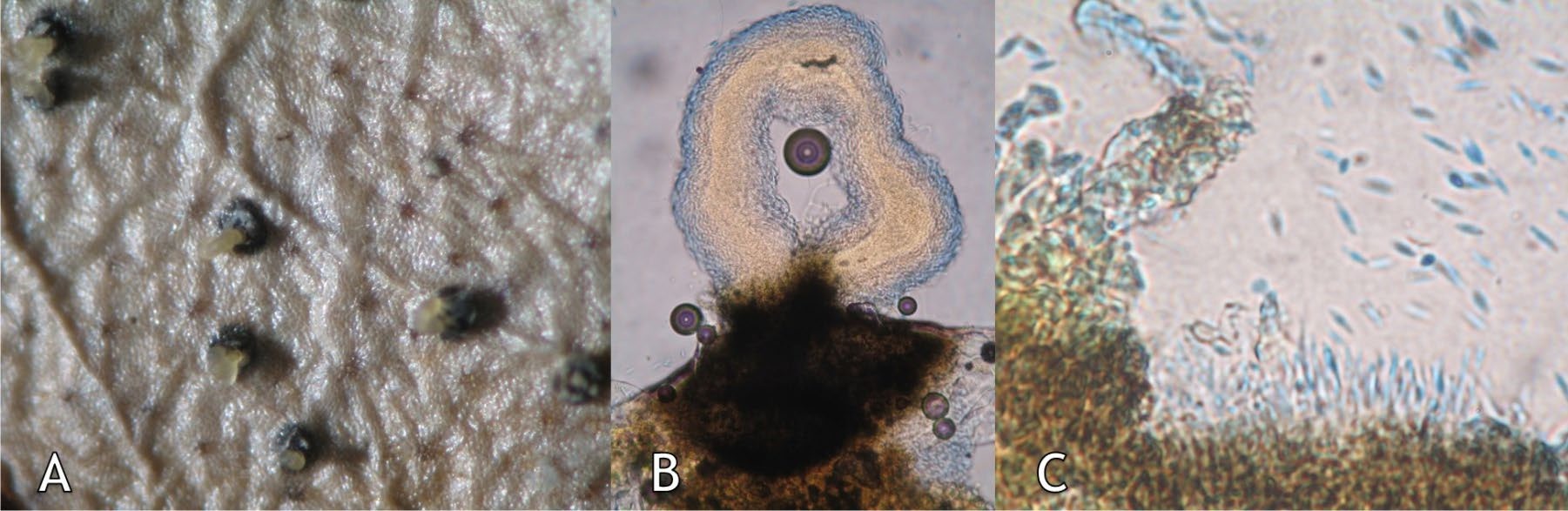
In Cuba, eucalyptus are considered as one of the most important forest species. Because of it rapid and high biomass production, it is suitable for a wide range of uses. During last years, areas dedicated to their cultivation are increasing within the country. Despite this there are few records of the incidence of phytopathogenic fungi on Cuban plantations of eucaliptus. The aim of this work was to identify fungal species associated to pathologies present in these plantations. Plantations of E. saligna in Pinar del Río, E. grandis in Santiago de Cuba and Eucalyptus sp.in Ciego de Ávila were sampled. Samples of stems, branches and leafs with different symptomatologies were collected, disinfected with sodium hypochlorite (NaOCL, 1-3 %), and placed in humid chambers. For fungal isolation, sections of disinfected symptomatic tissues were placed in Water Agar (2 %) and Potato Dextrose Agar plates supplemented with streptomycin sulphate (100 µg/mL). From the different pathologies ten fungal species were identified. On stems with canker symptoms Acremonium sp., Crysoporthe cubensis, Graphium sp. and Lasiodiplodia theobromae were detected; on branch with canker or blight Cryptosporiopsis eucalypti, L. theobromae and Pestalotiopsis guepinii were identified. While Coniella fragariae, Cryptosporiopsis eucalypti, Kirramyces epicoccoides, Pestalotiopsis disseminata and Phomopsis eucalypti were associated with foliar spots.
Article Details

This work is licensed under a Creative Commons Attribution-NonCommercial 4.0 International License.
Those authors who have publications with this journal accept the following terms of the License Attribution-NonCommercial 4.0 International (CC BY-NC 4.0):
You are free to:
- Share — copy and redistribute the material in any medium or format
- Adapt — remix, transform, and build upon the material
The licensor cannot revoke these freedoms as long as you follow the license terms.
Under the following terms:
- Attribution — You must give appropriate credit, provide a link to the license, and indicate if changes were made. You may do so in any reasonable manner, but not in any way that suggests the licensor endorses you or your use.
- NonCommercial — You may not use the material for commercial purposes.
- No additional restrictions — You may not apply legal terms or technological measures that legally restrict others from doing anything the license permits.
The journal is not responsible for the opinions and concepts expressed in the works, they are the sole responsibility of the authors. The Editor, with the assistance of the Editorial Committee, reserves the right to suggest or request advisable or necessary modifications. They are accepted to publish original scientific papers, research results of interest that have not been published or sent to another journal for the same purpose.
The mention of trademarks of equipment, instruments or specific materials is for identification purposes, and there is no promotional commitment in relation to them, neither by the authors nor by the publisher.
How to Cite
References
Alonso, R.; S. Tiscornia; A. Couto Alfenas; L. Bettucci: “Fungi associated to bark lesions of Eucalyptus globulus stems in plantations from Uruguay”, Revista Árvore, 2009, 33 (4): 591-597.
Barradas, C.; A. J. L. Phillips; A. Correia; E. Diogo; H. Bragança; A. Alves: “Diversity and potential impact of Botryosphaeriaceae species associated with Eucalyptus globulus plantations in Portugal”, European Journal of Plant Pathology, 2016.
Chen, S. E.; M. Gryzenhout; L. Roux; Y. J. Xie; M. J. Wingfield; X. D. Zhou: “Identification and pathogenicity of Chrysoporthe cubensis on Eucalyptus and Syzygium spp. in South China”, Plant Dis., 2010, 94:1143-1150.
Chen, S. F.; D. Pavlic; J. Roux; B. Slippers; Y. J. Xie; M. J. Wingfield; X. D. Zhou: “Characterization of Botryosphaeriaceae from plantation-grown Eucalyptus species in South China”, Plant Pathology, 2011, 60, 739-751.
Crous, P. W.; A. Giraldo; D. L. Hawksworth; V. Robert; P. M. Kirk; J. Guarro; B. Robbertse; C. L. Schoch; U. Damm; T. Trakunyingcharoen; J. Z. Groenewald: “The Genera of Fungi: fixing the application of type species of generic names”, IMA Fungus 2014, 5(1):141-160.
Crous, P. W.; G. J. M. Verkley; J. Z. Groenewald: “Eucalyptus microfungi known from culture. 1. Cladoriella and Fulvoflamma genera nova, with notes on some other poorly known taxa”, Stud. Mycol., 2006, 55(1):53-63.
Farr, D. F.; A. Y. Rossman: “Fungal Databases, Systematic Mycology and Microbiology”, 2017, Laboratory, ARS, USDA, http://nt.ars-grin. gov/fungaldatabases/.
Gryzenhout, M.; H. Myburg; N. A. van der Merwe; B. D. Wingfield; M. J. Wingfield: “Chrysoporthe, a new genus to accommodate Cryphonectria cubensis”, Studies in Mycology, 2004, 50:119-142.
Gryzenhout, M.; C. A. Rodas; J. Mena Portales; P. Clegg; B. D. Wingfield; M. J. Wingfield: “Novel hosts of the Eucalyptus canker pathogen Chrysoporthe cubensis and a new Chrysoporthe species from Colombia”, Mycol. Res., 2006, 110: 833-845.
Gryzenhout, M.; B. D. Wingfield; M. J. Wingfield: Taxonomy, Phylogeny, and Ecology of Bark-Inhabiting and Tree-Pathogenic Fungi in the Cryphonectriaceae, APS Press, St. Paul, Minnesota, 2009, 119 pp.
Iglesias-Trabad, G.; R. Carbaeira-Tenreiro; J. Folgueiia-Lozano: (2009). “Eucalyptus universalis”, Global cultivated eucalypt forest map Version 1.2 In: GIT Forestry Consulting’s Eucalyptologics: Information resources on Eucalyptus cultivation world wide, http://www.git-forestry.com (verified Oct 19, 2009).
Jiménez-Terry, F.; D. Agramonte: “Cultivo in vitro y macropropagación como vía de sostenibilidad de la propagación de especies forestales”, Biotecnología Vegetal, 2013, 13(1). Recuperado de https://revista.ibp. co.cu/index.php/BV/article/view/89/456.
López, R.; C. Guerra; A. Duarte; H. Cruz; A. Fernández; A. García; Y. Varela La O; M. Berrios; N. Triguero; I. Vila: “Actualización del inventario de insectos y microorganismos nocivos a las especies forestales en Cuba”, Fitosanidad, 2003, 7(2): 3-9.
Mordue, J. E. M.: Pestalotiopsis guepinii, IMI Descriptions of Fungi and Bacteria, Sheet N° 320, Cab International, Reino Unido, 1971.
Old, K. M.; M. J. Wingfield; Z. Q. Yuan: A manual of diseases of eucalypts in South-East Asia, Center for International Forestry Research, Jakarta, Indonesia, 2003, 106 pp.
Phillips, A. J. L.; A. Alves; J. Abdollahzadeh; B. Slippers; M. J. Wingfield; J. Z. Groenewald; P. W. Crous: “The Botryosphaeriaceae: genera and species known from culture”, Studies in Mycology, 2013, 76, 51-167.
Slippers, B.; T. Burgess; D. Pavlic; R. Ahumada; H. Maleme; S. Mohali; C. Rodas; M. J. Wingfield: “A diverse assemblage of Botryosphaeriaceae infect Eucalyptus in native and nonnative environments”, Southern Forests: a Journal of Forest Science, 2009, 71, 101-110.
Wingfield, M. J.: “Increasing threat of diseases to exotic plantation forest in the southern hemisphere: lessons from Cryphonectria canker”, Australasian Plant Pathology, 2003, 32:133-139.