
Evaluation of extracts propolis in post-harvest quality of mango Super Haden
Article Sidebar
Main Article Content
Abstract
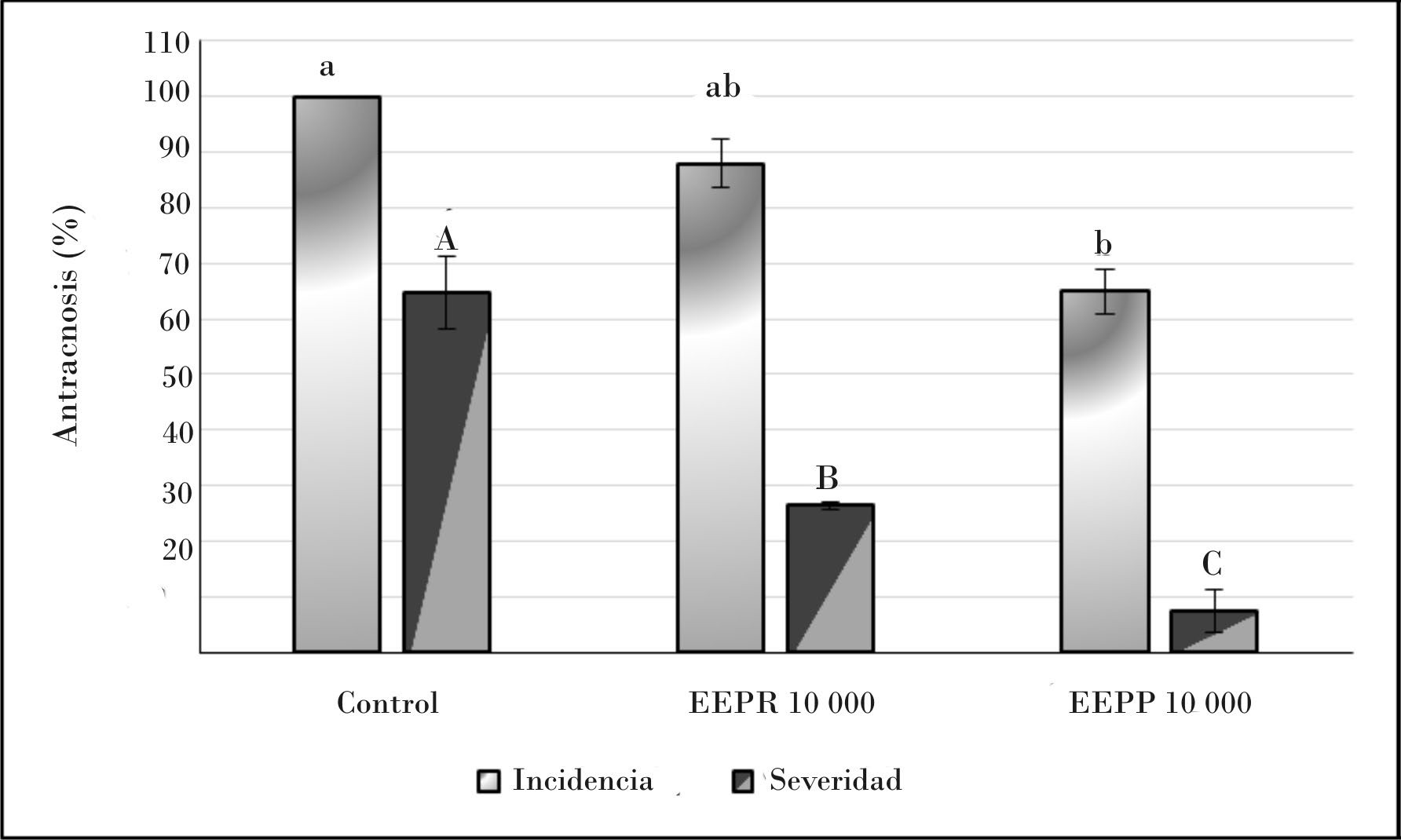
Propolis is a resinous substance produced by honey bees from the buds of certain plants exudates and then processed by in the hive. Its antifungal activity against fungi that cause rot in fruits has been demonstrated. Anthracnose is considered the main fungal disease of mango and causes high losses during postharvest. The aim of this study was to evaluate the effect of two ethanolic extracts of propolis (EEP) brown (EEPB) and red (EEPR) in the control of anthracnose and quality of mango fruit ‘Super Haden’. Both EEP at 10 000 mg • L-1 were applied by immersing the fruits for five minutes and control in water. Later the fruits are stored at 14 ± 1 ° C for 12 days. The incidence, severity and treatment effectiveness in controlling anthracnose (%), loss of fresh mass (%), mesocarp firmness (kgf), TSS (° Brix), acidity (%) were determined and a sensorial panel was held. The EEPB showed greater effectiveness in controlling anthracnose, the incidence decreased significantly compared to the EEPR and control. The severity index of disease was 7.3 % with EEPB, 26.33 % for EEPR and in control 64.66 %. The EEPR allows the normal maturation of the fruit and with the EEPP the physiological process is advanced, evidenced in the indicators of maturity and by the absence of bad tastes. These results showed the potential of propolis in the control of anthracnose and quality postharvest of mango.
Article Details

This work is licensed under a Creative Commons Attribution-NonCommercial 4.0 International License.
Those authors who have publications with this journal accept the following terms of the License Attribution-NonCommercial 4.0 International (CC BY-NC 4.0):
You are free to:
- Share — copy and redistribute the material in any medium or format
- Adapt — remix, transform, and build upon the material
The licensor cannot revoke these freedoms as long as you follow the license terms.
Under the following terms:
- Attribution — You must give appropriate credit, provide a link to the license, and indicate if changes were made. You may do so in any reasonable manner, but not in any way that suggests the licensor endorses you or your use.
- NonCommercial — You may not use the material for commercial purposes.
- No additional restrictions — You may not apply legal terms or technological measures that legally restrict others from doing anything the license permits.
The journal is not responsible for the opinions and concepts expressed in the works, they are the sole responsibility of the authors. The Editor, with the assistance of the Editorial Committee, reserves the right to suggest or request advisable or necessary modifications. They are accepted to publish original scientific papers, research results of interest that have not been published or sent to another journal for the same purpose.
The mention of trademarks of equipment, instruments or specific materials is for identification purposes, and there is no promotional commitment in relation to them, neither by the authors nor by the publisher.
How to Cite
References
Abott, W. S.: “A method of compoting the effectiveness of on insecticide”, Journal Economic Entomolgy, 18:267-267, 1925.
Abramovic, H.; T. Polar; J. Bertoncelj; P. Jamnik; S. Smole; B. Jersey: “Chemical properties and antioxidant and antimicrobial activities of Slovenian propolis”, Chem Biodivers, 9(8):1545-1558, 2012.
Asgar, A.; Ch. Chen Khan; Z. Noosheen: “Composite effect of propolis and gum arabic to control postharvest anthracnose and maintain quality of papaya during storage”, International Journal Agriculture and Biology, 16:1117-1122, 2014.
Arauz, L. F.: “Mango anthracnose: Economic impact and current options for integrated management”, Plant Disease, 6: 600-611, 2000.
Arias, R.; L. Carrizales: “Control químico de la antracnosis del mango Mangifera indica L. en pre y poscosecha en el municipio Cedeño, Estado de Monagas, Venezuela”, Bioagro, 9:19-25, 2007.
Barrera, E.; M. Gil; C. García; D. Durangon; H. Gil: “Empleo de un recubrimiento formulado con propóleos para el manejo poscosecha de frutos de papaya (Carica papaya L. cv. Hawaiana), Revista Facultad Nacional de Agronomía, Medellín, 65(1): 6497-6506, 2012.
Barrera, E.; J. Gil; A. Restrepo; K. Mosquera; D. Durango: “Un recubrimiento de quitosano y extracto de propóleos para el manejo poscosecha de la papaya (Carica papaya L. cv. Hawaiiana), Revista Facultad Nacional de Agronomía, Medellín, 68(2): 7667-7678, 2015.
Brecht, J.; S. Sargent; E. Mitcham; F. Maul; P. Brencht; O. Menocal: “Manual práctico para el mejoramiento poscosecha del mango”, Copyright. National Mango Board, Orlando, Florida, EE.UU., 2010, http://WWW.edis.ifas.ufl.edu/pdffiles/hs/hs119000.pdf. Consultado el 6 de septiembre de 2016.
Çandir, E. E.; A. E. Özdemir; E. M. Soylu; N. Fiahinler; A. Gül: “Effects of propolis on storage of sweet cherry cv. Aksehir Napolyon”, Asian Journal Chemical, 21:2659-2666, 2009.
Corrado, L.: “Evaluation of an ethanolic extract of propolis as a potential pre and post-harvest fungicide for ‘fuerte’ avocado (Persea Americana Mill.) Fruits and Orchards, The Degree of Master of Science to the University of the Witwatersrand, Johannesburg, 2008.
Cupull, R.; R. Cortés; E. Olazába; C. Hernández: “Actividad antifúngica de propóleos obtenidos en tres provincias de Cuba sobre hongos contaminantes en cultivo de tejidos vegetales”, Acta Universitaria, 23(6):3-9, 2013.
Farré, R.; I. Frasquet; A. Sánchez: “El própolis y la salud”, Revista Ars Pharmaceutica, 45 (1): 21-43, 2004.
Figueroa, J.; J. Salcedo; Y. Aguas; R. Olivero; G. Narvaez: “Recubrimientos comestibles en la conservación del mango y aguacate y perspectiva, al uso del propóleos en su formulación”, Rev. Colombiana Cienc. Anim., 3(2):386-399, 2011.
Gil, M.; A. Perelli; R. Alvarado; Y. Arias; E. Blumenthal: “Actividad bacteriostática y bactericida de la tintura de propóleos sobre bacterias enteropatógenas”, Salus online, 2012, 16(3):29-37, http://wwwsalus-online.fcs/ uc.edu.ve/tintura_propoleos.pdf.
Hegazi, A.; A. Abdou: F. Abd-Allah: “Egyptian propolis 11: Its antimicrobial activity with comparison with different localities”, Int. J. Curr. Microbiol Applied Sci., 3:530-538, 2014.
Hernández, A.; M. Pérez; D. Bosch; L. Rivero: Nueva versión de clasificación genética de los suelos de Cuba, Ed. Agrinfor, Instituto de Suelos, Ministerio de la Agricultura, La Habana, 1999.
Ismail, A. M.; G. Cirvilleri; T. Yaseen; F. Epifani; G. Perrone; G. Polizzi: “Characterization of Colletotrichum species causing anthracnose disease of mango in Italy”, Journal of Plant Pathology, 97 (1):167-171, 2015.
Kader, A.: Mango. “Recommendations for maintaining postharvest quality”, 2014, http://www.ucdavis.edu/PFfruits/Mango. Consultado: 21 abril 2016.
Kalogeropoulos, N.; S. Konteles; E. Troullidou; I. Mourtzinos; V. Karathanos: “Chemical composition, antioxidant activity and antimicrobial properties of propolis extracts from Greece and Cyprus”, Food Chemestry, 2009, 116: 452-461.
Kamel, H.; A. Zeinab; Z. Zaki; E. Abd El-Moneim: “The Effect of Propolis and Sodium Metabisulfite as Postharvest Treatments on Pomegranate Arils Storage”, American-Eurasian J. Agric. & Environ. Sci. 15 (10):1962-1973, 2015.
Kumah, P.; F. Appiah; J. Opoku-Debrah: “Effect of hot water treatment on quality and shelf-life of Keitt mango”, Agriculture and Biology Journal of North America 2, (5):806-817, 2011.
Lima, N. B.; M. V. De A. Batista; M. A. De Morais, Jr.; M. A. G. Barbosa; S. J. Michereff; K. D. Hyde; M.P.S. Câmara: “Five Colletotrichum species are responsible for mango anthracnose in northeastern Brazil”, Fungal Diversity, 61:75-88, 2013.
Markham, K.; K. Mitchell; A. Wilkins; J. Daldy; Y. Lu: “HPLC and GCMS identification of the major organic constituents in New Zealand propolis”, Phytochemistry, 42(3): 205-211, 1996.
Martínez, J.: “Caracterización físico-química y evaluación de la actividad antifúngica de propóleos recolectados en el suroeste antioqueño”, Universidad Nacional de Colombia, sede Medellín, Facultad de Ciencias Agropecuarias, Maestría en Ciencia y Tecnología de Alimentos, 2009.
Mattiuz, B. H.; M. Ducamp-Collin; C. Mattiuz; C. Vigneaultd; K. Agalhães; W. Sagouab; D. Montet: “Effect of propolis on postharvest control of anthracnose and quality parameters of ‘Kent’ mango”, Scientia Horticulturae, 184:160-168, 2015.
Matny, O.: “Efficacy Evaluation of Iraqi Propolis Against Gray Mold of Stored Orange Caused by Penicillium digitatum”, Plant Pathology Journal 14 (3):153-157, 2015.
McKinney, H. H.: “Influence of soil temperature and moisture on infection of wheat seedlings by Helmintosporium sativum”, J. Agric. Res., 26:195-218,1923.
Ministerio de la Agricultura: Catálogo de cultivares de mango en Cuba, 2014.
Mulkay, T.: “Desarrollo de las tecnologías poscosecha de frutas de mango (Mangifera indica. L.) papaya (Carica papaya L.), aguacate (Persea americana Mill.) y maracuyá (Passiflora edulis Sims f. flavicarpa Degener) con destino al mercado en fresco e industria. Informe final de proyecto”, Instituto de Investigaciones en Fruticultura Tropical de Cuba, 2015.
Mulkay, T.; A. Paumier; I. González; M. Fajardo: “Evaluación in vitro de dos extractos etanólicos de propóleos sobre Colletotrichum gloeosporioides (Penz.) Penz. & Sacc. agente causal de la antracnosis en el mango (Mangifera indica L.)”, rev. Apiciencia, vol. XVI, Edición Extraordinaria, 13-23, 2014.
ONEI: Anuario Estadístico de Cuba, 2015, Agricultura, Ganadería, Servicultura y Pesca, edición 2016. Oficina Nacional de Estadísticas República de Cuba, http://www.one.cu/aec2009. Consultado 8 marzo 2017.
Özdemir, A. E.; E. Çandir; M. Kaplankiran; E. Soylu; N. Şahinler; A. Gül: “The effects of ethanol-dissolved propolis on the storage of grapefruit cv. Star Ruby”, Turk. J. Agric. For. 34: 155-162, 2010.
Palomino, L.; J. Martínez; C. García: “Caracterización fisicoquímica y actividad antimicrobiana del propóleos en el municipio de La Unión (Antioquia, Colombia), Rev. Fac Nal. Agr., Medellín, 63 (1): 5373-5383, 2010.
Passos, F.; F. Queiroz; M. Crivelari da Cunha; and A. Mundstock: “Propolis extract coated in Pera orange fruits: An alternative to cold storage”, African Journal of Research Agricultural, 11(23): 2043-2049, 2016.
Pastor, C., L. Sánchez; A. Marcilla; A. Chiralt; M. Cháfer; C. González: “Quality and safety of table grapes coated with hydroxypropyl-methylcellulose edible coatings containing propolis extract”, Postharvest Biology and Technology, 60(1):64-70, 2010.
Peng, L.; S. Yang; Y. Chen; S. Pan: “Antifungal activity and action mode of pinocembrin from propolis against Penicillium italicum, Huazhong Agricultural University, Wuhan, Food Science and Technology, 21:133-1534, 2012.
Pineda, J.; J. Principal; C. Barrios; D. Milla; Y. Solano; E. Gil: “Propiedad fungistática in vitro de propóleos sobre tres aislamientos de Colletotrichum gloeosporioides”, Zootecnia Tropical, 28 (1) 7, 2010.
Ploetz, R. C.: “Mango diseases caused by fungi. Anthracnose”, Compendium of tropical fruit diseases, 8, 88, 1994.
Singh, P.; M. Kumar; V. Kumar; M. Kumar; S. Malik: “Effect of physico-chemical treatments on ripening behavior and post-harvest quality of Amrapali mango (Mangifera indica L.) during storage”, J. Environ. Biol., 33: 227-232, 2012.
Statsoft Statistica (Data analysis software system). version 6, 2001, www.StatSof.com.
Zahid, N.; A. Asgar; Y. Siddiqui; M. Maqbool: “Efficacy of ethanolic extract of propolis in maintaining postharvest quality of dragon fruit during storage”, Postharvest Biol. Technol. 79: 69-72, 2013.