
Algunas consideraciones sobre la biología y etología de diaphania hyalinata (L.) (lepidoptera:pyralidae) en la zona norte de la provincia de las tunas
Article Sidebar
Main Article Content
Abstract
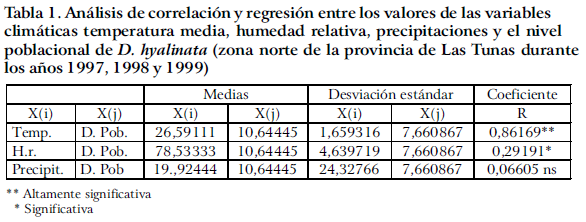
Diaphania hyalinata (L.) is the key pest of the cucurbitaceous, however, the specifications of their biology and etology are ignored in the north zone of Las Tunas province, where the pumpkin (Cucurbita moschata, Duch.) is a cultivation of economic interest whose yields are affected by the pest. During 3 years the general characteristics of the vital cycle and behaviour were observed to define, under natural conditions, the features more important bioetologics. The morphometrics observations of the vital states were carried out with a microscope stereoscopic with micrometer of lineal scale. The data, processed through the calculation of the intervals of trust of the means, showed differences with those obtained in other regions of the country. The populational levels of the pest, calculated weekly according to the method for their signalling and the means values of the temperatures, relative humidity and precipitations, quantified in the places of the experience, were interpreted statistically by regression and lineal correlation analysis being high significance between the values of the populational distribution and those of the temperatures, while the relative humidity was less significant. The biological cycle of the pirálido lapsed, with means temperatures of 26,5 to 28,1°C and relative humidity of 78,5 to 83% between 28,97 and 33,00 days. The larves began their attacks to the 12-14 days postgermination and they delayed from 10 to 13 days. The larves and pupas were attacked for Nemorilla floralis (Fall) and Conura hirtifemora (Ashmead) respectively.
Article Details

This work is licensed under a Creative Commons Attribution-NonCommercial 4.0 International License.
Those authors who have publications with this journal accept the following terms of the License Attribution-NonCommercial 4.0 International (CC BY-NC 4.0):
You are free to:
- Share — copy and redistribute the material in any medium or format
- Adapt — remix, transform, and build upon the material
The licensor cannot revoke these freedoms as long as you follow the license terms.
Under the following terms:
- Attribution — You must give appropriate credit, provide a link to the license, and indicate if changes were made. You may do so in any reasonable manner, but not in any way that suggests the licensor endorses you or your use.
- NonCommercial — You may not use the material for commercial purposes.
- No additional restrictions — You may not apply legal terms or technological measures that legally restrict others from doing anything the license permits.
The journal is not responsible for the opinions and concepts expressed in the works, they are the sole responsibility of the authors. The Editor, with the assistance of the Editorial Committee, reserves the right to suggest or request advisable or necessary modifications. They are accepted to publish original scientific papers, research results of interest that have not been published or sent to another journal for the same purpose.
The mention of trademarks of equipment, instruments or specific materials is for identification purposes, and there is no promotional commitment in relation to them, neither by the authors nor by the publisher.
How to Cite
References
Abraham, J.: Comunicación personal, 1993.
Ceballos, M.; M. Hernández: «Comunidad parasítica de Diaphania hyalinata (L.) (Lepidoptera: Pyralidae) en un cultivar de calabaza (Cucurbita moschata, Duch.)», Rev. Protección Vegetal, CENSA, 10 (1):29-33, 1995.
Guerra, Walkiria et al.: Estadística, Ed. Félix Varela, La Habana, 1998.
Hernández, Y.; M. Surís; M. López: «Ciclo de vida y reproducción de Diaphania hyalinata (L.) (Lepidoptera:Pyralidae) en condiciones de laboratorio», Rev. Protección Vegetal, CENSA 10(3):241-246, 1995.
King, A. B.; T. L. Saunders: Las plagas de invertebrados a los cultivos anuales en América Central,. Ad. y Desarrollo Extranjero. Londres, 1984, p. 52.
Martínez, P.; G. Lindo: «Ciclo biológico y comportamiento de Diaphania hyalinata (L.) en zapallo y melón», Rev. Peruana de Entomología, 29:115, 1986.
Méndez, B. A.: Principales insectos que atacan las plantas económicas de Las Tunas, Universidad Central Martha Abreu, Las Villas, Cuba, 2002.
MINAGRI: «Tecnología para el cultivo de las viandas tropicales y el maíz», La Habana, 2002.
Murguido, C.: «Metodología de señalización de Diaphania hyalinata (L.) y Diaphania nitidalis Stol. C.N.S.V, La Habana,1990.
Peter, C.; B. David: «Population Dynamic of the Pumpkin Caterpillar, D. indica (Lepidoptera: Pyralidae)», Tropical Management 37(1):75-79, 1991.
Pozo, E.: «Biología de Diaphania hyalinata (L.) (Lepidoptera:Pyralidae) en condiciones ambientales»,. Rev. Centro Agrícola, 21 (1):47-50,1994.
Pozo, E. et al.: «Manejo integrado de Diaphania hyalinata (L.) (Lepidoptera:Pyralidae) en Cuba», XII Seminario Científico, INCA, La Habana, 2000, p. 96.
Reid, W. J.;F. P. Cuthber: «Biology Studies of Pickleworm», Jor. Econ. Entomol. 49(6):870-873, 1956.
Suárez, R. et al.: Plagas, enfermedades y su control, Ed. Pueblo y Edu- cación, La Habana, 1989.
Surís, M.; Y. Hernández; M. López: «Comportamiento poblacional de Diaphania hyalinata (L.) (Lepidoptera:Pyralidae) en calabaza», Rev.Protección Vegetal 12(1):39-45, 1997.