
Ratoon stunting (Leifsonia xyli subsp. xyli) bacterial disease of the sugarcane
Article Sidebar
Main Article Content
Abstract
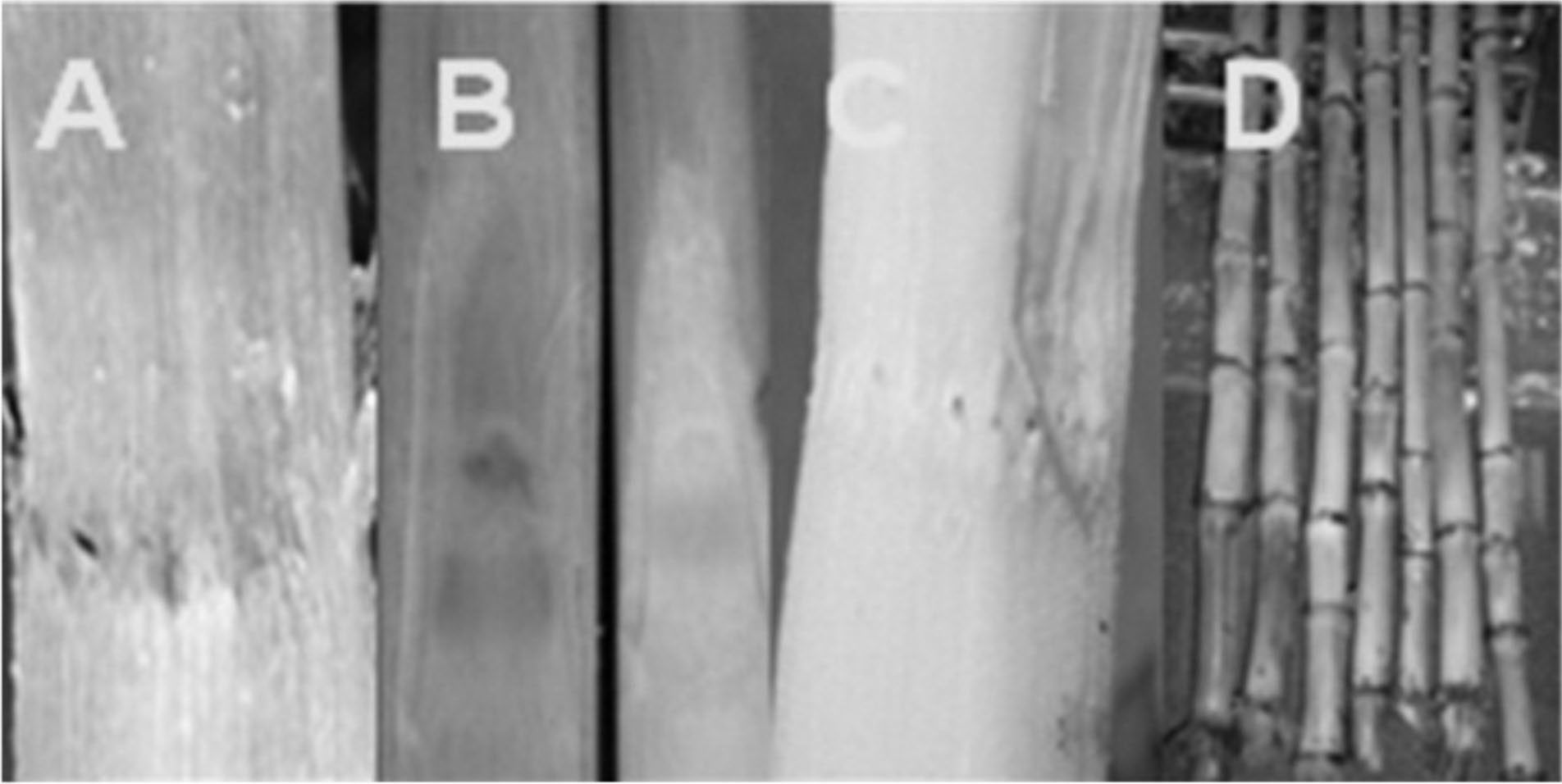
The ratoon stunting (Leifsonia xyli subsp. xyli) is one of the most important bacterial disease for the sugarcane. This work is bibliographical review of this pathology with the purpose to update your knowledge for to explain the research results. This disease was observed for the first time in Australia in 1944 and nine years later it was informed in Cuba. The symptoms are not specific, although to produce vascular fluid that it originate points and short lines of orange-reddish color in the base of the knots of shafts takes place, delay of the growth and plants with appearance rickety product to the interference of the transport of water and nutrients through of the xilema. The production can be affected to more than 50 % although visible symptoms don’t exist as it is increased the number of crops of the plantations and the susceptibility grade of the varieties. The stress conditions can facilitate the development of the bacteria and progressive reduction of the sugarcane production. In the determination of the incidence and distribution of the illness in the sugarcane plantations the serologic methods are preferred. The main way for the dissemination of the bacterium in sugarcane is the material used for the propagation, for which must carry out the hidrotermic treatment to the agamic seed and disinfection of the court instruments used in the sugarcane plantations.
Article Details

This work is licensed under a Creative Commons Attribution-NonCommercial 4.0 International License.
Those authors who have publications with this journal accept the following terms of the License Attribution-NonCommercial 4.0 International (CC BY-NC 4.0):
You are free to:
- Share — copy and redistribute the material in any medium or format
- Adapt — remix, transform, and build upon the material
The licensor cannot revoke these freedoms as long as you follow the license terms.
Under the following terms:
- Attribution — You must give appropriate credit, provide a link to the license, and indicate if changes were made. You may do so in any reasonable manner, but not in any way that suggests the licensor endorses you or your use.
- NonCommercial — You may not use the material for commercial purposes.
- No additional restrictions — You may not apply legal terms or technological measures that legally restrict others from doing anything the license permits.
The journal is not responsible for the opinions and concepts expressed in the works, they are the sole responsibility of the authors. The Editor, with the assistance of the Editorial Committee, reserves the right to suggest or request advisable or necessary modifications. They are accepted to publish original scientific papers, research results of interest that have not been published or sent to another journal for the same purpose.
The mention of trademarks of equipment, instruments or specific materials is for identification purposes, and there is no promotional commitment in relation to them, neither by the authors nor by the publisher.
How to Cite
References
Alvez B.; M. Oropeza; G. Alonso. 2016. Leifsonia xyli subsp. xyli, patogeno de la caña de azúcar en Venezuela agente causal del raquitismo de los retoños de la caña de azúcar. España. Editorial Académica Española, 120 p.
Brumbley, S.; L. Petrasovits; S. Hermann; A. Young; B. Croft. 2006. Recent advances in the molecular biology of Leifsonia xyli subsp. xyli: causal organism of ratoon stunting disease. Australian Plant Pathology. 35 (6): 681-689, diciembre.
Carvalho, G.; F. Olivera; A. Ramos. 2010. Devolopmet of a quantitative real-time PCR protocol for the analysis of early colonization of sugarcane plantlets with Leifsonia xyli subsp. xyli. Phitopathology. Vol. 100 (6): 56-64, diciembre.
Chinea A.; A. Chinea H.; J. Días; F. Hernández. 2007a. Hospedantes de enfermedades de la caña de azúcar en Cuba: Características y estrategia de manejo. Cuba & Caña (CU). 56-62, diciembre.
Chinea, A.; G. Pérez; A. Chinea H.; L. Cabrera; R. Cruz; J. Pérez; Y. Pérez. 2012. Caracterización fitopatológica del germoplasma de la caña de azúcar en Cuba. ATAC (CU). 24-29, diciembre.
Chinea, A.; G. Pérez; L. Cabrera; J. Pérez; J. Pérez; S. Vidal. 2010. Comportamiento del germoplasma de la caña de azúcar ante el raquitismo de los retoños en Cuba. Publinica. La Habana. 5 p.
Chinea, A.; M. Pérez; E. Peralta; M. Matos 2007b. Raquitismo de los retoños de la caña de azúcar: medio siglo de investigaciones en Cuba. Cuba & Caña (CU). 24-29, diciembre.
Comstock, J.; R. Gilbert. 2012. Sugarcane Ratoon Stunting Disease. University of Florida SS-AGR-202. Agricultural Sciences. (16): 120-125, diciembre.
Contreras, N.; O. Jiménez; M. Bonilla; H. Nass. 2008. Identificación y caracterización de Leifsonia xyli subsp. xyli como patógeno de la caña de azúcar (Saccharum spp.) en la región centro occidental de Venezuela. Bioagro. 20 (2): 111-118, diciembre.
Davis, M.; A. Gillaspie; R. Harris; R. Lawson. 1980. Ratoon stunting disease of sugar cane: Isolation of the causal bacterium. Science. (10): 1365-1367, diciembre.
Davis, M.; R. Bailey. 2000. Ratoon stunting. In: Rott, P.; R. Bailey; J. Comstock; J. Croft; A. Saumtally (Eds.), a guide to sugar cane diseases. CIRAD. Montpellier. pp. 49-54.
Delgado, J. 2014. Inmuno impresión directa de tejidos para el diagnóstico masivo de Leifsonia xyli subsp. xyli en caña de azúcar (Saccharum spp.). Mayabeque. 72 h. Tesis (en opción al título académico de Máster en Sanidad Vegetal) –Universidad Agraria de La Habana.
Digonzelli, P.; J. Giardina; J. Fernández; S. Casen; M. Tonatto; M. Leggio; E. Romero; L. Alonso. 2012. La termoterapia una alternativa para la obtención de caña de semilla saneada EEAOC. Tucuman, Argentina. EEAOC. 15 p.
Dinh, H.; B. Cauh; L. Dinh; N. Duc. 2008. Determinación del estado del raquitismo de los retoños de la caña de azúcar (RSD) en el sudeste de Vietnam. Cuba & Caña (CU). 60-65, abril.
Evtushenko, L.; L. Dorofeeva; S. Subbotin; J. Cole; J. Tiejde. 2000. Leifsonia poae gen. nov., sp. nov., isolated from nematode galls on Poa annua, and reclassification of Corynebacterium aquaticum Leifson, 1962 as Leifsonia aquatica (ex Leifson 1962) gen. nov., nom. Rev., comb. nov. and Clavibacter xyli Davis et al., 1984 with two subspecies as Leifsonia xyli (Davis et al., 1984) gen. nov., comb. nov. Int. J. Syst. Evol. Microbial. (50): 371-380, diciembre.
Filippone, M.; M. Perera; M. Salgado; M. García; G. Vellicce; A. Castagnaro. 2010. Diagnóstico molecular de enfermedades sistémicas de la caña de azúcar en la Argentina: ajuste metodológico y aplicaciones. Revista Industria y Agricultura de Tucumán. 87 (2): 01-11, diciembre.
Fontana, P.; V. Di; R. Sopena. 2014. Raquitismo de las socas en caña de azúcar: servicio de diagnóstico para los productores. Buenos Aires. INTA Famaillá. 15 p.
Funes, C.; R. Bertani; I. Cazón; C. Kairuz; V. González; L. Ploper. 2012. Estado sanitario de lotes comerciales de caña de azúcar destinados a la obtención de caña semilla durante el periodo 2008–2011 en Tucumán, R. Argentina. EEAOC. Avance Agroindustrial. Argentina. 33 (1): 8-12, diciembre.
Garcés, F.; F. Fiallos; J. Mendoza; E. Silva; R. Castillo; M. Valdez; I. Viteri. 2013. Manejo preventivo del raquitismo de los retoños de la soca (Leifsonia xyli subsp. xyli) escaldadura de la hoja (Xanthomonas albilineans) y la hoja amarilla (Sugarcane yellow leaf virus, SCYLV) de la caña de azúcar (Saccharum spp.). III Congreso AETA, 18 al 20 de septiembre del 2013. Guayaquil-Ecuador.
García, H. 2014. Diagnóstico de Xanthomonasalbilineans (Ashby) Dowwon y Leifsoniaxylisubsp. xyli en caña de azúcar en la Chontalpa, Tabasco, México. Tabasco. Tabasco. 79 h. Tesis (en opción al grado científico de Máster en Ciencias, especialista en Producción Agroalimentaria en el Trópico) – Colegio de Postgraduados México.
García, H; C. García; S. García; A. Valdez; H. Silva; W. Ovalle. 2016. Inmunodetección de la bacteria Leifsopniaxylisubspxyli en clones comerciales de caña de azúcar en la Chontalpa, Tabasco, México. Agroproductividad. 9 (3): 3-9, marzo.
Gillaspie, A.; D. Teakle. 1989. Ratoon stunting disease. En: Ricaud, Diseases of sugarcane. Elsevier. Amsterdam. pp. 58-80.
Gillaspie, A.; M. Davis; J. Worley. 1973. Diagnosis of ratoon stunting disease based on the presence of a specific microorganism. Plant Disease Report. (57): 981-990, diciembre.
Hussnain, S.; S. Afghan; M. Haq; J. Comstock; S. Mughal; A. Shahazad; K. Hussain; K. Nawaz; Y. Pan; P. Jackson; A. Batool; A. Irfan. 2011. First report of ratoon stunt of sugarcane caused by Leifsonia xyli. subsp. xyli in Pakistan. Plant Disease (95): 1581, diciembre.
Iglesia, A. 2005. Estudio del raquitismo de los retoños de la caña de azúcar en Cuba. La Habana. 98 h. Tesis (en opción al grado científico de Doctor en Ciencias Agrícolas) –Universidad Agraria de La Habana.
Iglesia, A.; E. Lilia; D. Martín; E. Álvarez; J. Milian; M. Matos. 2007a. Relación de la funcionalidad de los vasos del xilema y la presencia de Leifsonia xyli subsp. xyli. Protección Vegetal (CU). 22 (1): 89-96, abril.
Iglesia, A.; M. Díaz; M. Ramos. 2011. Validación de técnicas para el diagnóstico del raquitismo en los retoños de la caña de azúcar en Cuba. ATAC (CU): 18-23, diciembre.
Iglesia, A.; R. González; D. Martín; M. Díaz; E. Álvarez. 2007b. Aislamiento e identificación morfológica, bioquímica y molecular de Leifsonia xyli subsp. xyli en Cuba. Protección Vegetal (CU). 22 (1): 29-33, abril.
INICA, 2013. Metodologías del sistema de extensión agraria para la caña de azúcar. La Habana. INICA. 139 p.
INICA, 2016. XXIII reunión nacional de variedades, semilla y sanidad vegetal. La Habana. Cuba & Caña (CU). 48 p (suplemento especial).
Ipiales, M. 2010. Raquitismo de la soca. Técnico en Agroindustria. Colombia, noviembre 23: 18 p.
Johnson, S.; A. Tyagi. 2010. Effect of ratoon stunting disease (RSD) on sugarcane yield in Fiji. The South Pacific Journal of Natural and Applied Sciences 28 (1): 69-73, diciembre.
Kazeem, S.; B. Ikotun; O. Awosusi; A.Wintola; A. Wada. Status of ratoon stunting disease of sugarcane (Leifsonia xyli subsp. xyli) in Nigeria. Trop Plant Pathol. 2015. Vol. 40: 350-354.
Lemma, A.; A. Tafesse; A. Tekle. Status of ratton stunting disease (Lefisonia xyli subsp xyli) in the initial seed cane and seed cane fields of Wonji Sugar factory. Global Science Research Journals. 2015. Vol. 3 (2): 213-217.
Martínez, E.; G. Barrios; L. Rovesti; R. Santos. 2007. Manejo integrado de plagas. Manual práctico. España. Grup Bou, Tarragona. 526 p.
Monteiro, M. 2013. Termoterapia asociada al cultivo de tejidos para la obtención de plantas de caña de azúcar de la variedad SP80-3280 libres de Leifsonia xyli subsp. xyli. Piracicaba. 76 h. Tesis (en opción al grado científico de máster en Agronomía), Universidad Sao Paulo.
Mutonyi, J.; H. Nyongesa. Incidence and prevalence of ratoon stunting disease (Leifsonia xyli subsp. xyli, Evtushenko) in the mumias sugar cane growing zone Kenya. IOSR Journal of Agriculture and Veterinary Science (IOSR-JAVS). Vol. 9 (11) Ver. II: 28-31.
Oropeza, M.; G. Alonso. Leifsonia xyli subsp. xyli, patógeno de la caña de azúcar en Venezuela: agente causal del raquitismo de los retoños de la caña de azúcar. Madrid. Editorial Académica Española. 2016. 120 p.
Peña, M. 2007. Implementación de un servicio fitosanitario en la agricultura cañera de la provincia de Guantánamo. Granma. 97 h. Tesis (en opción al grado de Máster en Ciencias Agrícolas) –Universidad de Granma.
Pérez, J.; J. Montalbán; Y. Figueredo; M. Matos; I. Abrantes; G. Barroso; G. Delgado. 1998. Evaluación del sistema tradicional de producción de semilla empleado en Cuba para el control de enfermedades de la caña de azúcar. Informe Final. CITMA-INICA. La Habana, Cuba. 73 p.
Pérez, J. 1985. El raquitismo de los retoños (RSD) de la caña de azúcar en Cuba. La Habana. 126 h. Tesis (en opción al grado científico de Doctor en Ciencias Agrícolas) INICA-ACC.
Pérez, H.; I. Santana; I. Rodríguez. 2013. Manejo sostenible de tierras en la producción de caña de azúcar. La Habana, Cuba. 290 p.
Pérez, Y.; S. Rodríguez. 2007. Respuesta del tratamiento hidrotérmico sobre la enfermedad raquitismo de los retoños en caña de azúcar. Cuba & Caña (CU). 38-40, diciembre.
Piñón, D. 2001. Hacia una fitoprotección ecológica de plagas en el SEFIT. En: Curso de actualización en temáticas de sanidad vegetal (SEFIT). INICA. La Habana, Cuba. 84 p.
Ponte, E.; S. Silveira; J. Barros; R. Moreira. 2010. Incidencia de Leifsonia xyli subsp. xyli en áreas de producción de caña de azúcar en Espíritus Santo, sur de Bahia y oeste de Minas Gerais. Summa Phytopathologica. Vol. 36 (4): 313-321, diciembre.
Ramallo, J. 2001. Aplicación de la hidrotermoterapia para la obtención de caña semilla de sanidad controlada. Avance Agroindustrial. (22): 16-18, diciembre.
Rodríguez, E.; A. Chinea; I. Alfonso; R. Acevedo; F. Barroso; O. Aday; M. Rodríguez; B. Bendig. 2007. Enfermedades y plagas de la caña de azúcar. PDVSA Agrícola-INICA. Barinas. 30 p.
Rufin, Y. 2011. Raquitismo de los retoños de la caña de azúcar: Resistencia varietal y comparación de métodos de evaluación. La Habana. 58 h. Tesis (en opción al título académico de Máster en Sanidad Vegetal)–Universidad Agraria de La Habana.
Santana, I.; M. González; R. Crespo; S. Guillen. 2014. Instructivo técnico para el manejo de la caña de azúcar. La Habana. INICA. 302 p.
Silva, H. 2013. Enfermedades bacterianas asociadas a caña de azúcar. México. Revista Mexicana de Fitopatología. Vol. (31) (Suplemento): 63-64, diciembre.
Taher, K. 2010. Bases metodológicas para el manejo integrado del raquitismo de los retoños de la caña de azúcar en Irán. Santa Clara. 107 h. Tesis (en opción al grado científico de Doctor en Ciencias Agrícolas) –Universidad Central de las Villas.
Urashima, A.; L. Marchetti. Incidence and Severity of Leifsonia xyli subsp. xyli Infection of sugarcane in Sao Paulo State, Brazil. Journal of Phytopathology. 2013. Vol. 161: 478-484.
Yan, M.; W. Huang; Z. Deng. 2010. Aplication of PCR based disease detection methods in sugarcane. Agricultural Sciences. (12): 123-129, mayo.
Yasem, M. 2011. Enfermedades causadas por bacterias. FAZ-UNT. Tucumán, Argentina. 49 p.