
Influence of relative humidity and temperature in poblational density of Rumina decollata (L.) (Gastropoda: Subulinidae) at Nursery Organoponic Alamar
Article Sidebar
Main Article Content
Abstract
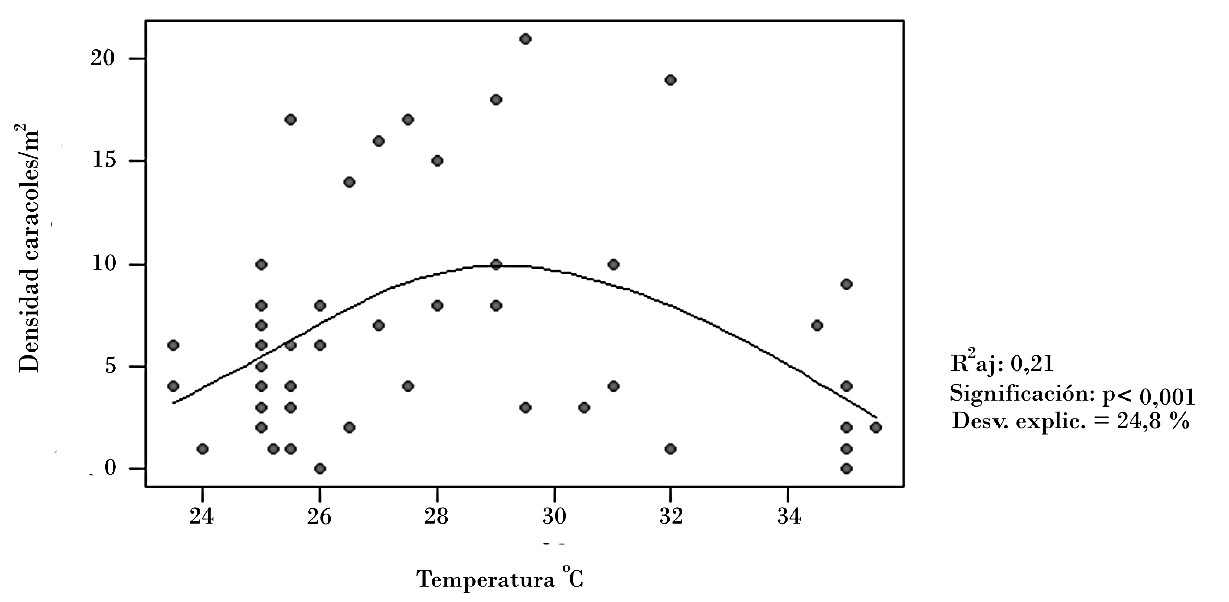
Among the species of molluscs that most affect the Swiss chard culture is the snail Rumina decollata L., this species lacks ecological studies that facilitate its control. This study was carried out with the objective of evaluating the influence of temperature and relative humidity on the population density of R. decollata in the UBPC Organopónico Vivero Alamar. The population density was evaluated by the method of Andrews (1987) modified. The data were processed with the SPSS statistical package to determine the theoretical sampling distribution to which they had the best fit. A multiple regression analysis was developed with the use of the adjusted GAM (Generalized Additive Models) model, the regression trees were subjected to a cross validation and both were executed in the program R. The best fit was obtained with the quadratic regression. The regression tree showed that relative humidity is the factor with the greatest influence on the population density of R. decollata. Relative humidity above 73.52 % is optimal for increasing the population density of R. decollata in this production entity. The effect of temperature (between 23 and 35 °C) is positive and for each degree above 23 °C the population density of R. decollata increased in 13 individuals. The temperature favored the increase of the population density until 29oC, from this value it began to decrease. The interactions between the climatological variables show that the relative humidity values higher than 86.5 % and 25.35 oC of temperature caused the highest population densities (17 snails/m2). The worst conditions for the population densities of R. decollata were observed at temperatures above 34 °C with low levels of relative humidity (≤ 66 %).
Article Details

This work is licensed under a Creative Commons Attribution-NonCommercial 4.0 International License.
Those authors who have publications with this journal accept the following terms of the License Attribution-NonCommercial 4.0 International (CC BY-NC 4.0):
You are free to:
- Share — copy and redistribute the material in any medium or format
- Adapt — remix, transform, and build upon the material
The licensor cannot revoke these freedoms as long as you follow the license terms.
Under the following terms:
- Attribution — You must give appropriate credit, provide a link to the license, and indicate if changes were made. You may do so in any reasonable manner, but not in any way that suggests the licensor endorses you or your use.
- NonCommercial — You may not use the material for commercial purposes.
- No additional restrictions — You may not apply legal terms or technological measures that legally restrict others from doing anything the license permits.
The journal is not responsible for the opinions and concepts expressed in the works, they are the sole responsibility of the authors. The Editor, with the assistance of the Editorial Committee, reserves the right to suggest or request advisable or necessary modifications. They are accepted to publish original scientific papers, research results of interest that have not been published or sent to another journal for the same purpose.
The mention of trademarks of equipment, instruments or specific materials is for identification purposes, and there is no promotional commitment in relation to them, neither by the authors nor by the publisher.
How to Cite
References
Andrews, K. L.: “Técnicas de muestreo para la determinación de la densidad poblacional y actividad de las babosas Veronicellidos”, Ceiba. 28 (2): 5-7, 1987.
Batts, J. H.: “Anatomy and cycle of snail Rumina decollata (Pulmonata: Achatinidae)”, The Southwestern Naturalist 2 (2-3) abril-julio: 74-82, 1957.
Bruner, S.; F. Valdés: “Medios para combatir los principales insectos que atacan a las hortalizas, Estación Agronómica Santiago de las Vegas, Cuba. Circular no. 88, diciembre, pp. 23-47, 1953.
Capinera, J. L.: “Culture of terrestrial slugs and snails (Gastropoda) Florida”, Entomologist 95(4): 1077-1085, 2012.
Fimia-Duarte, R.; G. R. González; R. O. Cepero; Á. M. Valdés; Osés R. R.; S. E. Corona; P. G. Argota: “Influencia de algunas variables climáticas sobre la malacofauna fluvial con importancia zoonótica en la provincia Villa Clara”, Revista Electrónica de Veterinaria, 5(8B): agosto 1-8, 2014.
Fisher, T. W.; R. E. Orth; S. C. Swanson: “Snail against snail”, California Agriculture, Nov.-Dec.: 18-20, 1980.
Hernández, M. Q. y B. T. Reyes: “Composición y estructura en agregaciones de moluscos terrestres en el complejo de vegetación de mogote Escaleras de Jaruco, Cuba”. Rev. Biol. Trop. 61 (4): 1769-1783, 2013.
Hernández, M.Q.: “Composición, estructura y uso de sustratos en comunidades de moluscos terrestres del complejo de vegetación de mogote de Escaleras de Jaruco, Cuba”, Tesis Maestría. Facultad de Biología. Universidad de La Habana, 2011.
Herrera, N.; B. López; L. Castellanos; I. Perez: “Incidencia de los moluscos plagas en los organopónicos del municipio de Cienfuegos”, Centro Agrícola 40 (4) oct.-dic.: 49-55, 2013.
Herrera, N. S. y L. G. Castellanos: “Informe sobre la incidencia de moluscos plaga en organopónicos del municipio de Cienfuegos, Cuba”, Centro Agrícola, 40(1): 89-90, 2013.
Matamoros, M.: “Los moluscos fitófagos en la agricultura cubana”, Agricultura Orgánica. 20 (2): 9-13, 2014.
Oliva-Olivera, W. y R. Real: “Moluscos terrestres de las elevaciones cársticas de Viñales, Pinar del Río, Cuba”, Rev. Biol. Trop. 57 (3): 589-604, 2009.
Pérez, B. V.: “Innovación y análisis empresarial en la UBPC en Cuba”, recuperado de http://www.gestiopolis.com/innovacion-analisis-empresarial-ubpc-cuba, 2009.
Pilsbry, H. A.: “Rumina decollate”, Man. Conch 17: 212, 1905.
R Development Core Team: “A language and environment for statistical computing. R. Foundation for Statistical Computing”, Viena, Austria, http://www.R-project.org, 2016.
Rodríguez, A. N.; N. C. Companioni; E. T. Peña; F. P. Cañet; J. B. Fresneda; J. O. Estrada; R. G. Rey; E. G. Fernández; L. M. Vázquez; R. P. Avilés; N. D. Arozarena; B. Á. Dibut; R. B. González; J. M. Pozo; R. C. R. C. González; F. R. Martínez; C. L. Moya; O. C. Gómez; M. G. Álvarez; T. S. Shagarodsky; P. L. F. González; J. J. Castellanos; J. S. Hernández; M. V. Ramírez: Manual técnico para organopónicos, Huertos intensivos y organoponía semiprotegida, 6ta. ed., Instituto de Investigaciones Fundamentales en Agricultura Tropical (INIFAT) y Asociación Cubana de Técnicos Agrícolas y Forestales (ACTAF), 2007.
Sánchez, C. R.; Y. O. Núñez; O. R. Rodríguez; C. V. Ricardo; B. Cruz y B. C. García: “Buenas prácticas para el control de caracoles y babosas”, Boletín Informativo de la Agricultura Urbana 12 (21): 6, 2016.