
Presence of the mite Ornithonyssus bursa in Agapornis fischeri in Cuba
Article Sidebar
Main Article Content
Abstract
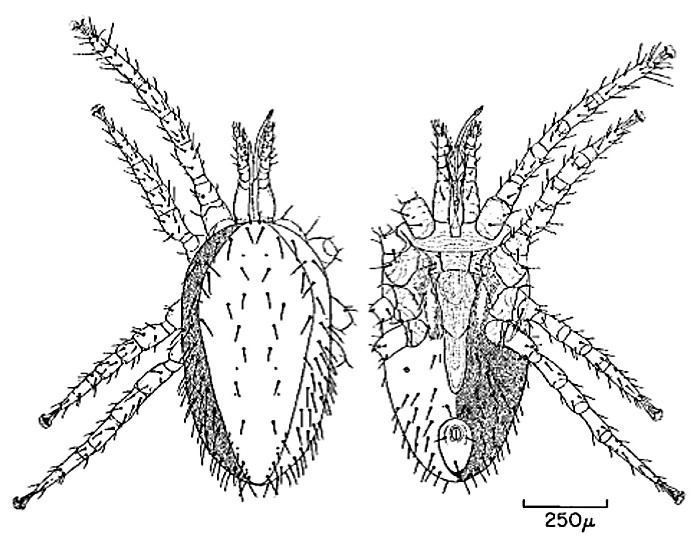
Ornithonyssus bursa is a hematophagous mites that affectin a many birds. In the present study, specimens of hematophagous mites found in Agapornis fischeri nests from an aviary owned by a breeder member of the National Ornithological Association of Cuba (ANOC) were investigated. These samples were sent to the Laboratory of Avian Research and Diagnosis (LIDA), belonging to the Institute of Poultry Research. The collected specimens were assembled in Hoyer’s solution in slides and covered with coverslip sheets. The plates were placed in an incubator at 28 ºC for 7 days for the clarification of the samples with a view to their subsequent identification. The arachno-pathological diagnosis confirmed the presence of the Ornithonyssus bursa mite, characterized by elongated and edentulous chelicerae, the membranous and lobed cornices, the trochanter of the palpe showed an elevated mediolateral keel, a broad, rounded dorsal plate with three pairs of mushrooms inside the plaque External. The presence of the mite Ornithonyssus bursa in Agapornis fischeri in Cuba is reported.
Article Details

This work is licensed under a Creative Commons Attribution-NonCommercial 4.0 International License.
Those authors who have publications with this journal accept the following terms of the License Attribution-NonCommercial 4.0 International (CC BY-NC 4.0):
You are free to:
- Share — copy and redistribute the material in any medium or format
- Adapt — remix, transform, and build upon the material
The licensor cannot revoke these freedoms as long as you follow the license terms.
Under the following terms:
- Attribution — You must give appropriate credit, provide a link to the license, and indicate if changes were made. You may do so in any reasonable manner, but not in any way that suggests the licensor endorses you or your use.
- NonCommercial — You may not use the material for commercial purposes.
- No additional restrictions — You may not apply legal terms or technological measures that legally restrict others from doing anything the license permits.
The journal is not responsible for the opinions and concepts expressed in the works, they are the sole responsibility of the authors. The Editor, with the assistance of the Editorial Committee, reserves the right to suggest or request advisable or necessary modifications. They are accepted to publish original scientific papers, research results of interest that have not been published or sent to another journal for the same purpose.
The mention of trademarks of equipment, instruments or specific materials is for identification purposes, and there is no promotional commitment in relation to them, neither by the authors nor by the publisher.
How to Cite
References
Arrabal J. P.; D. E. Manzoli; L. R. Antoniazzi; M. Lareschi; P. M. Beldomenico: “Prevalencia del ácaro Ornithonyssus bursa Berlese, 1888 (Mesostigmata: Macronyssidae) en un ensamble de aves (Passeriformes) de bosques del centro de la provincia de Santa Fe, Argentina”, Rev. Ibero-Latinoam. Parasitol. 71(2):172-178, 2012.
Bohrer, M.; G. Liberato y C. Eugenio: “Dermatitis caused by the tropical fowl mite Ornithonyssus bursa Berlese (Acari: Macronyssidae): a case report in humans”, Rev. Soc. Bras. Med. Trop. 48(6), Uberaba, Nov./Dec., 2015, http://dx.doi.org/10.1590/0037-8682-0170-2015.
Bowman D., Georgis: Parasitology for Veterinarians, 10th edition, ELSEVIER SAUNDER, USA, pp. 63-65, 2014.
González, A.; R. Larramendy; B. Sczypel; A. Pérez; M. Ramos: “Ornithonyssus bursa (Acari: Macronyssidae). Nueva especie de ácaro en la gallina de Guinea (Numidameleagris) en Cuba”, Revista Cubana de Ciencia Avícola 24(1):47-50, 2000.
Larramendy, R.; A. González; N. Cuervo; M. Ramos; B. Szczypel; A. Pérez: Presencia de Ornithonyssus sylviarum (Canestrini y Fanzago; Acari: Macronyssidae) en Cuba”, Revista de Salud Animal 21(2):121-123, Cuba, 1999.
Larramendy, R.; D. Rodríguez; M. Ramos; N. Cuervo; J. R. López; O. Reinaldo; M. Xuárez; Y. Morales; R. Rebollar: “Ácaros plumícolas en aves ornamentales: primer informe de Nymphicilichus perezae Mironov y Galloway (Acari: Pterolichidae) para Cuba”, Revista Cubana de Ciencia Avícola, vol. 38(2), 63-68, 2014.
Lindquist, E.; G. W. Kranntz; D. E. Walter: “Order Mesostigmata”, Manual of Acarology, 3rd edition, Texas, Tech University Press, USA, p. 134, 2009.
Morishita, T. and J. Schaul: Chapter 10: “Parasites of Birds”, Parasites of Laboratory Animals, 2nd edition, Blackwell Publishing, USA, pp. 272-274, 2007.
Mul, M. y H. Bens: “El ácaro rojo de las aves”, Selecciones Avícolas 56 (2):9-11, España, 2014.
Pérez-Vigueras, I.: Enfermedades infecciosas y parasitarias de los animals domésticos, Ed. Minerva, La Habana, Cuba, 1953, pp. 486-488.
Rodríguez, D.; R. Larramendy; E. Varona; M. Colás; O. Reinaldo; J. R. Villa; Y. Morales; I. Cobas; R. Rebollar: “Comportamiento de los parásitos externos en aves (Gallus gallus) de diferentes líneas puras”, Revista Cubana de Ciencia Avícola 39(2):5-12, 2015.