
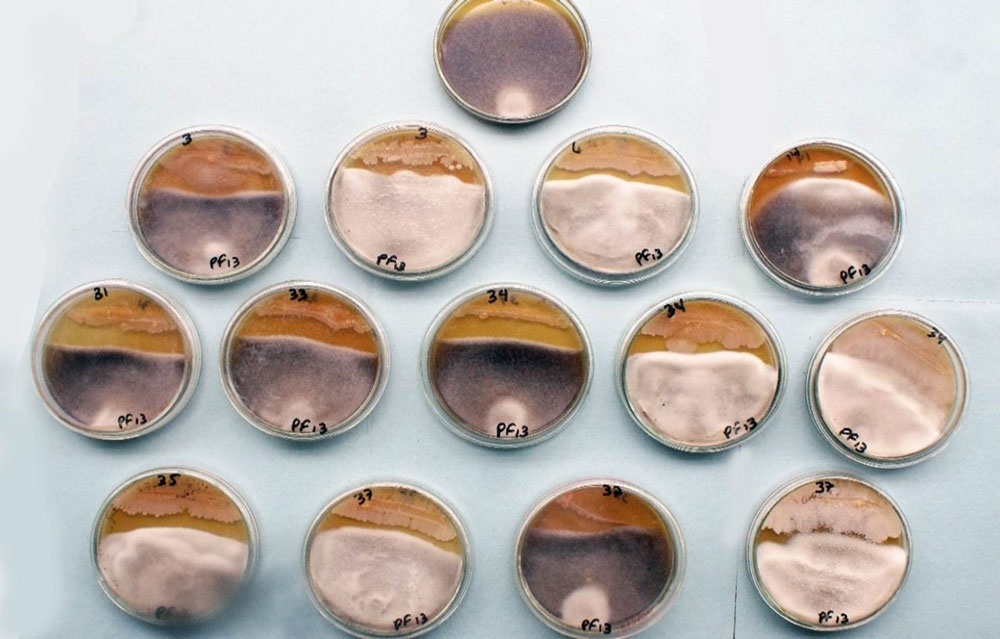
In vitro antagonistic activity of Bacillus spp. against Macrophomina phaseolina and Bipolaris sp.
Article Sidebar
Main Article Content
Abstract
The search for sustainable alternatives to the chemical control of plant diseases is crucial for resilient agriculture. This study evaluated the in vitro antagonistic activity of Bacillus spp. strains against the phytopathogenic fungi Macrophomina phaseolina and Bipolaris sp. The dual culture method was used on Sabouraud Dextrose agar, inoculating the fungi against different bacterial strains. After incubation at 28 °C, the diameter of the fungal colonies was measured to calculate the percentage of inhibition, and the data were analyzed using ANOVA and Tukey's test. The results showed that all the Bacillus strains evaluated significantly inhibited the growth of both pathogens, with inhibition halos attributed to the production of secondary metabolites during the exponential phase of bacterial growth. Bacillus subtilis (Bs-21) demonstrated the greatest effectiveness against both fungi. It was concluded that Bacillus spp. It possesses remarkable potential as a biocontrol agent, although its antagonistic effect may be transient, depending on nutrient availability and the bacterial growth phase, highlighting the importance of optimizing its formulation and application in the field.
Article Details

This work is licensed under a Creative Commons Attribution-NonCommercial 4.0 International License.
Those authors who have publications with this journal accept the following terms of the License Attribution-NonCommercial 4.0 International (CC BY-NC 4.0):
You are free to:
- Share — copy and redistribute the material in any medium or format
- Adapt — remix, transform, and build upon the material
The licensor cannot revoke these freedoms as long as you follow the license terms.
Under the following terms:
- Attribution — You must give appropriate credit, provide a link to the license, and indicate if changes were made. You may do so in any reasonable manner, but not in any way that suggests the licensor endorses you or your use.
- NonCommercial — You may not use the material for commercial purposes.
- No additional restrictions — You may not apply legal terms or technological measures that legally restrict others from doing anything the license permits.
The journal is not responsible for the opinions and concepts expressed in the works, they are the sole responsibility of the authors. The Editor, with the assistance of the Editorial Committee, reserves the right to suggest or request advisable or necessary modifications. They are accepted to publish original scientific papers, research results of interest that have not been published or sent to another journal for the same purpose.
The mention of trademarks of equipment, instruments or specific materials is for identification purposes, and there is no promotional commitment in relation to them, neither by the authors nor by the publisher.
How to Cite
References
Castañeda, E. y Sánchez, L. C. (2016). Evaluación del crecimiento de cuatro especies del género Bacillus sp., primer paso para entender su efecto biocontrolador sobre Fusarium sp. Nova, 14(26), 53-62.
Cazorla, F. M., Romero, D., Pérez-García, A., Lugtenberg, B. J. J., Vicente, A. de, & Bloemberg, G. (2007). Isolation and characterization of antagonistic Bacillus subtilis strains from the avocado rhizoplane displaying biocontrol activity. Journal of Applied Microbiology, 103(5), 1950-1959. https://doi.org/10.1111/j.1365-2672.2007.03433.x
Hong, S., Kim, T. Y., Won, S.-J., Moon, J.-H., Ajuna, H. B., Kim, K. Y., Ahn, & Y. S. (2022) Control of Fungal Diseases and Fruit Yield Improvement of Strawberry Using Bacillus velezensis CE 100. Microorganisms, 10, 365. https://doi.org/10.3390/ microorganisms10020365
Köhl, J., Kolnaar, R., & Ravensberg, W. J. (2023). Mode of action of microbial biological control agents against plant diseases: Relevance beyond efficacy. Frontiers in Plant Science, 14, 1162886. https://doi.org/10.3389/fpls.2023.1162886
Luan, P., Yi, Y., Huang, Y., Cui, L., Hou, Z., Zhu, L., Ren, X., Jia, S., & Liu, Y. (2023). Biocontrol potential and action mechanism of Bacillus amyloliquefaciens DB2 on Bipolaris sorokiniana. Frontiers in Microbiology, 14:1149363. https://doi:10.3389/fmicb.2023.1149363
Malik, M. S., Rehman, A., Khan, I. U., Khan, T. A., Jamil, M., Rha, E. S., & Muhammad, A. (2023). Thermo-neutrophilic cellulases and chitinases characterized from a novel putative antifungal biocontrol agent: Bacillus subtilis TD11. PLoS ONE, 18(1), e0281102. https://doi.org/10.1371/journal.pone.0281102
Morales-Barrón, B. M., González-Fernández, R., Vázquez-González, F. J., De La Mora-Covarrubias, A., Quiñonez-Martínez, M., Muñoz-Rojas, J. (2019). Importancia del Secretoma de Bacillus spp. en el control biológico de hongos fitopatógenos. Alianzas y Tendencias BUAP. 4(15), 36-48. https://www.aytbuap.mx/publicaciones#h.9j1e5lid2awk
Méndez-Úbeda, J. M., Flores Hernández, M. S., Páramo-Aguilera, L. A. (2017). Aislamiento e identificación de Bacillus subtilis y evaluación del antagonismo in vitro frente a hongos fitopatógenos. Nexo, 30(02), 96-110. http://doi.org/10.5377/nexo.v30i2.5530
Pedraza, L. A., López, C. A. y Uribe-Vélez, D. (2020). Mecanismos de acción de Bacillus spp. (Bacillaceae) contra microorganismos fitopatógenos durante su interacción con plantas. Acta Biológica Colombiana, 25(1). http://doi.org/10.15446/abc.v25n1.75045
Rabbee, M. F., Ali, M. S., Choi, J., Hwang, B. S., Jeong, S. C., & Baek, K.-H. (2019). Bacillus velezensis: A Valuable Member of Bioactive Molecules within Plant Microbiomes. Molecules, 24, 1046. https://doi.org/10.3390/molecules24061046
Ramos García, B., Hernández Fundora, Y. y Gil Vidal, J. F. (2025). Aislamiento y caracterización de hongos fitopatógenos de cultivares de leguminosas en la provincia La Habana, Cuba. Agrotecnia de Cuba, 49.https://cu-id.com/2120/v49e12. https://www.agrotecnia.edicionescervantes.com/index.php/agrotecnia/article/view/1096
Sarwar, A., Brader, G., Corretto, E., Aleti, G., Abaidullah, M., Sessitsch, A., & Hafeez, F. Y. (2018) Qualitative analysis of biosurfactants from Bacillus species exhibiting antifungal activity. PLoS ONE, 13(6), e0198107. https://doi.org/10.1371/journal. pone.0198107
Shafi, J., Tian, H., & Ji, M. (2017). Bacillus species as versatile weapons for plant pathogens: A review. Biotechnology & Biotechnological Equipment, 31(3), 446-459. https://doi.org/10.1080/13102818.2017.1286950
Tejera-Hernández, B., Rojas-Badía, M. M. y Heydrich-Pérez, M. (2011). Potencialidades del género Bacillus en la promoción del crecimiento vegetal y el control biológico de hongos fitopatógenos. Revista CENIC Ciencias Biológicas, 42(3), 131-138. http://www.redalyc.org/articulo.oa?id=181222321004
Tovar-Pedraza, J. M. y García León, E. (2025). Hongos causantes de enfermedades en cultivos de importancia económica en Sinaloa: Una lista actualizada. Bioc Scientia, 1(1). https://doi.org/10.63622/RBS.2505
Valenzuela-Ruiz, V., Parra-Cota, F. I., Santoyo, G., & de los Santos-Villalobos, S. (2022). Potential biocontrol mechanisms of Bacillus sp. TSO2 against Bipolaris sorokiniana, spot blotch in wheat. Mexican Journal of Phytopathology, 40(2), 230-239. https://doi.org/10.18781/R.MEX.FIT.2201-1