
Estudio fitoquímico preliminar y actividad fungicida de corteza de Maytenus urquiolae mory (celastraceae)
Article Sidebar
Main Article Content
Abstract
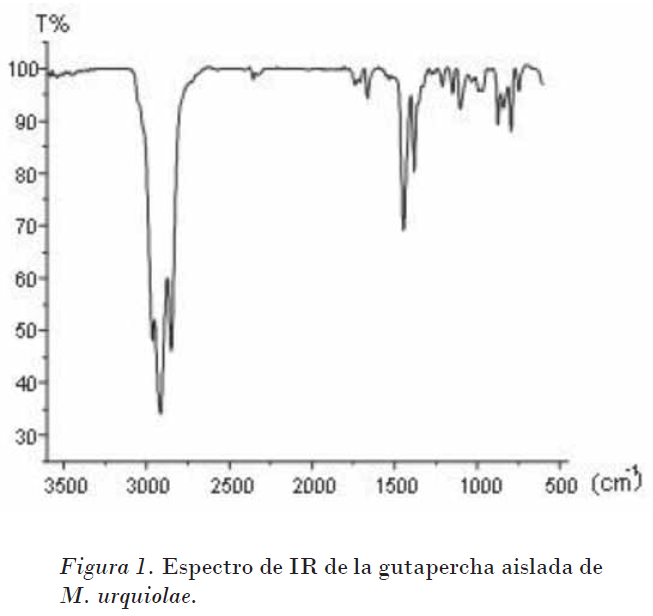
A phytochemical screening of Maytenus urquiolae Mory steam barks was done. This study showed that triterpenes and fenolic compounds were the main metabolites families present in plant material. Polymer 1,4 trans polyisoprene was isolated and characterized as chemiotaxonomic significance of Celestraceae family. Finally a chemical composition study of the lower polarity fraction was carried out by CG-MS, where 11 compounds were identified and six of them belong to sesquiterpene family. The steam barks n-hexane: ethyl ether (1:1) extract showed in vitro fungicide activity against the pathogen Curvularia clavata B. L. Jain.
Article Details

This work is licensed under a Creative Commons Attribution-NonCommercial 4.0 International License.
Those authors who have publications with this journal accept the following terms of the License Attribution-NonCommercial 4.0 International (CC BY-NC 4.0):
You are free to:
- Share — copy and redistribute the material in any medium or format
- Adapt — remix, transform, and build upon the material
The licensor cannot revoke these freedoms as long as you follow the license terms.
Under the following terms:
- Attribution — You must give appropriate credit, provide a link to the license, and indicate if changes were made. You may do so in any reasonable manner, but not in any way that suggests the licensor endorses you or your use.
- NonCommercial — You may not use the material for commercial purposes.
- No additional restrictions — You may not apply legal terms or technological measures that legally restrict others from doing anything the license permits.
The journal is not responsible for the opinions and concepts expressed in the works, they are the sole responsibility of the authors. The Editor, with the assistance of the Editorial Committee, reserves the right to suggest or request advisable or necessary modifications. They are accepted to publish original scientific papers, research results of interest that have not been published or sent to another journal for the same purpose.
The mention of trademarks of equipment, instruments or specific materials is for identification purposes, and there is no promotional commitment in relation to them, neither by the authors nor by the publisher.
How to Cite
References
Alvarenga, N.; C. A. Velásquez; N. Canela de Alvarenga: «Actividad biológica de compuestos aislados de corteza de raíz», Revista de Ciencia y Tecnología, Dirección de Investigaciones, UNA 1 (3): 51, México, 2001.
Avilla, J.; A. Teixidio; C. Velázquez; N. Alvarenga; E. A. Ferro; R. Canela: «Insecticidal Activity of Maytenus species (Celastraceae) Nortriterpene Quinone Methides Against Codling Moth, Cydia pomonella (L.) (Lepidoptera: Tortricidae)», Journal of Agricultural and Food Chemistry 48 (1): 88-92, EE. UU., 2000.
Baskar, K.; R. Maheswaran; S. Kingsley; S. Ignacimuthu: «Bioefficacy of Couroupita guianensis (Aubl) Against Helicoverpa armigera (Hub.) (Lepidoptera: Noctuidae) Larvae, Spanish», Journal of Agricultural Research 8 (1): 135-141, España, 2010.
Céspedes, C. L.; E. J. Aranda; A. J. Becerra; O. M. Silva; L. Achnine: «Insect Growth Regulator and Insecticidal Activity of â-Dihydroagarofurans from Maytenus spp. (Celastraceae)», Zeitschrift fur Naturforschung 56: 603-613, Alemania, 2001.
Chen, J. C.; M. H. Chiu; R. L. Nie; G. A. Cordell; S. X. Qiuc: «Cucurbitacins and Cucurbitane Glycosides: Structures and Biological Activities», Natural Products Reports 22: 386-399, EE. UU., 2005.
Connolly, J. D.; R. A. Hill: «Triterpenoids», Natural Products Reports, 19: 494-513, EE. UU., 2002.
Dias, J. F.; G. M. Cirio; M. D. Miguel; O. G. Miguel: «Contribution to the Allelophatic Study of Maytenus ilicifolia Mart. ex Reiss., Celastraceae», Revista Brasileira Farmacognosia. 15 (3): 220-223, Brasil, 2005.
Duke, S. O.: Natural Pesticides From Plants, Advances in New Crops, Timber Press, Portland, EE. UU., 1990.
Fraga, B. M.: «Natural Sesquiterpenoids», Natural Products Reports 20: 392-413, EE. UU., 2003.
González, A. G.; N. Alvarenga; A. Ravelo; I. Bazzocchi; E. Ferro; A. Navarro; L. Moujir: «Scutione. A New Bioactive Norquinonemethide Triterpene from Maytenus Scutioides (Celastraceae). Biorganic», Medicinal Chemistry 4: 815-820, EE. UU., 1996.
Menezes de Oliveira, D.; G. D. De Fátima Silva; L. Pains Duarte; S. A. Vieira Filho: «Chemical Constituents Isolated from Roots of Maytenus acanthophylla Reissek (Celastraceae)», Biochemical Systematics and Ecology 34: 661-665, EE. UU., 2006.
Minsap: Guía para el tamizaje fotoquímico, Minsap, La Habana, 1994.
Mory, B.: «Maytenus urquiolae Mory sp. nov. eine neue Celastraceae für die flora von kuba mit 3 tafeln und 2 tabellen», Feddes Repertorium 104 (7-8): 431-438, Alemania, 1993.
Philip, H. E.; W. S. Bowers; E. J. Funk: «Identification on Fungicidal and Namaticidal Omponents in the Leaves of Piper bettle (Piperaceae)», Journal of Agricultural and Food Chemistry 32: 1254-1256, EE. UU., 1984.
Santos-Oliveira, R.; S. Coulaud-Cunha; C. Waldeciro: «Revisão da Maytenus ilicifolia Mart. ex Reissek, Celastraceae. Contribuição ao estudo das propriedades farmacológicas», Revista Brasileira de Farmacognosia 19 (2b): 650-659, Brasil, 2009.
Silva, A. P. da; M. A. Marçal; M. G. Bichara; R. L. Cunha: «Efeitos potencialmente alelopáticos dos óleos essenciais de Piper hispidinervium C. DC. e Pogostemon heyneanus Benth sobre plantas daninhas», Acta Amazonica 39 (2), Brasil, 2009.
Spivey, A. C.; M. Weston; S. Woodhead: «Celastraceae Sesquiterpenoids: Biological Activity and Synthesis», Chemical Society Review 31 (1): 43-59, EE. UU., 2002.