
Control químico de patógenos fungosos en piña (Ananas comosus (l.) merrill) de vivero (II)
Article Sidebar
Main Article Content
Abstract
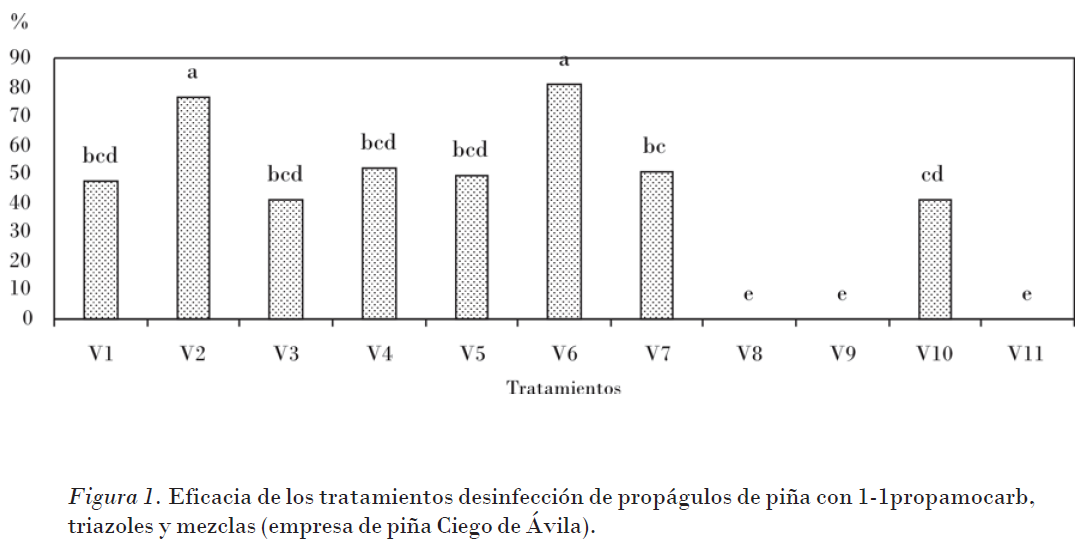
In order to determine the efficacy of a fungicide group on some plant pathogenic fungi that affect the cultivation of pineapple in field nurseries, a test was conducted in randomized blocks, with stems fractions of the variety Smooth Cayenne Serrana, disinfected by immersion in solution of 10 L by 10 minutes, with the active ingredients 1-1 propamocarb at doses of 1.04 g/L a.i. alone and 0.78 g/L a.i. in mixtures with triazols; triadimenol at 0.5 g/L a.i.; propiconazole, tebuconazole, hexaconazole a rate of 0.05 g/L a.i. alone and in mixtures with 1-1 propamocarb to 0.375 g/L a.i., besides metiran 3 g/L a.i. Phytophthora nicotianae, Fusarium subglutinans and Chalara pardoxa were isolated during the experiment, which showed the presence of agents causing diseases of economic importance in crop. It was found that triadimenol (0.5 g/L a.i.) and the mixture 1-1 propamocarb+triadimenol (0.78 + 0.375 g/L a.i.) offer good control levels on these fungal pathogens with efficiency of 76.2 and 80.9%, respectively; both treatme0nts showed significant differences to other variants tested and the control without applications and provided protection for 30 days.
Article Details

This work is licensed under a Creative Commons Attribution-NonCommercial 4.0 International License.
Those authors who have publications with this journal accept the following terms of the License Attribution-NonCommercial 4.0 International (CC BY-NC 4.0):
You are free to:
- Share — copy and redistribute the material in any medium or format
- Adapt — remix, transform, and build upon the material
The licensor cannot revoke these freedoms as long as you follow the license terms.
Under the following terms:
- Attribution — You must give appropriate credit, provide a link to the license, and indicate if changes were made. You may do so in any reasonable manner, but not in any way that suggests the licensor endorses you or your use.
- NonCommercial — You may not use the material for commercial purposes.
- No additional restrictions — You may not apply legal terms or technological measures that legally restrict others from doing anything the license permits.
The journal is not responsible for the opinions and concepts expressed in the works, they are the sole responsibility of the authors. The Editor, with the assistance of the Editorial Committee, reserves the right to suggest or request advisable or necessary modifications. They are accepted to publish original scientific papers, research results of interest that have not been published or sent to another journal for the same purpose.
The mention of trademarks of equipment, instruments or specific materials is for identification purposes, and there is no promotional commitment in relation to them, neither by the authors nor by the publisher.
How to Cite
References
Bartholomew, D. P; R. E. Paull; K. G. Rohrbach: The Pineapple. Botany, Production and Uses. University of Hawaii, Honolulu, CABI Publishing, EE. UU., 2003.
Carvalho, R. A.; E. F. de Oliveira; J. T. de Lacerda; M. B. Neto; J. X. de Araújo: «Alternative Control of Pineapple Fusariosis», Abstracts of the VIth International Pineapple Symposium. Oral presentations. Sessión III Plant Protection, João Pessoa, Paraiba, Brasil, November 18 to 23, 2007.
Choary, S. A.; E. F. de Olivera; A. P. de Matos: «Controle químico da broca e da fusariose no fruto do abacaxizeiro», Joao Pessoa, EMEPAPB, EMBRAPA-PB. Documentos 20, Brasil, 1997.
Ciba-Geygi: Manual de ensayos de campo, 2.a ed., Suiza, 1981.
Erwin, D. C.; O. K. Ribeiro: Phytophthora diseases Worldwide, The American Phytopathology Society, Minnesota, EE. UU., 1996.
Dagnellie, P.: «Theorical Méthodes Statistiques», Les Presses Agronomiques de Gembloux, vol. 2, Bélgica, 1974.
González, Dulce M.: «Evaluación de diferentes densidades de plantación durante la fase de aviveramiento de bulbillo en dependencia del tamaño», Trabajo de Diploma, Instituto Superior Agrícola Ciego de Ávila, Cuba,, julio de 1988.
Hernández, A.: «Determinación, epifitiología y control de los patógenos fúngicos que afectan la fase de vivero en el cultivo de la piña», tesis en opción al título académico de Máster en Microbiología. Mención en Microbiología General, Facultad de Biología, Universidad de La Habana, julio 1999.
Hernández, A.; Carmen Rosón; Aliuska Sierra; O. Concepción; Doris Escalante; Nury Pérez: «Incidence, Estimate of Losses and Management in the Control of Fungi Pathogens in Systems of Propagation of Pineapple Crops in vitro (Ananas escamosus (L.)», Proccedings Fourth International Penapple Symposium, Veracruz City, Mexico, April 16-19, 2002.
Hernández, A.; Bertha Lina Muiño García; Carmen Rosón Álvarez; Caridad Casola González; Ángela Porras González; Aliana López Mayea: «Control químico de patógenos fungosos en piña de vivero (I)», Fitosanidad 14 (1): 31-37, La Habana, 2010.
Lyr, H.: Modern Selective Fungicide: Properties, Applications, Mechanisms of Action, 2 ed., Ed. Gustav Fischer Verlag, Nueva York, EE. UU., 1995.
Muiño, B.; A. Hernández; A. Porras: «Sensibilidad de especies de hongos fitopatógenos a los inhibidores de la biosíntesis de ergosterol (IBE)», Fitosanidad 4 (3-4): 45-48, La Habana, 2000.
Pérez, L.; Berta Lina Muiño: Seminario teórico-práctico sobre fungicidas y resistencia a fungicidas, FAO-Inisav, La Habana, 1995.
Unterstenhoefer, G.: «Las bases para ensayos fitosanitarios de campo», Pflanzenschutz-Nachrichten Bayer 16 (3): 89-176, Alemania, 1963.
Rohrbach, K. G.; D. P. Schmitt: Pineapple. Compendium of Tropical Fruits Diseases, Part IV, The American Phytopathological Society, EE.UU., 1994.
Ventura, J. A.; H. Costa; M. P. Culik; P. Machado: «Pineapple Fusariosis Reserch in Brazil: Progress UPDATE», Journal of Plant Pathology 90 (3, Supplement): S3.76. Disponible en http://www.sipav.org/main/ jpp/volumes/1208/020_Session8_S71.pdf (consultado el 6 de agosto del 2009).