
Spirotetramat, nuevo insecticida para el control de insectos chupadores en el cultivo de la papa
Article Sidebar
Main Article Content
Abstract
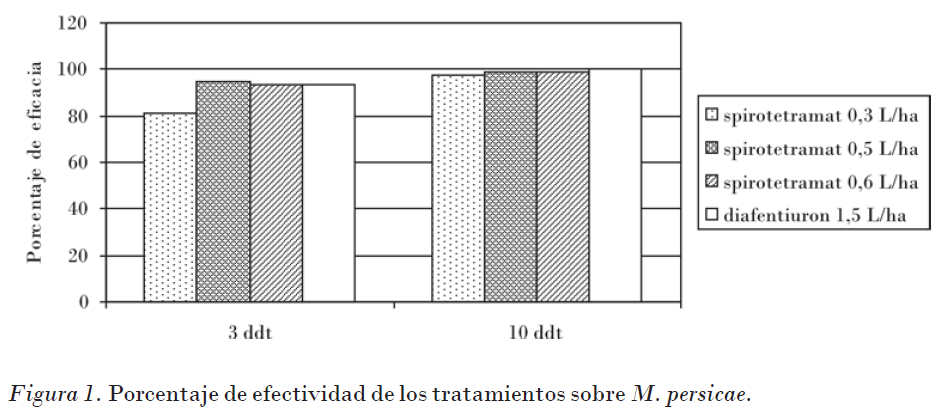
Different insecticides are applied for the control of pests that cause damages on potato crop (Solanum tuberosum L.) during their development cycle. The consecutive use of these substances causes the appearance of secondary plagues, insect-resistance development, natural enemies destruction and affectations to the atmosphere, among other problems. For this causes is advisable the evaluation of new more efficient products for the control of the pest complex in this crop. Active ingredient spirotetramat is an insecticide that belongs to new group of cetoenols which stands out for its systemic bidirectional effect and wide action spectrum against sucker insects, as aphids, trips and white flies, among other, particularly against juvenile states. In order to evaluate the effectiveness of this insecticide in the control of Myzus persicae Sulzer, Bemisia tabaci Gennadius and Thrips palmi Karny a field experiment was developed on potato cultivation. Results indicate that the effectiveness of spirotetramat at doses of 0.5 and 0.6 L/ha were acceptable on the three plague species respect to production standard. It was found also that this new insecticide had no effect on bioregulators associated with pests, since they completed their cycles and were observed until the end of the experiment.
Article Details

This work is licensed under a Creative Commons Attribution-NonCommercial 4.0 International License.
Those authors who have publications with this journal accept the following terms of the License Attribution-NonCommercial 4.0 International (CC BY-NC 4.0):
You are free to:
- Share — copy and redistribute the material in any medium or format
- Adapt — remix, transform, and build upon the material
The licensor cannot revoke these freedoms as long as you follow the license terms.
Under the following terms:
- Attribution — You must give appropriate credit, provide a link to the license, and indicate if changes were made. You may do so in any reasonable manner, but not in any way that suggests the licensor endorses you or your use.
- NonCommercial — You may not use the material for commercial purposes.
- No additional restrictions — You may not apply legal terms or technological measures that legally restrict others from doing anything the license permits.
The journal is not responsible for the opinions and concepts expressed in the works, they are the sole responsibility of the authors. The Editor, with the assistance of the Editorial Committee, reserves the right to suggest or request advisable or necessary modifications. They are accepted to publish original scientific papers, research results of interest that have not been published or sent to another journal for the same purpose.
The mention of trademarks of equipment, instruments or specific materials is for identification purposes, and there is no promotional commitment in relation to them, neither by the authors nor by the publisher.
How to Cite
References
Alston, Diane: «Influence of Egg Hatch, Survival and Immigration on Insecticide Performance in Dry Bulb Onion», 2007, Utah Onion Thrips Insecticide Efficacy Trial, Utah Agricultural Experiment Station, Kaysville, Disponible en http://utahpests.usu.edu/ipm/files/uploads/ PDFDocs/res07-onion-thrips-insecticides.pdf (consultado el 14 de enero del 2010).
Bayer CropScience: «Basta de jugar a las escondidas», Correo 2: 22-25. La Revista de Bayer CropScience para la Agricultura Moderna, 2008.
Christie, D.; J. Bell; R. Steffens: «Ultor: A new Product from Bayer CropScience with a Novel Mode of Action for Broad spectrum. Sucking Insect Control», Abstracts of the 82nd Annual Orchard Pest and Disease Management Conference, 9-11 January, Hilton Hotel, Portland, E.E. U.U., Publ. by Washington State Univ. Pullman, 2008.
Ciba-Geigy: Manual de ensayo de campo en producción vegetal. 2da ed., Suiza, 1981.
CNSV: Lista oficial de plaguicidas autorizados, Departamento Registro de Plaguicidas, CNSV, La Habana, 2010.
Kühnhold, J.; A. M. Klueken; L. de Maeyer; X. van Waetermeulen; E. Brück; A. Elbert: «Movento, an Innovative Solution for Sucking Insect Pest Control in Agriculture: Field Performance in Fruits and Vegetables», Bayer CropScince Journal 61 (2): 279-306, Alemania, 2008.
Nauen, R.; T. Bretschneider; A. Elbert; R. Fischer; U. Reckmann; X. van Waetermeulen: «Biological and Mechanistic Considerations on the Mode of Action of Spirotetramat», 11th IUPAC Int. Congress of Pesticide Chemistry, 6-10 August 2006 in Kobe, Japan. Book of Abstracts (2), I-1-i-21C, 2006.
Nauen, R.; U. Reckmann; J. Thomzik; W. Thielert: «Biological Profile of Spirotetramat (Movento), a New Two-Way Systemic (Ambimobile) Insecticide Against Sucking Pest Species», Bayer CropScience Journal 61 (2): 245-278, Alemania, 2008.
Olivares, S. E.: Paquete de diseños experimentales, Facultad Agronómica, Universidad Autónoma de Nuevo León (FAUANL), versión 2.5, México, 1994.
Schnorbach, J.; A. Elbert; B. Laborie; J. Navacerrada; E. Bangels; B. Gobin: «Movento, an Ideal Tool for Integrated Pest Management in Pome Fruit, Citrus and Vegetables», Bayer CropScience Journal 61 (2): 377-402, Alemania, 2008.