
Caracterización de la mirmecofauna y su relación con las prácticas adoptadas en un sistema de producción agrícola urbano
Article Sidebar
Main Article Content
Abstract
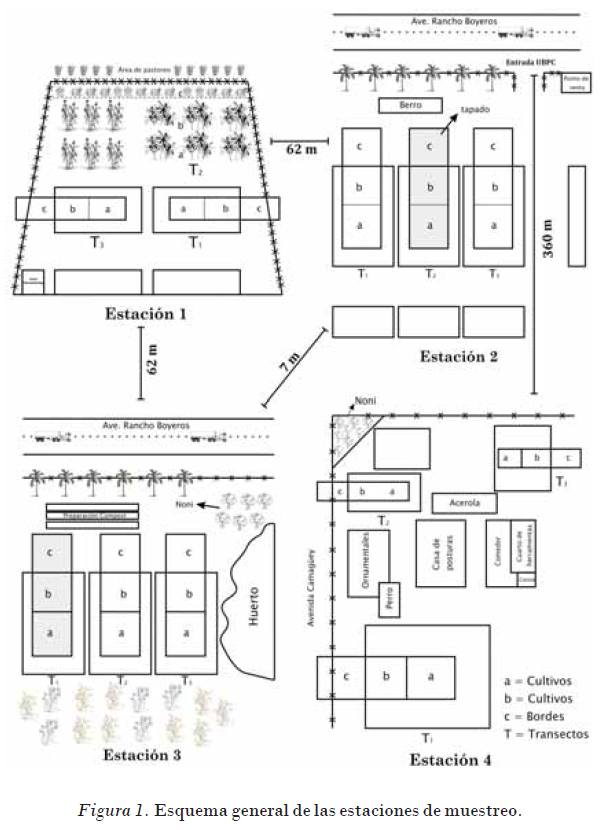
Ants constitute around 15% of total animal biomass and they realize important functions in every ecosystem. In agrarian systems they show high abundance and diversity, thus they also provide important ecological services. With the objective of evaluate the relationship between ants fauna and practices made in an urban agrarian production system a study was conducted at the UBPC 1 de Julio, in Cerro municipality, Havana, between March 2009 and March 2010. Four sampling stations were selected with three transects and three micro-environments each one. Bimonthly samples were made with traps made with moistened and sweetened cotton edible baits. Prevailing genus, species richness and presence frequency were the variables evaluated. Solenopsis was the most abundant and frequent genus, followed by Paratrechina, Brachymyrmex and Wasmannia. It was evident that in stations with higher plant variety and lower management intensity, ants’ abundance is greater. Higher genera richness was observed in edge areas, in which Solenopsis (1 594), Wasmannia (494) and Brachymyrmex (271) dominated. The use of intensive practices as use of pesticides, fertilizers, soil remove and intensive edge areas management, among others favored the occurrence of high anthropization degree environments colonization.
Article Details

This work is licensed under a Creative Commons Attribution-NonCommercial 4.0 International License.
Those authors who have publications with this journal accept the following terms of the License Attribution-NonCommercial 4.0 International (CC BY-NC 4.0):
You are free to:
- Share — copy and redistribute the material in any medium or format
- Adapt — remix, transform, and build upon the material
The licensor cannot revoke these freedoms as long as you follow the license terms.
Under the following terms:
- Attribution — You must give appropriate credit, provide a link to the license, and indicate if changes were made. You may do so in any reasonable manner, but not in any way that suggests the licensor endorses you or your use.
- NonCommercial — You may not use the material for commercial purposes.
- No additional restrictions — You may not apply legal terms or technological measures that legally restrict others from doing anything the license permits.
The journal is not responsible for the opinions and concepts expressed in the works, they are the sole responsibility of the authors. The Editor, with the assistance of the Editorial Committee, reserves the right to suggest or request advisable or necessary modifications. They are accepted to publish original scientific papers, research results of interest that have not been published or sent to another journal for the same purpose.
The mention of trademarks of equipment, instruments or specific materials is for identification purposes, and there is no promotional commitment in relation to them, neither by the authors nor by the publisher.
How to Cite
References
Alonso, L. E.; D. Agosti: «Biodiversity Studies, Monitoring of Ants: An Overview», Ants: Standard Methods for Measuring and Monitoring Biodiversity, Smithsonian Institution Press, Washington, 2000, pp. 1-8.
Andersen, A. N.: «The Use of ant Communities to Evaluate Change in Australian Terrestrial Ecosystem: A Review and Recipe», Proceedings of the Ecological Society of Australia 16: 347-357, 1990.
Armbrecht, I.; P. Ulloa: «The Little Fire Ant Wasmannia auropunctata (Roger) (Hymenoptera: Formicidae) as a Diversity Indicator of Ants In Tropical Dry Forest Fragments of Colombia», Environmental Entomology 32 (3): 542-547, EE. UU., 2003.
Carroll, C. R; S. J. Risch: «Tropical Annual Cropping Systems: Ant Ecology», Environ. Manage. 7: 51-57, Nueva York, 1983.
Castiñeiras, A.; E. Ponce: «Efectividad de la utilización de Pheidole megacephala (Hymenoptera: Formicidae) en la lucha biológica contra Cosmopolites sordidus», Protección de Plantas 1 (2): 15-21, Cuba, 1991.
Castiñeiras, A.; S. Monteagudo; M. González: «Observaciones sobre Wasmannia auropunctata (Hymenoptera: Formicidae) en cultivos de cafeto y cítricos en Cuba», Rev. Protección Vegetal 2 (3): 234-238, La Habana, 1987.
Companioni, N.; Yanet Ojeda; E. Páez; C. Murphy: «La agricultura urbana en Cuba». Funes, F.; L. García; M. Bourque; Nilda Pérez; P. Rosset Transformando el campo cubano: Avances de la agricultura sostenible, ACTAF, La Habana, 2001, pp. 93-110.
Dennis, D.: Curso de posgrado Ecología de Comunidades, Facultad de Biología, Universidad de La Habana, 2006.
Díaz, J. A.; P. C. E. Molano; J. C. Gaviria: «Diversidad genérica de hormigas (Hymenoptera: Formicidae) en ambientes de bosque seco de los montes de María, Sucre, Colombia», nota corta, Rev. Colombiana Cienc. Anim. 1 (2): 279-285, 2009.
Farji, A.; J. Silva: «Leaf-Cutting Ants and Forest Grove’s in a Tropical Parkland Savanna of Venezuela: Facilitated Succession?», Journal of Tropical Ecology 11 (4): 651-669, Inglaterra, 1995.
Feinsinger, P.: Designing Field Studies for Biodiversity Conservation, Island Press, Washington, EE.UU., 2001.
Fernández, F.; M. Ospina: «Sinopsis de las hormigas de la region Neotropical», Introducción a las hormigas de la región Neotropical, Instituto de Investigación de Recursos ¬:Biológicos Alexander von Humboldt, Colombia, 2003.
Fernández, F.; M. J. Sharkey: Introducción a los Hymenoptera de la Región Neotropical, Sociedad Colombiana de Entomología, Colombia, 2006.
Floren, A.; K. E. Linsenmair: «The Influence of Anthropogenic Disturbances on the Structure of Arboreal Arthropod Communities», Plant Ecology 153: (1-2): 153-167, EE. UU., 2001.
Folgarait, P. J.: «Ant Biodiversity and Its Relationship to Ecosystem Functioning: a Review», Biodiversity and Conservation 7: 1221-1244, 1998.
Matienzo, Y.; E. Rijo; O. Milán; N. Torres; J. Larrinaga; N. Cueto; E. Massó; R. Abreu; M. Veitía; J. L. Armas; M. Pineda; T. Ramos; E. Gómez; S. Caballero; T. Corona; J. Díaz; L. Á. Rodríguez; M. Peña; I. Esson; R. Granda; Y. Hernández; O. L. García: «Desarrollo de practices para el manejo y la conservación de enemigos naturales de plagas agrícolas en sistemas de producción agrícolas urbanos», trabajo en opción a premio, Instituto de Investigaciones de Sanidad Vegetal, Ministerio de la Agricultura, La Habana, 2008.
Matienzo, Y.; L. L. Vázquez; M. Veitía; O. Milán; E. Botta; A. I. Elizondo; M. Matamoros; J. Alfonso; T. García; A. Almirall; Y. Grana: «Validación de prácticas agroecológicas para la conservación de artrópodos benéficos en la agricultura urbana de Ciudad de La Habana», Informe final de Proyecto, Instituto de Investigaciones de Sanidad Vegetal, La Habana, 2010.
Medina, C. A.: «Nidificación y patrones de distribución espacial de nidos de hormigas en una sabana tropical, Carimagua: llanos orientales de Colombia», Bol. Mus. Ent. Univ. Valle 2 (1-2): 31-42, Colombia, 1994.
Peck, S. I.; B. Mcquaid; C. L. Campbell: «Using Ant Species as a Biological Indicator of Agroecosystem Condition», Environmental Entomology 27 (5): 1102-1110, Colombia, 1998.
Perfecto, I.; J. Vandermeer: «Microclimatic Changes and the Indirect Loss of Ant Diversity in a Tropical Agroecosystem», Oecologia 108: (3): 577-582, Alemania, 1996.
Perfecto, I.; J. Vandermeer: «Quality of Agroecological Matrix in a Tropical Montane Landscape: Ants in Coffee Plantations in Southern Mexico», Conservation Biology 16: (1): 174-182, EE. UU., 2002.
Quiran, E.: «El género neotropical Brachymyrmex Mayr (Hymenoptera: Formicidae) en la Argentina. II redescripción de las especies B. admotus Mayr, de B. brevicornis Emery y B. gaucho Santschi», Neotrop. Entomol. 34 (5): 761-768, Brasil, 2005.
Rivera, L.; I. Armbrecht: «Diversidad de tres gremios de hormigas en cafetales de sombra, de sol y bosques de Risaralda», Revista Colombiana de Entomología 31 (1): 89-96, 2005.
Roth, D.; I. Perfecto; B. Rathcke: «The Effects of Management Systems on Ground-Foraging Ant Diversity in Costa Rica», Ecol. Appl. 4 (3): 423-436, EE. UU., 1994.
Vázquez, L. L.; E. Fernández; J. Lauzardo; Tais García; Janet Alfonso; Rebeca Ramírez: «Manejo agroecológico de plagas en fincas de la agricultura urbana (MAPFAU)», Ed. Cidisav, Instituto de Investigaciones de Sanidad Vegetal, La Habana, 2005.
Vázquez, L. L.; E. Fernández: «Bases para el manejo agroecológico de plagas en sistemas agrarios urbanos». Ed. Cidisav. Instituto de Investigaciones de Sanidad Vegetal. Ciudad de La Habana. 121p. 2007.
Vázquez, L. L.; Y. Matienzo; J. Alfonso; D. Moreno; A. Álvarez: «Diversidad de especies de hormigas (Hymenoptera: Formicidae) en cafetales afectados por Hypothenemus hampei Ferrari (Coleoptera: Curculionidae: Scolytinae)», Fitosanidad 13 (3): 163-168, La Habana, 2009.
Villareal, H.; M. Álvarez; F. Córdoba; G. Fagua; F. Gast; H. Mendoza; M. Ospina; M. Umaña: Manual de métodos para el desarrollo de inventarios de biodiversidad, Instituto de Investigación de Recursos Biológicos Alexander Von Humboldt, Colombia, 2006.
Zenner, I.; N. Ruiz: «Hábitos alimenticios y relaciones simbióticas de la Hormiga Loca (Nylanderia fulva) con otros artrópodos», Rev. Col. Entomol. 11: (1): 3-10, Colombia, 1985.