
Glomus intraradices para el control de Meloidogyne incognita (kofoid & white) chitwood en condiciones protegidas
Article Sidebar
Main Article Content
Abstract
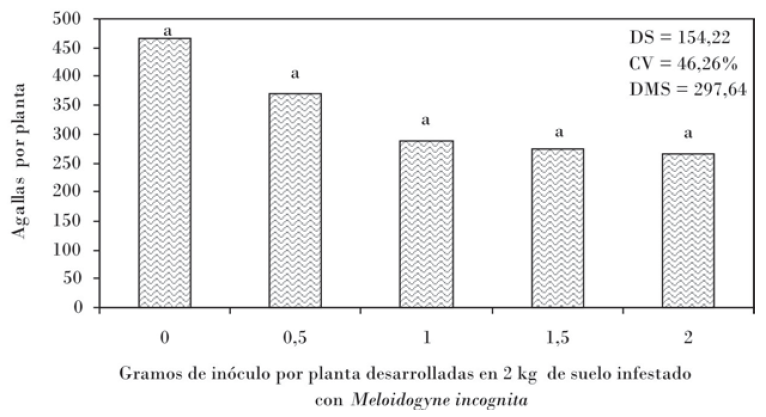
The effects of the inoculation with arbuscular micorrhizal fungus Glomus intraradices on tomato (Lycopersicon esculentum Mill.) cv. Maya were evaluated. Variables related to nematode reproduction such as number of galls per plant–1 (NA), number of females per g-1 of stained root (NF) and number of eggs per g–1 of blended root (NE) were estimated. Plant agronomic variables such as plant height (AH), fruit weight (FW), root weight (RW), root volume (RV) and plant dry weight (DW) were also evaluated. The variance analysis for the variables NA, NF, AH, FW, RW, RV and DW did not show significant differences among treatments. Significant difference was only observed on the variable NE. The variable NA was higher on the control plants with no inoculation of arbuscular micorrhizal Glomus intraradices with an average of 467 root-knots per plant; it was also observed that the plants treated with higher concentration of the inoculum showed lower number of root-knots per plant. In general, it was observed at least 39% lower knot-root formation on plants inoculated with the micorrhizal fungus.
Article Details

This work is licensed under a Creative Commons Attribution-NonCommercial 4.0 International License.
Those authors who have publications with this journal accept the following terms of the License Attribution-NonCommercial 4.0 International (CC BY-NC 4.0):
You are free to:
- Share — copy and redistribute the material in any medium or format
- Adapt — remix, transform, and build upon the material
The licensor cannot revoke these freedoms as long as you follow the license terms.
Under the following terms:
- Attribution — You must give appropriate credit, provide a link to the license, and indicate if changes were made. You may do so in any reasonable manner, but not in any way that suggests the licensor endorses you or your use.
- NonCommercial — You may not use the material for commercial purposes.
- No additional restrictions — You may not apply legal terms or technological measures that legally restrict others from doing anything the license permits.
The journal is not responsible for the opinions and concepts expressed in the works, they are the sole responsibility of the authors. The Editor, with the assistance of the Editorial Committee, reserves the right to suggest or request advisable or necessary modifications. They are accepted to publish original scientific papers, research results of interest that have not been published or sent to another journal for the same purpose.
The mention of trademarks of equipment, instruments or specific materials is for identification purposes, and there is no promotional commitment in relation to them, neither by the authors nor by the publisher.
How to Cite
References
Agrios, G. N.: Fitopatología, Ed. Limusa, 2.a. ed., México, 1998, pp. 734-741.
Ayoub, M. S.: Plant Nematology an Agricultural Training Aid, Department of Food and Agriculture Division of Plant Industry Laboratory Services Nematology, California, EE. UU., 1977.
Castillo, P.; A. C. Azcón; R. del Rincón; C. Calvet; R. M. Jiménez: «Protection of Olive Planting Stocks Against Parasitism of Root-Knot Nematodes by Arbuscular Mycorrhizal Fungi», Plant Pathology 5:705-713, EE. UU., 2006.
Elsen, A.; S. Declerck; D. De Waele: «Effects of Glomus intraradices on the Reproduction of the Burrowing Nematode (Radopholus similis) in Dixenic Culture», Mycorrhiza 11:49-51, 2001.
Habte, M.; C. Zhang; D. P. Schimtt: «Effectiveness of Glomus Species in Protecting White Clover Against Nematode Damage», Abstract, Can. Journal Botanic, Canadá, 1999.
Jepson, S. B.: Identification of Root-Knot Nematodes (Meloidogyne Species), Commonwelth Agricultural Bureau International, Cambrian, News Ltd., Aberystwyth, Inglaterra, 1987.
Masadeh, B.; H. von Alten; S. G. Grunewaldt; R. A. Sikora: «Biocontrol of Root-Knot Nematodes Using the Arbuscular Mycorrizal Fungus Glomus intraradices and the Antagonist Trichoderma viride in Two Tomato Cultivars Differing in Their Suitability as Hosts for the Nematodes», Journal of Plant Diseases and Protection 111 (4):322-333, Alemania, 2004.
Pinochet, J.; C. Fernández; M. Jaizme; P. Tenoury: «Micropropageted Banana Infected with Meloidogyne javanica Responds to Glomus intraradices and Phosphorus», HortScience 32:101-103, EE. UU., 1997.
Verdejo, L. S.; C. Ornat; F. J. Sorbías; A. Stchiegel: «Species of Root-Knot Nematodes and Fungal Eggs Parasites Recovered from Vegetables in Almería and Barcelona, Spain», Journal of Nematology 2:1-2, EE. UU., 2002.
Zhang, L.; J. Zhang; P. Christie; X. Li: «Pre-inoculation with Arbscular Mycorrhizal Fungi Supresses Root Knot Nematode (Meloidogyne incognita) on Cucumber (Cucumis sativus)», Biol. Fertil Soils 45:205-211, Alemania, 2008.