
Reacción de clones naturales e híbridos de la fhia de bananos y plátanos a las poblaciones de Cuba de Fusarium oxysporum f. Sp. cubense, agente causal de la marchitez por fusarium o mal de Panamá
Article Sidebar
Main Article Content
Abstract
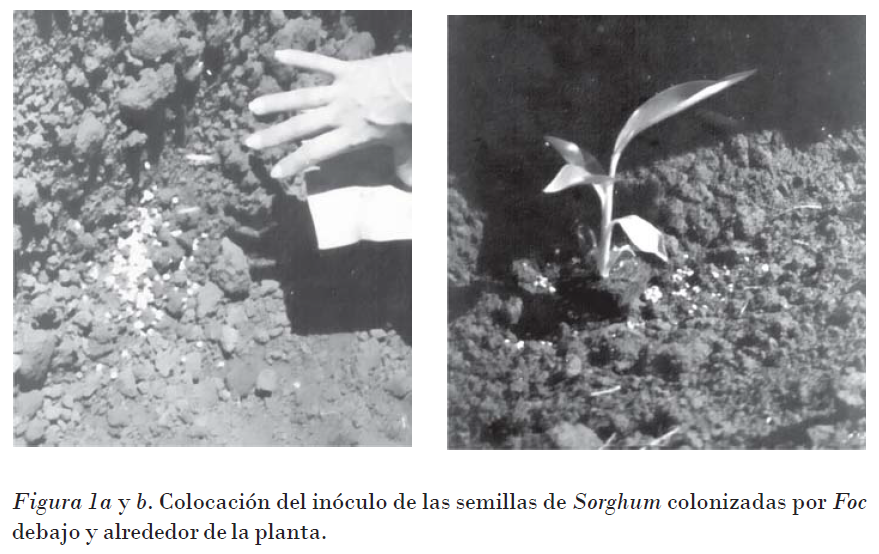
Fusarium wilt by Fusarium oxysporum f.sp.cubense (Foc) is one of the most important diseases of banana. The reaction of FHIA hybrids cultivars (cv.), diploids and landraces to artificial inoculations with Foc (VCGs 01210, race 1; 0124 and 0128, race 2) was studied. Foc inoculum was reproduced on Sorghum vulgare in trays in the lab. Fifteen grams of inoculated Sorghum seeds of each VCG were placed on the soil under each of five inoculated tissue culture plants. Manzano and Gros Michel cvs. were only susceptible to race 1 (VCG 01210). Burro CEMSA, Pisang awak and FHIA 03 were severely affected by isolates of race 2 (VCGs 0124 and 0128) and slightly by race 1. The cultivars FHIA 02 and FHIA 04 does not showed symptoms with any of the isolates tested. FHIA 18 was slightly affected by the races 1 and 2. It has been reported naturally affected in conducible soils to Foc. A differential reaction of the cultivars Pelipita, Pisang Jari Buaya and Paka against the GCVs 0124 y 0128 obtained from Burro Criollo (race 2) were observed, supporting the criteria that both isolates differs in pathogenicity to other cultivars and belong to different races. The results indicate that the current system of classification of races, has not genetic sense and requires further international collaborative research to achieve a better understanding of Foc pathogenicity. The method of inoculum multiplication and inoculation proved to be efficient for testing cvs. reaction to the disease.
Article Details

This work is licensed under a Creative Commons Attribution-NonCommercial 4.0 International License.
Those authors who have publications with this journal accept the following terms of the License Attribution-NonCommercial 4.0 International (CC BY-NC 4.0):
You are free to:
- Share — copy and redistribute the material in any medium or format
- Adapt — remix, transform, and build upon the material
The licensor cannot revoke these freedoms as long as you follow the license terms.
Under the following terms:
- Attribution — You must give appropriate credit, provide a link to the license, and indicate if changes were made. You may do so in any reasonable manner, but not in any way that suggests the licensor endorses you or your use.
- NonCommercial — You may not use the material for commercial purposes.
- No additional restrictions — You may not apply legal terms or technological measures that legally restrict others from doing anything the license permits.
The journal is not responsible for the opinions and concepts expressed in the works, they are the sole responsibility of the authors. The Editor, with the assistance of the Editorial Committee, reserves the right to suggest or request advisable or necessary modifications. They are accepted to publish original scientific papers, research results of interest that have not been published or sent to another journal for the same purpose.
The mention of trademarks of equipment, instruments or specific materials is for identification purposes, and there is no promotional commitment in relation to them, neither by the authors nor by the publisher.
How to Cite
References
Acuña, J.; R. Díaz: Estudios económico-sociales. Municipio de Baracoa, Banco de Fomento Agrícola e Industrial de Cuba, 1953.
Batlle, A.; L. Pérez: «Grupos de compatibilidad vegetativa de las poblaciones de Fusarium oxysporum Schlecht f. sp. cubense (E. F. Smith) Snyd. and Hans. presentes en Cuba», Infomusa 8(1):22-23, Francia, 1999.
Batlle, A.; L. Pérez: «Population Biology of Fusarium oxysporum f. sp. cubense of Banana and Plantains in Cuba: Vegetative Compatibility Groups», Abstracts of Papers. Annual Meeting APS Caribbean Division, June 11-15, 2001-Havana, Posted online August 8, 2001.
Bentley, S.; K. G. Pegg; N. Y. Moore; D. R. Davis; I. W. Buddenhagen: «Genetic Variation Among Vegetative Compatibility Groups of Fusarium oxysporum f. sp. cubense Analyzed by DNA Fingerprinting », Phytopathology 88:1283-1293, EE. UU, 1998.
Carlier, J.; D. De Waele; J. Escalant: «Evaluación global de la resistencia de los bananos al marchitamiento por Fusarium, enfermedades de las manchas foliares causadas por Mycosphaerella y nematodos», Guías Técnicas Inibap 6, Ed. Ipgri, Francia, 2002.
Inibap: «Results of IMTP Phase II», International Musa Testing Program, Inibap, Ipgri 2000. (formato digital), Francia, 2000.
Johnston, J. R.: «La enfermedad del plátano en Cuba», Estación Experimental Agronómica de Santiago de las Vegas, Circ. 47, 13, La Habana, 1915.
Leslie, J. F.: «Genetic Exchange Within Sexual and Asexual Populations in the Genus Fusarium», Fusarium wilt of banana, APS Press St. Paul, MN, EE. UU., 1990, pp. 37-48.
––––: «Vegetative Compatibility in Fungi», Ann. Rev.of Phytopath. 31:127-151, EE. UU., 1993.
Masdek, N.; M. Mahmood; A. Molina; S. C. Hwang; A. Dimyati; R. Tangaveli; I. Omar: «Global Significance of Fusarium Wilt: Asia», Abstracts of Papers 2nd. International Symposium on Fusarium wilt on Banana, Promusa-Inibap/Embrapa, Salvador de Bahía, 22-26 sept., Brasil, 2003.
Nasdir, N.: «Fusarium Wilt Race 4 in Indonesia», Abstracts of Papers 2nd. International Symposium on Fusarium wilt on Banana, Promusa- Inibap/Embrapa, Salvador de Bahía, 22-26 sept., Brasil, 2003.
Pegg, K. G.; N. Y. Moore; S. Bentley: «Fusarium Wilt of Banana in Australia», Australian Journal of Agriculture Research 47:633-650, Australia, 1996.
Pérez, L.; J. M. Álvarez; M. Pérez: «Economic Impact and Management of Black Leaf Streak Disease in Cuba», Mycosphaerella Leaf Spot Diseases of Bananas: Present Status and Outlook, Proceedings of the International Workshop on Mycosphaerella Leaf Spot Diseases, San José, Costa Rica, 2002, pp. 71-83.
Ploetz, R. C.: Population Biology of Fusarium oxysporum f. sp. cubense. Fusarium Wilt of Banana, APS Press St. Paul, MN, EE. UU, 1990, pp. 63-76.
Ploetz, R. C.; K. G. Pegg: Fusarium wilt. Diseases of Banana, Abaca and Enset, CABI Publishing, Wallingford, Reino Unido, 1999, pp. 143-159.
Ploetz, R. C.; H. L. Haynes; A. Vázquez: «Responses of New Banana Accessions in South Florida to Panama Disease», Crop Protection 18:445-449, EE. UU., 1999.
Ploetz, R. C.: «Panama Disease: An Old Nemesis Rears its Ugly Head». Part 1: The Beginnings of the Banana Export Trades Featured History on APSnet, EE. UU., August, 2005.
Smith, E. F.: «A Cuban Disease», Science 31:754-755, EE. UU., 1910.
Stover, R. H.: «Fusarial Wilt (Panama Disease) on Banana and Other Musa species», Phytopathological Paper 4. CMI, CAB, Inglaterra, 1962, pp. 117.
Stover, R. H.; I. W. Buddenhaguen: «Banana Breeding, Polyploidy, Disease Resistance and Productivity», Fruits 41:175-191, Francia, 1986.
Vidal, A.: «Sigatoka negra en Cuba. En nuevos focos de plagas y enfermedades», Boletín Fitosanitario de la FAO 40:(1-2), Italia, 1992.
Wardlaw, C. W.: Banana Diseases Including Plantain and Abaca», Longman, Nueva York-Londres, 1972.