
Malezas asociadas a plantas ornamentales
Article Sidebar
Main Article Content
Abstract
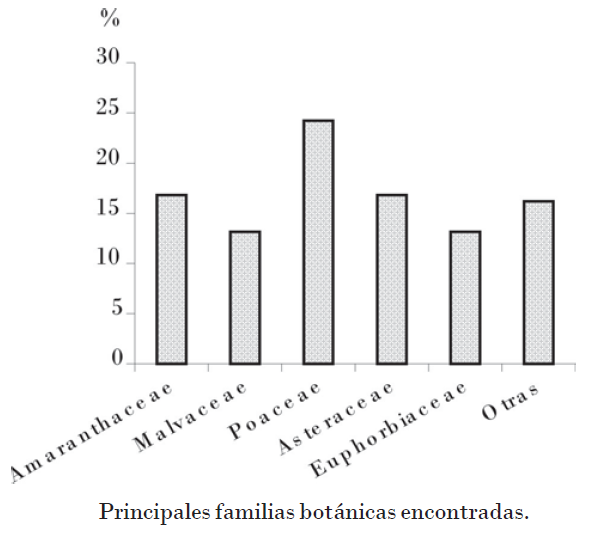
Weeds are really natural enemies of plants so a suitable management is necessary to realize on them. In ornamentals is important to know main species associated in order to define the best strategies. A study of weeds composition in gardens, particular areas and a floristic organoponic appertaining to Guantanamo Municipal Enterprise of Communal Services was realized. A total of 27 weeds from 24 genera and 10 botanic families were recorded. Principal families present were Poaceae, Asteraceae, Malvaceae, Euphorbiaceae and Amaranthaceae.
Article Details

This work is licensed under a Creative Commons Attribution-NonCommercial 4.0 International License.
Those authors who have publications with this journal accept the following terms of the License Attribution-NonCommercial 4.0 International (CC BY-NC 4.0):
You are free to:
- Share — copy and redistribute the material in any medium or format
- Adapt — remix, transform, and build upon the material
The licensor cannot revoke these freedoms as long as you follow the license terms.
Under the following terms:
- Attribution — You must give appropriate credit, provide a link to the license, and indicate if changes were made. You may do so in any reasonable manner, but not in any way that suggests the licensor endorses you or your use.
- NonCommercial — You may not use the material for commercial purposes.
- No additional restrictions — You may not apply legal terms or technological measures that legally restrict others from doing anything the license permits.
The journal is not responsible for the opinions and concepts expressed in the works, they are the sole responsibility of the authors. The Editor, with the assistance of the Editorial Committee, reserves the right to suggest or request advisable or necessary modifications. They are accepted to publish original scientific papers, research results of interest that have not been published or sent to another journal for the same purpose.
The mention of trademarks of equipment, instruments or specific materials is for identification purposes, and there is no promotional commitment in relation to them, neither by the authors nor by the publisher.
How to Cite
References
Bayer: «La industria de flores de corte en Malasia», Correo fitosanitario, Alemania, 1999, p. 15.
Cortés, Sara: «Situación actual de la producción de plantas ornamentales en Cuba», III Taller de Flores de Coste y Plantas Ornamentales, XII Seminario Científico, Programa y Resúmenes, del 14 al 17 de noviembre, INCA, Cuba, 2000, p. 199.
Cruz, Mercedes; Virginia Marrero; B. Cruz; T. Díaz: «Picudo verde azul de los cítricos (Pachnaeus litus Germar) como agente causal de daño en Gerbera jamesonii Bolus», Fitosanidad 13(3):219-220, La Habana, 2009.
Díaz, Yunaisy; E. Botta; Lérida Almaguel; P. de la Torre: «Ácaros depredadores en el cultivo de las plantas ornamentales», Taller Internacional Producción y Manejo Agroecológico de Artrópodos Benéficos, Sesión I. Prospección de artrópodos benéficos, del 15 al 18 de mayo, La Habana, 2007.
Gandarilla, Hortensia; E. Fernández: «Registro actualizado de fitonematodos en plantas ornamentales de Cuba», Fitosanidad 6(3):9-27, La Habana, 2002.
Paredes, E.; R. García; E. Pérez: «Metodología para el manejo de malezas en áreas agrícolas», II Taller Internacional de Manejo de Plagas del VI Seminario Científico Internacional de Sanidad Vegetal, del 22 al 29 de septiembre, La Habana, 2008.
Pérez, E.: «Manejo de malezas en la agricultura», Boletín Agroalimentario 1(7):2, La Habana,1992.
Rodríguez, W.; Elena González; J. González; Noemí Lastres; P. Sánchez: «Sansevieria guineensis (Jack) Will., nuevo hospedante en Cuba de Erwinia chrysanthemi Burk», Fitosanidad 8(4):3-5, La Habana, 2004.
Sandoval, Ileana; María Ofelia López; Tania Bonilla; O. Oliva: «Estudios del biocontrol de hongos del suelo con Trichoderma harzianum y la combinación de la solarización en el clavel (Dianthus barbatus)», Fitosanidad 7(4):23-25, La Habana, 2003.