
Efecto inhibitorio in vitro de cinco monoterpenos de aceites esenciales sobre un aislado de Rhizoctonia solani en papa (Solanum tuberosum l.)
Article Sidebar
Main Article Content
Abstract
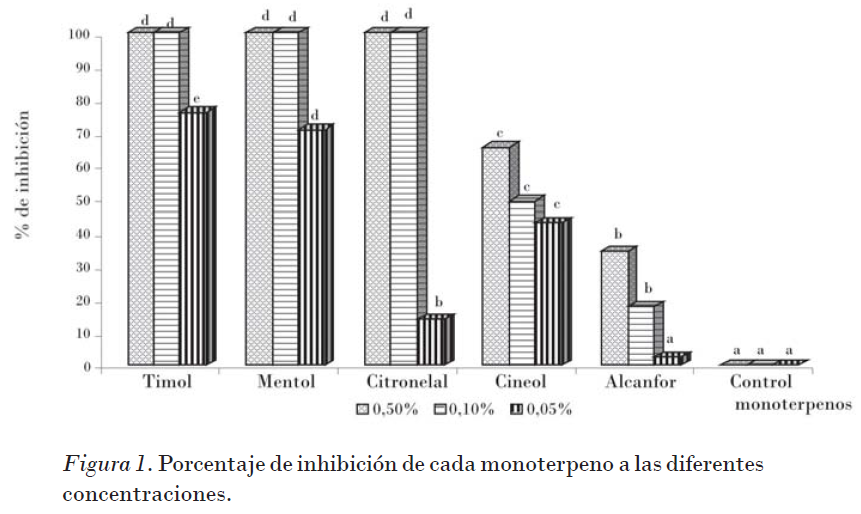
The looking for new alternative to chemical control for integrated pest management to reduce the environmental impact has received attention internationally in last decades. Essentials oils have been using in pharmaceutical and cosmetic industry, recently they have become in an interesting possibility for pest and disease control. The fungicide activity of five monoterpens (menthol, thymol, camphor, citronellal and 1,8 cineol), commonly found in essentials oils was evaluated. The method of culture media poisoning was used with concentration of 0,5; 0,1 y 0,05% w/v. The inhibitory effect was evaluated on a Rhizoctonia solani isolate, pathogen which causes rizoctoniasis in potato crops. The inhibition percentage was calculated and the results were statistically analyzed. Thymol, menthol and citronellal showed 100% of inhibition at 0,5 and 0,1%. The monoterpens camphor and 1, 8 cineol showed lower values of inhibition percentage, but they will taking into account for future studies with a wider range of concentration.
Article Details

This work is licensed under a Creative Commons Attribution-NonCommercial 4.0 International License.
Those authors who have publications with this journal accept the following terms of the License Attribution-NonCommercial 4.0 International (CC BY-NC 4.0):
You are free to:
- Share — copy and redistribute the material in any medium or format
- Adapt — remix, transform, and build upon the material
The licensor cannot revoke these freedoms as long as you follow the license terms.
Under the following terms:
- Attribution — You must give appropriate credit, provide a link to the license, and indicate if changes were made. You may do so in any reasonable manner, but not in any way that suggests the licensor endorses you or your use.
- NonCommercial — You may not use the material for commercial purposes.
- No additional restrictions — You may not apply legal terms or technological measures that legally restrict others from doing anything the license permits.
The journal is not responsible for the opinions and concepts expressed in the works, they are the sole responsibility of the authors. The Editor, with the assistance of the Editorial Committee, reserves the right to suggest or request advisable or necessary modifications. They are accepted to publish original scientific papers, research results of interest that have not been published or sent to another journal for the same purpose.
The mention of trademarks of equipment, instruments or specific materials is for identification purposes, and there is no promotional commitment in relation to them, neither by the authors nor by the publisher.
How to Cite
References
Acuña, I.; M. Vargas: «Rhizoctoniasis de la papa», Boletín Informativo 46:1-4, Instituto de Investigaciones Agropecuarias, La Habana, 2004.
Castellanos, L.; T. Rivero; A. Pomas; J. Pajón: «Modelación matemática de Alternaria solani Sor en papa en función del tiempo», Fitosanidad 9 (1):28-33, La Habana, 2005.
Dixon, R.: «Natural Products and Plant Disease Resistance», Nature 411:843-847, EE.UU., 2001.
Estévez, A.; M. E. González; M. M. Hernández; J. Castillo; O. Moré; M. Cordero: «Estrategia para el desarrollo del mejoramiento de la papa», Granma Ciencia 5: 21-30, Cuba, 2001.
Firn, R. D.; C. G. Jones: «Natural Products. A simple Model to Explain Chemical Diversity», Natural Product Reports 20 (3):382-391, Inglaterra, 2003.
García, J. M; I. Cenoz; C. García: «Composición natural para controlar la patología poscosecha de frutas y hortalizas y método de aplicación », Oficina Española de Patentes y Marcas, ES 2 163 999 1, 2002.
Gherman, C.; M. Culea; O. Cozar: «Comparative Analysis of Some Active Principles of Herb Plants by GC/MS», Talanta 53 (1):253-262, Elsevier, Rumania, 2000.
Gómez, M.: «Aceites esenciales contra hongos fitopatógenos» Revista Andalucía Investiga: 3, http://www.andaluciainvestiga.com/espanol/revista/revista_2004.asp, 2006.
Guzmán, S. P.; A. Trochéz; M. Zúñiga: «Efecto insecticida y residual de tres extractos de Lippia alba para el control de Acanthoscelides obtectus en fríjol», Diacol Calima, Revista Científica Guillermo de Ockham 7 (1), Colombia, 2004.
Hernández, A. N.; S. Bautista; M. G. Velásquez: «Prospectiva de extractos vegetales para controlar enfermedades poscosecha hortofrutícolas», Revista Fitotecnia Mexicana 30 (2):119-123, 2007.
López, M. D.: «Toxicidad volátil de monoterpenoides y mecanismos bioquímicos en insectos plagas del arroz almacenado», Tesis en opción al título de Doctor en Ciencias, Universidad de Murcias, España, http://www.tesisenxarxa.net/TESIS_UM/AVAILABLE/TDR-1218108-132706/LopezBelchi.pdf, 2008 (consulta 4 de septiembre del 2008).
Maggi, M. E.: «Insecticidas naturales», http://www.monografias.com/trabajos18/insecticidas-naturales/insecticidas-naturales.shtml, 2004 (consultado 4 de septiembre del 2008).
Molina, M.; I. Cabello; O. Lock: «Análisis cuantitativo de mentol en aceite esencial de menta», http://old.iupac.org/publications/cd/medicinalchemistry/Practica-VI-4.pdf, 2006 (consultado 4 de septiembre del 2008).
Sacchetti, G.; S. Maietti; M. Muzzoli; M. Scaglianti; S. Manfredini; M. Radice; R. Bruni: «Comparative Evaluation of 11 Essential Oils of Different Origin As Functional and Spatial Analysis of Epidemics Caused by Species in the Genus Antioxidants, Antiradicals and Antimicrobials in Foods», Food Chem. 91:621-632, Alemania, 2005.
Zavaleta, E.: «Alternativas del manejo de las enfermedades de las plantas», Terra 17:202-217, México, 2000.
Zygadlo, J. A.; D. M. Maestri; A. L. Lamarque; C. A Guzmán: «Fungitoxicidad de algunos terpenoides de Lippia junelliana (mold.) tronc», vol. XVI, IX Congreso Nacional de Recursos Naturales Aromáticos y Medicinales, Argentina, del 18 al 20 de noviembre del 2000, pp. 147-149.