
Caracterización de cepas de Bacillus thuringiensis berliner y actividad biológica hacia Spodoptera frugiperda (j. E. Smith) (lepidoptera: noctuidae) y Anticarsia gemmatalis hübner (lepidoptera: noctuidae)
Article Sidebar
Main Article Content
Abstract
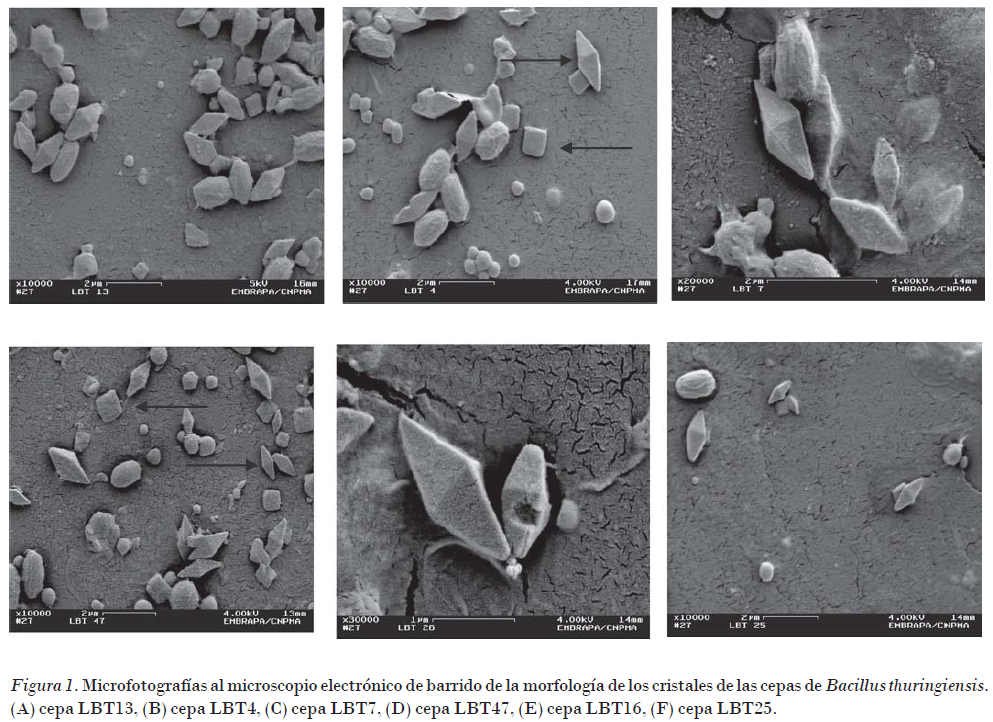
This study describes the characterization of nine Cuban Bacillus thuringiensis strains based on crystal morphology, SDS polyacrylamide electrophoresis (PAGE) and insecticidal activity against Spodoptera frugiperda and Anticarsia gemmatalis. Ultrastructural analysis of parasporal bodies of the nine strains showed the typical bipyramidal crystal and cubic inclusion partially embedded in the middle of the bipyramidal crystal. The PAGE analysis showed two bands of 130 kDa and 70 kDa belongs to Cry 1 and Cry 2 protein present to HD1 standard strains B. thuringiensis var. kurstaki. The strains LBT 4 and LBT 7 analyzed in this report showed potential as biological insecticide against S. frugiperda and LBT 4, LBT 7, LBT13 and LBT47 strains showed 100% of mortality to Anticarsia gemmatalis.
Article Details

This work is licensed under a Creative Commons Attribution-NonCommercial 4.0 International License.
Those authors who have publications with this journal accept the following terms of the License Attribution-NonCommercial 4.0 International (CC BY-NC 4.0):
You are free to:
- Share — copy and redistribute the material in any medium or format
- Adapt — remix, transform, and build upon the material
The licensor cannot revoke these freedoms as long as you follow the license terms.
Under the following terms:
- Attribution — You must give appropriate credit, provide a link to the license, and indicate if changes were made. You may do so in any reasonable manner, but not in any way that suggests the licensor endorses you or your use.
- NonCommercial — You may not use the material for commercial purposes.
- No additional restrictions — You may not apply legal terms or technological measures that legally restrict others from doing anything the license permits.
The journal is not responsible for the opinions and concepts expressed in the works, they are the sole responsibility of the authors. The Editor, with the assistance of the Editorial Committee, reserves the right to suggest or request advisable or necessary modifications. They are accepted to publish original scientific papers, research results of interest that have not been published or sent to another journal for the same purpose.
The mention of trademarks of equipment, instruments or specific materials is for identification purposes, and there is no promotional commitment in relation to them, neither by the authors nor by the publisher.
How to Cite
References
Ayra, P. C.; C. L. Rodríguez; P. Y. Fernández; R. P. Téllez: «Increased Activity of a Hybrid Bacillus thuringiensis Toxin Against Spodoptera frugiperda Larvae from a Maize Field in Cuba», Biotecnología Aplicada 23:236-239, La Habana, 2006.
Benintende, G.; J. López-Meza; J. Cozzi; C. Piccinetti; J. Ibarra: «Characterization of INTA 51-3, a New Atypical Strain of Bacillus thuringiensis from Argentina», Curr. Microbiol. 41:396-401, EE.UU., 2000.
Bobrowski, V. L.; G. Pasquali; M. Bodanese-Zanettini; L. Fiuza: «Detection of cry1 Genes in Bacillus thuringiensis Isolates from South of Brazil and Activity Against Anticarsia gemmatalis (Lepidoptera: Noctuidae)», Brazilian J. Microbiol. 32:105-109, Brasil, 2001.
Carreras, B.: «Caracterización de cepas de Bacillus thuringiensis para el control fitosanitario», Tesis en opción al título de Maestro en Microbiología General, Universidad de La Habana, 2003.
Crickmore, N.: «Bacillus thuringiensis toxin nomenclatura», http://www.biols.susx.ac.uk/Home/Neil_Crickmore/Bt/index.html, 2000 (consulta 12 de enero del 2009).
Crickmore, N.; D. R. Zeigler; E. Schnepf; J. Van Rie; D. Lereclus; J. Baum; A. Bravo; D. Dean: «Bacillus thuringiensis toxin nomenclature», http://www.lifesci.sussex.ac.uk/home/Neil_ Crickmore/Bt/, 2005 (consulta 12 de enero del 2009).
Del Rincón-Castro, M. C.; J. Méndez-Lozano; J. E. Ibarra: «Caracterización de cepas nativas de Bacillus thuringiensis con actividad insecticida hacia el gusano cogollero del maíz (Spodoptera frugiperda (Lepidoptera: Noctuidae)), Folia Entomol. Mexic. 45 (2):157-164, México, 2006.
Gitahy, P.; M. Teixeira de Souza; R. Monnerat; E. Arrigoni; J. Baldani: «A Brazilian Bacillus thuringiensis Strain Highly Active to Sugarcane Borer Diatraea saccharalis (Lepidoptera: Crambidae)», Brazilian J. Microbiol. 38:531-537, 2007.
Glare, T.; M. O’Callaghan: Bacillus thuringiensis: Biology, Ecology and Safety, John Wiley and Sons, Chichester, Inglaterra, 2000.
Hernández, M.; F. Cuevas; M. González; L. Guzmán: «Comportamiento de dos variedades de soya CS 23 e IS 27 (Glycine max (L.) Merill) en diferentes épocas», Avances 6(3), 2004, http://www.avances.pinar.cu/No.2004-3/soya.htm (consulta 13 de julio del 2009).
Iñigo, R.; A. Estela; M. Porcar; C. Martínez; J. Oguiza; J. Ferré; P. Caballero: «Molecular and Insecticidal Characterization of a Cry 1 Protein Toxic to Insects of the Family Noctuidae, Tortricidae, Putellidae and Chrysomelidae», Appl. Environm. Microbiol. 72 (6):4796-4804, EE.UU., 2006.
Lee, H.: Distribution of Bacillus thuringiensis in Korea, Bacillus thuringiensis Biotecnology and Enviromental Benefits vol. I, Hua Shiang Yuan Publishing, Taiwán, 1995, pp. 201-215.