
Diversidad de especies de hormigas (hymenoptera: formicidae) en cafetales afectados por Hypothenemus hampei ferrari (coleoptera: curculionidae: scolytinae)
Article Sidebar
Main Article Content
Abstract
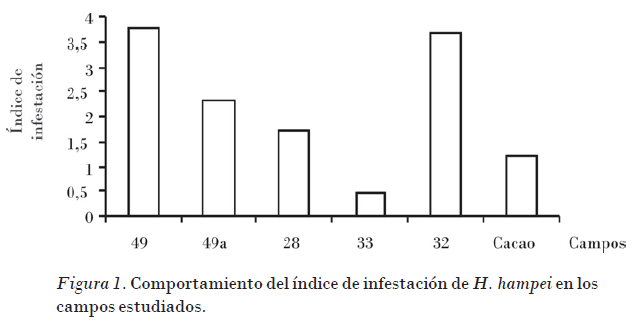
The conservation of coffee berry borer (Hypothenemus hampei Ferrari) natural enemies has great importance for Cuban coffee plantations; in this way a study of ants predators was carried out in the Empresa Cafetalera Bahía Honda, in Pinar del Río province during the crop of 2006, monthly evaluation was realized in six coffee plantations located to 200 meters some of other, with different soil and shade management. Ants was sampling in three vertical strata by means of trapping stations. In the own plants the index of coffee berry borer infestation was evaluated in each one of three productive branches by level. There were captured 1473 individuals of five ants species: Wasmannia auropunctata (Roger), Solenopsis geminata (Fabricius), Tetramorium bicarinatum (Nylander), Monomorium floricola (Jerdon) and Pheidole megacephala (Fabricius), the most abundant species was W. auropunctata. A bigger diversity of ants was observed in the order of preference floor>stem>bearing; traditional field type with forest trees, wrap pruning and cocoa tree trash reached the biggest diversity in the three studied strata. A narrow relationship was observed among the fields of smaller H. hampei infestation index and those of more ants species diversity, where T. bicarinatum and S. geminata prevailed, this suggests the necessity to continue the study of ants potentialities as biological controllers.
Article Details

This work is licensed under a Creative Commons Attribution-NonCommercial 4.0 International License.
Those authors who have publications with this journal accept the following terms of the License Attribution-NonCommercial 4.0 International (CC BY-NC 4.0):
You are free to:
- Share — copy and redistribute the material in any medium or format
- Adapt — remix, transform, and build upon the material
The licensor cannot revoke these freedoms as long as you follow the license terms.
Under the following terms:
- Attribution — You must give appropriate credit, provide a link to the license, and indicate if changes were made. You may do so in any reasonable manner, but not in any way that suggests the licensor endorses you or your use.
- NonCommercial — You may not use the material for commercial purposes.
- No additional restrictions — You may not apply legal terms or technological measures that legally restrict others from doing anything the license permits.
The journal is not responsible for the opinions and concepts expressed in the works, they are the sole responsibility of the authors. The Editor, with the assistance of the Editorial Committee, reserves the right to suggest or request advisable or necessary modifications. They are accepted to publish original scientific papers, research results of interest that have not been published or sent to another journal for the same purpose.
The mention of trademarks of equipment, instruments or specific materials is for identification purposes, and there is no promotional commitment in relation to them, neither by the authors nor by the publisher.
How to Cite
References
Alayo, P.: Introducción al estudio de los himenópteros de Cuba. Superfamilia Formicoidea, Serie Biológica no. 53, Instituto de Zoología, Academia de Ciencias de Cuba, La Habana, 1974.
Castiñeiras, A.; S. Monteagudo; M. González: «Observaciones sobre Wasmannia auropunctata (Hymenoptera: Formicidae) en cultivos de cafeto y cítricos en Cuba», Rev. Protección Vegetal 2: 234-238, La Habana, 1987.
CNSV: Programa de defensa contra la broca del café (Hypothenemus hampei Ferrari)», Centro Nacional de Sanidad Vegetal, Minag, La Habana, 1998.
CNSV: «Retrospectiva y situación actual de la broca del café en Cuba», Informe Técnico, Centro Nacional de Sanidad Vegetal y Dirección Nacional de Café y Cacao, Minag, sept. del 2003.
Fernández, F.: «Introducción a las hormigas de la región neotropical», Instituto de Investigación de Recursos Biológicos Alexander von Humboldt, Bogotá, Colombia, 2003, http://antbase.org/ants/publications/20987/20987.pdf
Fontenla, J. L.: «Lista preliminar de las hormigas de Cuba», Cocuyo 6:18-21, La Habana, 1997.
Gallego, M. C.; I. Armbrecht: «Depredación por hormigas sobre la broca del café Hypothenemus hampei (Curculionidae: Scolytinae) en cafetales cultivados bajo dos niveles de sombra en Colombia», Manejo Integrado de Plagas y Agroecología 76:32-40, Costa Rica, 2005.
Pérez, F. J.; F. M. Sola: «Divers exe: programa para el cálculo de los índices de diversidad (programa informático en línea)», http://perso.wanadoo.es/jp-l/descargas.htm, 1993 (consulta 14 de febrero del 2003).
Perfecto, I.; R. Snelling: «Biodiversity and the Transformation of a Tropical Agroecosystem: Ants in Coffee Plantations», Ecological Applications 5 (4):1084-1097, Nueva York, 1995.
Rivera, L.; I. Armbrecht: «Diversidad de tres gremios de hormigas en cafetales de sombra, de sol y bosques de Risaralda», Revista Colombiana de Entomología 31 (1):89-96, 2005.
Varón, E.; P. Hanson; O. Borbón; M. Carballo; L. Hilje: «Potencial de hormigas como depredadoras de la broca del café (Hypothenemus hampei) en Costa Rica», Manejo Integrado de Plagas y Agroecología 73:42-50, Costa Rica, 2004.
Vázquez, L. L.: «Experiencia cubana en el manejo agroecológico de plagas en cafeto y avances en la broca del café», Simposio sobre Situación Actual y Perspectivas de la Investigación y Manejo de la Broca del Café en Costa Rica, Cuba, Guatemala y México, Sociedad Mexicana de Entomología y El Colegio de la Frontera Sur, Tapachula, Chiapas, México, 2005, pp. 46-57.
Vázquez, L. L.; E. Blanco; O. Elósegui; Y. Matienzo; J. Alfonso: «Observaciones sobre enemigos naturales de la broca del café (Hypothenemus hampei Ferrari) en Cuba», Fitosanidad 10 (4):307-308, La Habana, 2006.