
Obtención de aislados de Bacillus thuringiensis berliner autóctonos de Cuba
Article Sidebar
Main Article Content
Abstract
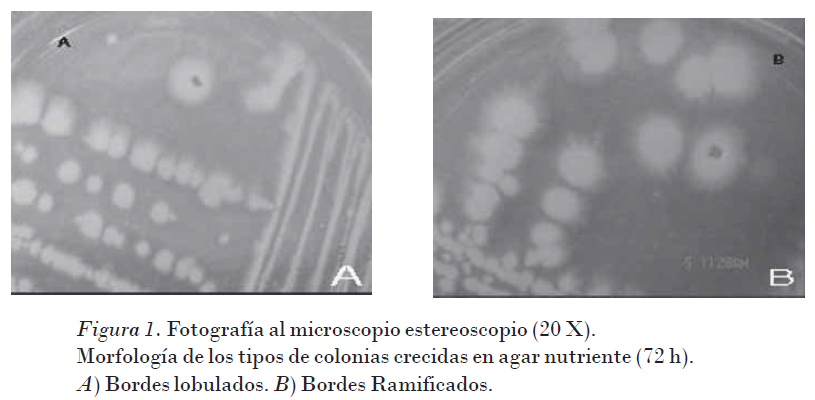
The presence of native isolates of Bacillus thuringiensis was determined by the analysis of 87 samples collected from different regions of Cuba. The pasteurization was utilized for the selection of sporulating colonies growed in nutrient medium. The colonies were selected because of their aspect and morphology by stereoscopic observation. It was observed the typical bacilar shape, position and morphology of the endospore by light microscopy, characteristics of cereus group, Bacillus genus. The bacterium was recognized basically due to the presence of a paraesporal crystal. The B. thuringiensis index obtained was determined by the relation between the numbers of B. thuringiensis colonies found with respect to the total number of colonies examined in the sample. 1-1,5 cm diameter colonies, plane, opaque, white-gray, lightly scabby consistence, irregular border, vegetative cells the typical bacilar shape and elipsoidal terminal endospores inside the vegetative cell allowed the selection of 609 sporulating colonies. From these, 341 colonies were classified as B. thuringiensis based on the production of parasporal crystal. B. thuringiensis isolates showed three crystal morphologies: bipyramidal mainly, amorphous, two isolates produced small parasporal bodies which appeared as a «cap» on the spore. The B. thuringiensis index varied from 0.37 to 0.74 and the B. thuringiensis index total was 0.56.
Article Details

This work is licensed under a Creative Commons Attribution-NonCommercial 4.0 International License.
Those authors who have publications with this journal accept the following terms of the License Attribution-NonCommercial 4.0 International (CC BY-NC 4.0):
You are free to:
- Share — copy and redistribute the material in any medium or format
- Adapt — remix, transform, and build upon the material
The licensor cannot revoke these freedoms as long as you follow the license terms.
Under the following terms:
- Attribution — You must give appropriate credit, provide a link to the license, and indicate if changes were made. You may do so in any reasonable manner, but not in any way that suggests the licensor endorses you or your use.
- NonCommercial — You may not use the material for commercial purposes.
- No additional restrictions — You may not apply legal terms or technological measures that legally restrict others from doing anything the license permits.
The journal is not responsible for the opinions and concepts expressed in the works, they are the sole responsibility of the authors. The Editor, with the assistance of the Editorial Committee, reserves the right to suggest or request advisable or necessary modifications. They are accepted to publish original scientific papers, research results of interest that have not been published or sent to another journal for the same purpose.
The mention of trademarks of equipment, instruments or specific materials is for identification purposes, and there is no promotional commitment in relation to them, neither by the authors nor by the publisher.
How to Cite
References
Aizawa, K.: «Shigetane Ishiwata: His Discovery of Sottokin (Bacillus thuringiensis) in 1901 and Subsequent Investigations in Japan», Proceedings of a Centennial Symposium Commemorating Ishiwata’s Discovery of Bacillus thuringiensis, Kurume, Japón, 2001, pp. 1-14.
Armengol, G.; M. C. Escobar; M. E. Maldonado; S. Orduz: «Diversity of Colombian Strains of Bacillus thuringiensis with Insecticidal Activity Against Dipteran and Lepidopteran Insects», J. Appl. Microbiol. 102(1):77-88, EE.UU., 2007.
Arrieta, G.; A. Hernández; A. M. Espinoza: «Diversity of Bacillus thuringiensis Strains Isolated from Coffee Plantations Infested with the Coffee Berry Borer Hypothenemus hampei», Rev. Biol. Trop. 52(3):757-764, Costa Rica, 2004.
Bel, Y.; F. Granero; T. Alberola; M. J. Martínez; J. Ferré: «Distribution, Frequency and Diversity of Bacillus thuringiensis in Olive Tree Environments in Spain», System Appl. Microbiol. 20:652-658, EE.UU., 1997.
Boone, D. R.; G. M. Garrity; R. W. Castenholz: Bergy’s Manual of Systematic Bacteriology, vol. 1, 2nd ed., Spring, Spring-Verlag, Nueva York, 2001.
Chatterjee, S. N.; T. Bhattacharya; T. K. Dangar; G. Chandra: «Ecology and Diversity of Bacillus thuringiensis in Soil Environment», African Journal of Biotechnology 6(13):1587-1591, 2007.
Ghelardi, E.; F. Celandroni; S. Salvetti; D. J. Beecher; M. Gominet; D. Lereclus; A. C. L. Wong; S. Senesi: «Requirement of flhA for Swarming Differentiation, Flagellin Export, and Secretion of Virulence Associated Proteins in Bacillus thuringiensis», J. Bacteriol. 184:6424-6433, EE.UU., 2002.
Hernández, J. A.; G. M. O. Ascanio: «The Development of Soil Classification in Cuba», Eurasian Soil Science 38 (12):1342-1346, 2005.
Iriarte, J.; Y. Bel; M. D. Ferrandis; R. Andrew; J. Murillo; J. Ferré; P. Caballero: «Environmental Distribution and Diversity of Bacillus thuringiensis in Spain», System. Appl. Microbiol. 21:97-106, EE.UU., 1998.
Maduell, P.; R. Callejas; K. R. Cabrera; G. Armengol; S. Orduz: «Distribution and Characterization of Bacillus thuringiensis on the Phylloplane of Species of Piper (Piperaceae) in Three Altitudinal Levels», Microb. Ecol. 44(2):144-53, EE.UU., 2002.
Maduell, P.; A. Armengol; S. Orduz: «Can Soil Phisicochemical Characteristics Affect the Presence of Bacillus thuringiensis Spores?», Microb. Ecol. 27(82):35-42, EE.UU., 2005.
Maduell, P.; G. Armengol; M. Llagostera; S. Orduz; S. Lindow: «Bacillus thuringiensis Is a Poor Colonist of Leaf Surfaces», Microb. Ecol. 55:212-219, EE.UU., 2008.
Martin, P. A. W.; R. S. Travers: «Worldwide Abundance and Distribution of Bacillus thuringiensis Isolates», Appl. Environ. Microbiol. 55:2437-2442, EE.UU., 1989.
Medrano, O. M.; O. H. A. Luna; J. J, Peña; J. M. Sánchez: «Supervivencia de células vegetativas de Bacillus thuringiensis en la espermosfera-rizosfera de frijol», Terra 18:333-337, 2000. (falta país)
Porcar, M.; V. Juárez: «Aislamiento y establecimiento de una colección de Bacillus thuringiensis», Bacillus thuringiensis en el control biológico, Universidad Nacional de Colombia, Bogotá, 2004, pp. 69-100.
Quesada E.; E. García; P. Valverde; C. Santiago: «Solation, Geographical Diversity and Insecticidal Activity of Bacillus thuringiensis from Soils in Spain», Microbiological Research 159:59-71, 2004. (falta país)
Rosas, N. M.; M. Mireles; J. L. Hernández; J. E. Ibarra: «Screening of Cry Gene Contents of Bacillus thuringiensis Strains Isolated from Avocado Orchards in Mexico, and Their Insecticidal Activity Towards Argyrotaenia sp. (Lepidoptera: Tortricidae) Larvae», J. Appl. Microbiol. 104:224-230, EE.UU., 2008.
Ruiz de Escudero, I.; M. A. Padilla; A. A. Ibáñez; P. Caballero: «Aislamiento y caracterización de nuevas cepas de Bacillus thuringiensis procedentes de muestras de tierra de Canarias», Bol. San. Veg. Plagas, 30:703-712, España, 2004.
Sánchez, J. M.; J. J. Peña: «Supervivencia de esporas de Bacillus thuringiensis en el filoplano de maíz, frijol y en suelo», Terra 18:325-331, Brasil, 2000.
Támez, P.; M. M. Iracheta; B. Pereira; L. J. Galán; R. Gómez; R. Támez; C. Rodríguez: «Caracterización de cepas mexicanas de Bacillus thuringiensis tóxicas para larvas de lepidópteros y coleópteros», Ciencia UANL 8 (4):477-482, México, 2007.
Valenzuela, E.: «Guía Pasos prácticos. Microbiología» 112, Instituto de Microbiología, Universidad Austral de Chile, 2003.