
Actividad antifúngica in vitro de la quitosana sigma frente a hongos fitopatógenos causantes del manchado del grano en el cultivo de arroz (Oryza sativa l.)
Article Sidebar
Main Article Content
Abstract
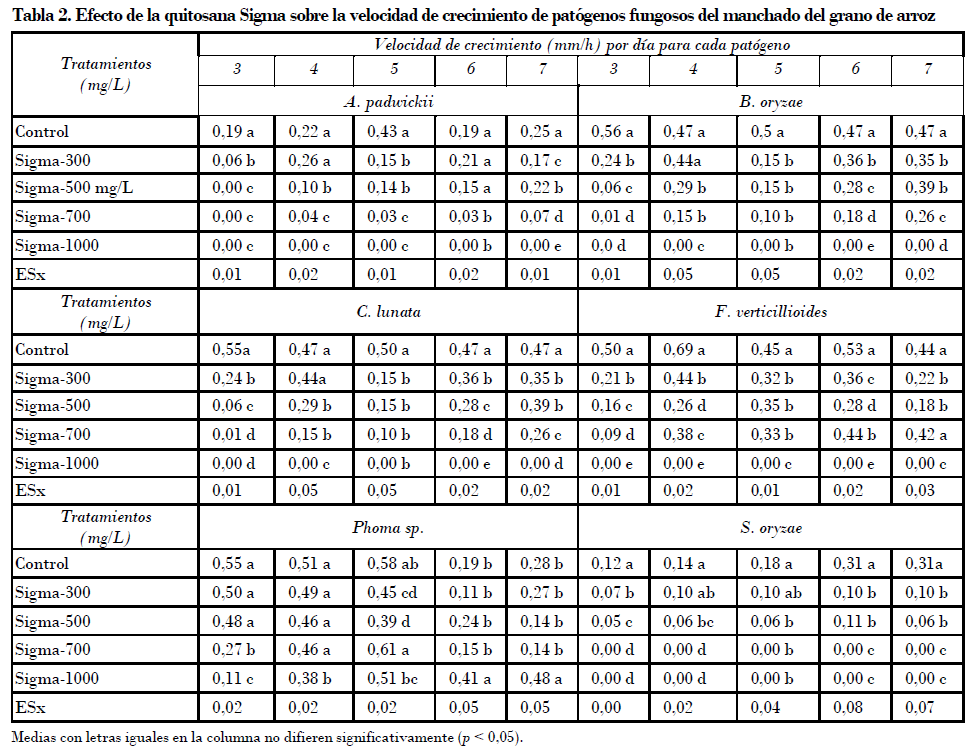
The antifungal activity of commercial chitosan Sigma at concentrations of 300, 500, 700 and 1000 mg/L on mycelial growth and sporulation of the rice spotted grain pathogen fungi Alternaria padwickii (Ganguly) Ellis, Bipolaris oryzae (Breda de Haan) Shoemaker, Curvularia lunata (Wakker) Boedijn, Fusarium verticillioides (Saccardo) Nirenberg, Phoma sp. Saccardo and Sarocladium oryzae (Sawada) Gams & Hawksworth was determined in vitro through the poisoning Potato-Dextrose-Agar media. Chitosan showed specificity in its inhibitory activity on fungi mycelial growth, and it was highest at concentration of 1000 mg/L, except for Phoma sp. Fungicidal action of the polymer on A. padwickii and B. oryzae was observed also and fungistatic action on the rest of fungi, with delayed growth on F. verticillioides. Fungal sporulation reduction while the concentration product increased was obtained. That is why chitosan Sigma is considered a promising alternative for the disease management.
Article Details

This work is licensed under a Creative Commons Attribution-NonCommercial 4.0 International License.
Those authors who have publications with this journal accept the following terms of the License Attribution-NonCommercial 4.0 International (CC BY-NC 4.0):
You are free to:
- Share — copy and redistribute the material in any medium or format
- Adapt — remix, transform, and build upon the material
The licensor cannot revoke these freedoms as long as you follow the license terms.
Under the following terms:
- Attribution — You must give appropriate credit, provide a link to the license, and indicate if changes were made. You may do so in any reasonable manner, but not in any way that suggests the licensor endorses you or your use.
- NonCommercial — You may not use the material for commercial purposes.
- No additional restrictions — You may not apply legal terms or technological measures that legally restrict others from doing anything the license permits.
The journal is not responsible for the opinions and concepts expressed in the works, they are the sole responsibility of the authors. The Editor, with the assistance of the Editorial Committee, reserves the right to suggest or request advisable or necessary modifications. They are accepted to publish original scientific papers, research results of interest that have not been published or sent to another journal for the same purpose.
The mention of trademarks of equipment, instruments or specific materials is for identification purposes, and there is no promotional commitment in relation to them, neither by the authors nor by the publisher.
How to Cite
References
Chien, P.; C. Chou: «Antifungal Activity of Chitosan and Its Application to Control Post-Harvest Quality and Fungal Rotting of Tankan Citrus Fruit (Citrus tankan Hayata)», Journal of the Science of Food and Agriculture 86:1964-1969, Inglaterra, 2006.
Cordero, V.; L. E. Rivero: Principales enfermedades fungosas que inciden en el cultivo del arroz en Cuba, Instructivo Técnico del Arroz, Instituto de Investigaciones del Arroz, La Habana, 2001, p. 29.
Cruz, A.; Deyanira Rivero; B. Martínez; M. A. Ramírez; L. A. Maqueira: «Efecto de la quitosana sobre el crecimiento y desarrollo in vitro del hongo Sarocladium oryzae Sawada y la protección de semillas de arroz (Oryza sativa Lin.)», Cultivos Tropicales 26(3):83-86, La Habana, 2005.
El Hassni, M.; M. A. El Hadrami; F. Daayf; E. Ait; I. El Hadrami: «Chitosan, Antifungal Product Against Fusarium oxysporum f. sp. Albedinis and Elicitor of Defence Reactions in Date Palms Roots», Phytopathologia Mediterranea 43(2):195-204, Italia, 2004.
Eweis, M.; S. S. Elkholy; M. Z. Elsabee: «Antifungal Efficacy of Chitosan and Its Thiourea Derivatives Upon the Growth of Some Sugar-Beet Pathogens», International Journal of Biological Macromolecules 38(1):1-8, Holanda, 2006.
Falcón, A.; D. Díaz; M. A. Ramírez: «Hidrólisis enzimática de quitosana. Actividad biológica del polímero y sus hidrolizados», Cultivos Tropicales 25(2):81-86, La Habana, 2004.
Gutiérrez, Susana; María A. Mazzanti; S. A. Mazza: «Hongos asociados a granos manchados de arroz», Reunión de Comunicaciones Científicas y Tecnológicas, Secretaría General de Ciencia y Técnica, Universidad Nacional del Nordeste, Corrientes, Argentina, http://www1.unne.edu.ar/cyt/2001/5-Agrarias/A-052.pdf, 2001 (consultado el 2 de septiembre del 2008).
Hernández, Ileana: «La quitosana: un producto bioactivo de diversas aplicaciones», Cultivos Tropicales 25(3):97-110, La Habana, 2004.
IIA: Instructivo técnico del cultivo de arroz, Centro Nacional de Sanidad Vegetal, Ministerio de la Agricultura, Cuba, 2006.
Król, E.: «Influence of Some Chemicals on the Viability of Phomopsis viticola Sacc. Spores», Journal of Plant Protection Research 45(3):195-203, Polonia, 2005.
Parra, Yanet; M. A. Ramírez: «Efecto de diferentes derivados de la quitina sobre el crecimiento in vitro del hongo Rhizoctonia solani Kuhn», Cultivos Tropicales 23(2):73-75, La Habana, 2002.
Peng, Y.; B. Han; L. Wanshun; X. Xiaojuan: «Preparation and Antimicrobial Activity of Hydroxypropyl Chitosan», Carbohydrate Research 340(11):1846-1851, Inglaterra, 2005.
Pinciroli, M.; M. N. Sisterna; R. Bezus; A. A. Vidal: «Manchado del grano de arroz: efecto de la fertilización nitrogenada», Revista de la Facultad de Agronomía, 105(2):11, La Plata, Argentina, 2003.
Pombo, R.: «Relación estructura-actividad de la quitosana y sus hidrolizados solubles sobre algunos hongos fitopatógenos», Tesis en opción al grado académico de Máster en Química Agrícola, Universidad Agraria de La Habana, 1996.
Ramírez, M. Á.; Aida T. Rodríguez; Liliam Becheram; C. Peniche; L. Alfonso: «Caracterización de derivados de quitina y evaluación de su actividad antimicrobiana sobre hongos patógenos vegetales», Memorias del XXVII Congreso Latinoamericano de Química, Palacio de Convenciones, La Habana, 16-20 de octubre del 2006.
Rodríguez, Aida T.; M. A. Ramírez; M. C. Nápoles; Ramona Márquez; Regla M. Cárdenas: «Antifungal Activity of Chitosan and One of Its Hidrolisates on Pyricularia grisea, Sacc. Fungus», Cultivos Tropicales 24 (2):85-88, La Habana, 2003.
Sisterna, M. N.; G. A. Lori; J. J. Marassi: «Sintomatología y hongos asociados al manchado del grano de arroz en el genotipo Irga 409», Revista de la Facultad de Agronomía, 70(1):13-21, La Plata, Argentina, 1994.
Synowiecky, J.; Nadia A. Al-Khateeb: «Production, Properties and Some New Applications of Chitin and Its Derivatives», Critical Reviews in Food Science and Nutrition 43(2):145-171, Inglaterra, 2003.