
Potencialidades de bacterias aerobias formadoras de endosporas para el biocontrol en plantas ornamentales
Article Sidebar
Main Article Content
Abstract
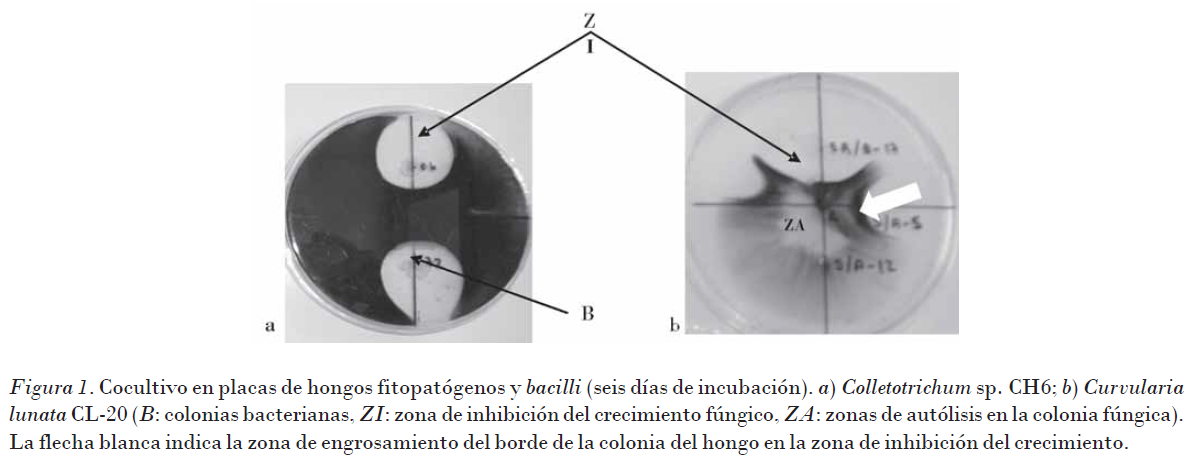
The in vitro evaluation of the growth inhibitory activity, carried out by aerobic endospore forming bacteria (AEFB) on phythopatogenic fungi, isolated from ornamental plants, was done. The biocide activity was determined by the co-inoculation of fungi and bacterial isolates on Petri dishes containing Potato Dextrose Agar, BIOCEN. There were presented the growth inhibition curves for each fungi and a control, and it was calculated the radial growth inhibition percentage (RGIP). The 62% of the bacterial isolates generate a fungal growth inhibition area, being selected five strains with simultaneous inhibitory activity, evident after the third day of incubation. In the colonies of Curvularia lunata it was observed an internal lyses area and a dimness of the colony border next of the inhibition zone. The RGIP oscillated between 51.6 and 72.2%. The bacteria isolates description based on phenotypic characteristics, confirmed their taxonomic location in the aerobic endospore forming bacteria group, Bacilli Class.
Article Details

This work is licensed under a Creative Commons Attribution-NonCommercial 4.0 International License.
Those authors who have publications with this journal accept the following terms of the License Attribution-NonCommercial 4.0 International (CC BY-NC 4.0):
You are free to:
- Share — copy and redistribute the material in any medium or format
- Adapt — remix, transform, and build upon the material
The licensor cannot revoke these freedoms as long as you follow the license terms.
Under the following terms:
- Attribution — You must give appropriate credit, provide a link to the license, and indicate if changes were made. You may do so in any reasonable manner, but not in any way that suggests the licensor endorses you or your use.
- NonCommercial — You may not use the material for commercial purposes.
- No additional restrictions — You may not apply legal terms or technological measures that legally restrict others from doing anything the license permits.
The journal is not responsible for the opinions and concepts expressed in the works, they are the sole responsibility of the authors. The Editor, with the assistance of the Editorial Committee, reserves the right to suggest or request advisable or necessary modifications. They are accepted to publish original scientific papers, research results of interest that have not been published or sent to another journal for the same purpose.
The mention of trademarks of equipment, instruments or specific materials is for identification purposes, and there is no promotional commitment in relation to them, neither by the authors nor by the publisher.
How to Cite
References
Basha, S.; S. Ulaganathan: «Antagonisms of Bacillus Species (strain BC121) Towards Curvularia lunata», Current Science 82(12):1458-1463, EE.UU., 2002.
Dickinson, C. H.: Patología vegetal y patógenos de plantas, Ed. Limusa, México, 1987.
Ding, N. G.; Y. J. Wang; Y. Liu; S. Chen: «Isolation and identification of nitrogen–fixing bacilli from plant rhizospheres in Beijing region», Journal of Applied Microbiology 99(5):1271-1275, Oxford, 2006.
Ezziyani, M.; C. Pérez; M. E. Requena; L. Rubio; M. E. Candela: «Biocontrol por Streptomyces rochei Ziyani, de la podredumbre del pimiento (Capsicumm annuum L.) causada por Phytophthora capsici», Anales de Biología 26:69-78, España, 2004a.
Ezziyyani, M., C. Pérez; M. E. Rquena; A. Sid; M. E. Candela: «Evaluación del biocontrol de Phytophthora capsici en pimiento (Capsium annuum L.) por tratamiento con Burkholderia cepacia», Anales de Biología 26:61-68, España, 2004b.
Fernández-Larrea, O.: «Microorganismos antagonistas para el control fitosanitario», Manejo Integrado de Plagas 62:96-100, Costa Rica, 2001.
Garrity, G. M.; J. A. Bell; T. G. Lilburn: «Taxonomic Outline of the Procaryotes», Bergey’s Manual of Systematic Bacteriology, 2nd ed., Release 5.0, Springer-Verlag, Nueva York, 2004, DOI: 10.1007/bergeysoutline200405.
Gong, M.; J. D. Wang; J. Zhang; H. Yang; X. F. Lu; Y. Pei; J. Q. Chen: «Study of the Antifungal Ability of Bacillus subtilis Strain PY-1 in vitro and Identification of Its Antifungal Substance (Iturin A)», Acta Biochimica et Biophysica Sinica 38(4):233-240, Shanghai, 2006.
Mafia, A. R. G.; A. C. Alfenas; G. Ventura; R. Alfenas: «Antracnose em Paphiopedilum insigne (Orquidaceae) causada por Colletotrichum gloesporoides», Fitopatologia Brasileira 30:(4):436, Brasil, 2005.
McSpadden, B.: «Ecology of Bacillus and Paenibacillus spp. In Agricultural Systems», Phytopathology 94(11):1252-1258, EE.UU., 2004.
Muhamad, S.; N. A. Amusa. «In vitro Inhibition of Growth of Some Seedling Blight Inducing Pathogens by Compost Inhabiting Microbes», African Journal of Biotechnology 2(6):161-164, Niairobi, 2003.
Norris, J. R.; D. W. Ribbons: Methods in Microbiology, vol. 5A, Academic Press, Nueva York, 1971.
Orbera, T.; I. Pérez; D. Ferrer; N. Cortés; Z. González: «Aislamiento de cepas de Bacillus sp. con potencialidades para la bioprotección y la estimulación del crecimiento vegetal», Revista Cubana de Química, XVII(1):189-195, Cuba, 2005.
Rahman, M. S.; T. Ano; M. Shoda: «Second Stage Production of Iturin A by Induced Germination of Bacillus subtilis RB14», Journal of Biotechnology 18:226-229, EE.UU., 2006.
Young-Keun, L.; J. Yu-Sin; C. Hwa-Hyoung; W. H. Seok; C. A. Hye-Young: «Putative Early Response of Antifungal Bacillus lentimorbus WJ5 Against the Plant Pathogenic Fungus Colletotrichum gloesporoides, Analyzed by a DNA Microarray», Journal of Applied Microbiology 43(3):308-312, EE.UU., 2005.