
Patogenicidad de Bauveria bassiana (bals.) vuillemin sobre estados inmaduros de mosquita blanca (Bemisia tabaci genn.)
Article Sidebar
Main Article Content
Abstract
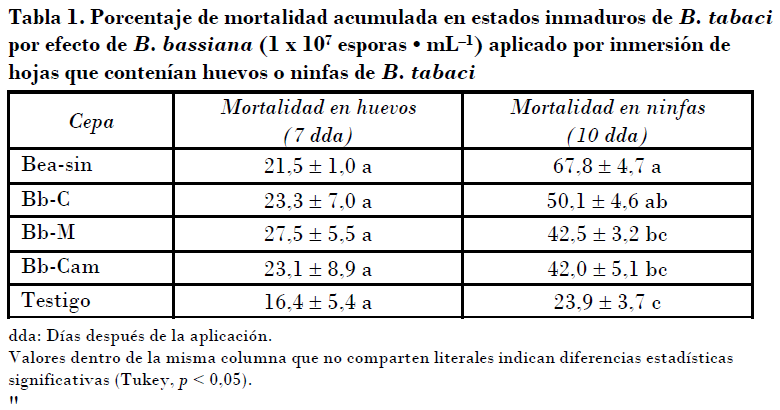
The pathogenicity of three indigenous (Bb-Cam, Bb-C y Bb-M) and one commercial (Bea-sin) isolates of Beauveria bassiana were evaluated on immature states of Bemisia tabaci. The evaluation was carried out under laboratory conditions with temperature of 27 ± 3ºC and relative humidity of 75 ± 8%, by the application of a conidial suspension containing 1 x 10⁷ spores • mL–1 to eggs and first instar nymphs. The effect of B. bassiana was higher on nymphs than on eggs. No significant difference (p > 0.05) was observed on egg mortality caused by B. bassiana isolates. These isolates showed different degree of pathogenicity on nymph bioassay. The isolate Bea-sin showed the highest (p < 0.05) effect (67.9% mortality). The rest of the isolates caused mortality from 42 to 50%. The medium lethal time (TL50) and the area under the curve of cumulative mortality (AUCCM) were calculated for the nymph bioassay. Bea-sin showed the lowest TL50 and the highest AUCCM, with values of 3.6 days and 381.22 units, respectively. These results indicate that Bea-sin showed more virulence than the indigenous isolates.
Article Details

This work is licensed under a Creative Commons Attribution-NonCommercial 4.0 International License.
Those authors who have publications with this journal accept the following terms of the License Attribution-NonCommercial 4.0 International (CC BY-NC 4.0):
You are free to:
- Share — copy and redistribute the material in any medium or format
- Adapt — remix, transform, and build upon the material
The licensor cannot revoke these freedoms as long as you follow the license terms.
Under the following terms:
- Attribution — You must give appropriate credit, provide a link to the license, and indicate if changes were made. You may do so in any reasonable manner, but not in any way that suggests the licensor endorses you or your use.
- NonCommercial — You may not use the material for commercial purposes.
- No additional restrictions — You may not apply legal terms or technological measures that legally restrict others from doing anything the license permits.
The journal is not responsible for the opinions and concepts expressed in the works, they are the sole responsibility of the authors. The Editor, with the assistance of the Editorial Committee, reserves the right to suggest or request advisable or necessary modifications. They are accepted to publish original scientific papers, research results of interest that have not been published or sent to another journal for the same purpose.
The mention of trademarks of equipment, instruments or specific materials is for identification purposes, and there is no promotional commitment in relation to them, neither by the authors nor by the publisher.
How to Cite
References
Al-Deghairi, M. A.: «Bioassay Evaluation of the Entomopathogenic Fungi, Beauveria bassiana Vuellenim Against Eggs and Nynphs of Bemisia tabaci Gennadius (Homoptera: Aleyrodidae)», Pakistan Journal of Biological Science 11(12):1551-1560, Pakistán, 2008.
Alean, C. I.: «Evaluación de la patogenicidad de diferentes hongos entomopatógenos para el control de la mosca blanca de la yuca (Aleurotrachelus socialis Bondar) (Homoptera: Aleyrodidae) bajo condiciones de invernadero», tesis de licenciatura, Pontifica Universidad Javeriana, Bogotá, Colombia, 2003.
Campbell, C. L.; L. V. Madden: Introduction to Plant Disease Epidemiology, Ed. John Whiley & Son., Nueva York, 1990.
Cárdenas S. E.: «Virus transmitidos por mosquita blanca», Hortalizas: plagas y enfermedades, Ed. Trillas. México, 1999, pp. 176-178.
Catie: «Desarrollo de micoinsecticidas para el manejo integrado de la mosca blanca (Bemisia tabaci) en cultivos frutales y hortícolas, en zonas neotropicales», Informe técnico final de proyecto Fontagro, Coorporación Colombiana de Investigación Agropecuaria (Corpoica), Colombia, 2006.
Dos Santos, R. A.; N. M. Pozo: «Alternativa para el manejo de Trialeurodes vaporariorum Westwood en tomate orgánico en Uruguay », Bol. San. Veg. Plagas 29:211-218, España, 2003.
Espinel, C.; L. Torres; E. Grijalba; L. Villamizar; A. M. Cotes: «Preformulados para control de la mosca blanca Bemisia tabaci (Hemiptera: Aleyrodidae) en condiciones de laboratorio», Revista Colombiana de Entomología 34(1):22-27, Colombia, 2008.
Falcon, L.: Development and Use of Microbial Insecticides in Biological Control in Agricultural IPM Systems, Academic Press, Londres, 1985, pp. 229-242.
Ferron, P.: «Biological Control of Insect Pests by Entomogenous Fungi», Annual Review of Entomology 23:409-442, EE.UU., 1977.
Gaitán, A.; A. M. Valderrama; G. Saldarriaga; P. Vélez; A. Bustillo: «Genetic Variability of Beuveria bassiana Associated to the Coffee Berry Borer Hypothenemus hampei and Other Insects», Mycolical Research 106(11):1307-1314, Inglaterra, 2002.
Gindin, G.; N. U. Geschtovt; B. Raccah; I. Barash: «Pathogenicity of Verticillium lecanii to Different Developmental Stages of the Silverleaf Whitefly, Bemisia argentifolii», Phytoparasitica 28(3):1-11, Holanda, 2000.
Godonou, I.; K. R. Green; K. A. Oduro; C. J. Lomer; K. Afreh-Nuamah: «Field Evaluation of Selected Formulation of Beuveria bassiana for the Management of the Banana Weevil (Cosmopolites sordidus) on Plantain (Musa spp.)», Biocontrol Science and Technology 10(6):779-788, Inglaterra, 2000.
Goettel, M.: «Fungal Agents for Biocontrol», Biological Control of Locust and Grasshoppers, CAB International, Ascot, Inglaterra, 1992, pp. 122-132.
Gutiérrez, O. M.; J. C. Rodríguez M.; C. Llanderal C.; A. P. Terán V.; A. Lagunes T.; O. Díaz G.: «Estabilidad de la resistencia a Neonicotinoides en Bemisia tabaci (Gennadius), Biotipo B de San Luis Potosí, México», Agrociencia 41:913-920, México, 2007.
Horowitza, R.; Z. Mendelson; M. Cahill, I. Deholm, I. Ishaaya: «Managing Resistance to the Insect Growth Regulator, Piriproxyfen, in Bemisia tabaci», Pesticide Science 55(3):272-276, Inglaterra, 1999.
Humber, R.: «Fungi: Identification», Manual of Techniques in Insect Pathology, Academic Press, Nueva York, 1996, pp. 153-185.
Monzón, A.: «Producción, uso y control de calidad de hongos entomopatógenos en Nicaragua» Manejo Integrado de Plagas y Agroecología 63:95-103, Costa Rica, 2001.
Muñiz, M.; G. Nombela: «Differential Variation of Development of the Band Q-Biotypes of Bemisia tabaci on Sweet Pepper Capsicum annum L. at Constant Temperatures», Environmental Entomology 30:720-727, EE.UU., 2001.
Nauen, R.; N. Stumpf; A. Elbert: «Toxicological and Mechanistic Studies on Neonicotinoid Cross Resistance in Q-Type Bemisia tabaci (Hemiptera: Aleyrodidae)», Pest Management Science 58(9):868-875, Inglaterra, 2002.
Palumbo, J. C.; A. R. Horowitz; N. Prabhaker: «Insecticidal Control and Resistance Management for Bemisia tabaci», Crop Protection 20:739-765, EE.UU., 2001.
Pariona, N.; P. Castellanos; E. León: «Capacidad entomocida de cepas nativas de Beauveria spp. sobre Schistocerca piceifrons peruviana», Revista Peruana de Biología 14(2):253-257, Lima, 2007.
Pucheta, D. M.; A. Flores; N. Rodríguez; M. de la Torre: «Mecanismo de acción de los hongos entomopatógenos», Interciencia 31(12): 856-860, Venezuela, 2006.
Skrobek, A.: «Investigations on the Effect of Entomopathogenic Fungi on Whiteflies» Institut für Pflanzenkrankheiten der Rheinischen Friedrich-Wilhelms-Universität Bonn. Doktorwürde der Agrarwissenschaften, http://hss.ulb.uni-bonn.de/diss_online/landw_fack/2001/skrobek_ anke/text.pdf. 2001 (consultado en enero del 2009).
Sotero, A. M.; J. C. Rodríguez M.; C. Santillán O.; A. Lagunes T.; O. Díaz G.; J. L. Martinez C.: «Susceptibilidad a insecticidas en dos poblaciones de Bemisia tabaci (Gennadius) (Hemiptera: Aleyrodidae) biotipo B colectadas en Baja California y Sinaloa, México», Interciencia 32(4):226-269, Venezuela, 2007.
Tanada, Y.; H. Kaya: Insect Pathology, Academic Press, NuevaYork, EE.UU., 1993.
Vicentini, S.; M. Faria; R. M. Oliveira: «Screening of Beauveria bassiana (Deutomycotina: Hyphomycetes) Isolates Against Bemisia tabaci (Genn.) Biotype B. (Hemiptera: Aleyrodidae) with a Description of a New Bioassay Method», Neotropical Entomology 30(1):97-103, Brasil, 2001.