
Evaluación de cepas de Bacillus thuringiensis para el control de Drosophila melanogaster maengi
Article Sidebar
Main Article Content
Abstract
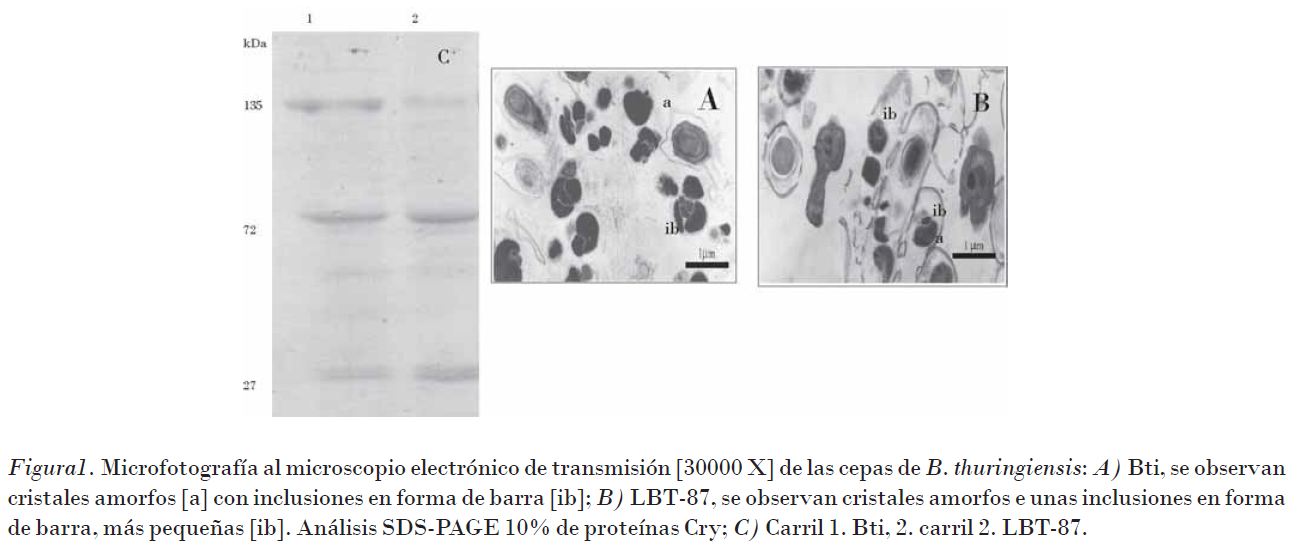
The use of Bacillus thuringiensis as biolarvicide is a viable alternative for insect control so the number of known Bacillus thuringiensis strains active on diptera is growing. The characterization of strains of this bacterium isolated from different regions of Cuba is presented. Characterization was based on their insecticidal activity against Drosophila melanogaster, electron microscopy observation of the spores and crystal mixtures and sodium dodecyl sulfatepolyacrylamide gel electrophoresis (SDS-PAGE) of spore-crystal suspensions. Strains LBT-63 and LBT-87 displayed similarities with the B. thuringiensis subs. israelensis used in this study with regard profile protein and morphology of crystal inclusions. These strains had major proteins of 130, 70 and 27 kDa and amorphous crystal; however, the strain LBT-87 only showed insecticidal activity against D. melanogaster but lower than B. thuringiensis subs. israelensis control.
Article Details

This work is licensed under a Creative Commons Attribution-NonCommercial 4.0 International License.
Those authors who have publications with this journal accept the following terms of the License Attribution-NonCommercial 4.0 International (CC BY-NC 4.0):
You are free to:
- Share — copy and redistribute the material in any medium or format
- Adapt — remix, transform, and build upon the material
The licensor cannot revoke these freedoms as long as you follow the license terms.
Under the following terms:
- Attribution — You must give appropriate credit, provide a link to the license, and indicate if changes were made. You may do so in any reasonable manner, but not in any way that suggests the licensor endorses you or your use.
- NonCommercial — You may not use the material for commercial purposes.
- No additional restrictions — You may not apply legal terms or technological measures that legally restrict others from doing anything the license permits.
The journal is not responsible for the opinions and concepts expressed in the works, they are the sole responsibility of the authors. The Editor, with the assistance of the Editorial Committee, reserves the right to suggest or request advisable or necessary modifications. They are accepted to publish original scientific papers, research results of interest that have not been published or sent to another journal for the same purpose.
The mention of trademarks of equipment, instruments or specific materials is for identification purposes, and there is no promotional commitment in relation to them, neither by the authors nor by the publisher.
How to Cite
References
Al-Momani, F.; M. Obeidat; I. Saadoun; M. Meqdam: «Serotyping of Bacillus thuringiensis Isolates, Their Distribution in Different Jordanian Habitats and Pathogenicity in Drosophila melanogaster», World Journal of Microbiology and Biotechnology 20(7):749-753, EE.UU., 2004.
Bravo, A.; M. Soberón; I. Gómez; C. Muñoz; L. Pardo; L. Galán; H. Luna; A. Alcázar; B. Pereira; J. A. Carrillo; R. García; L. Serrano; M. Patino; E. Galindo; M. C. del Rincón; J. E. Ibarra: «Los microorganismos en el control biológico de insectos y fitopatógenos», Rev. Latinoam. Microbiol. 48(2):113-120, México, 2006.
Fernández-Larrea, O.: «Proyecto 300104. Desarrollo de productos de Bacillus thuringiensis para el control de ácaros, nematodos y coleópteros. Etapa 01. Estudio del espectro de acción de las cepas », Inisav, Cuba, 1998.
––––: «Review of Bacillus thuringiensis Production in Cuba», Biocontrol News and Information 20(1):47-48, EE.UU.,1999.
Goldberg L. J.; J. Margalit: «A Bacterial Spore Demonstrating Rapid Larvicidal Activity Against Anopheles sergentii, Uranotaenia unguiculata, Culex univittatus, Aedes aegypti and Culex pipiens», Mosq. News 37:355-358, EE.UU., 1977.
Guerchicoff, A.; A. Delecluse; C. P. Rubinstein: «The Bacillus thuringiensis cyt Genes for Hemolytic Endotoxins Constitute a Gene Family», Appl. Environ. Microbiol. 67:1090-1096, EE.UU., 2001.
Guerrero, M.: «Las moscas de la fruta», Seca 1:71-23, 2003.
Ibarra, J. E.; M. C. del Rincón; O. Orduz; D. Noriega; G. Benintende; R. Monnerat; L. Regis; C. M. F. de Oliveira; H. Lanz; M. H. Rodríguez; J. Sánchez; G. Peña; A. Bravo: «Diversity of Bacillus thuringiensis Strains from Latin America with Insecticidal Activity Against Different Mosquito Species», Appl. Environ. Microbiol. 69:5269-5274, EE.UU., 2003.
Kwang-Bo, J.; J.Cóte: «A Review of the Environmental Impacts of the Microbial Insecticide Bacillus thuringiensis», Agriculture and Agri-Food, Canadá. 2002. Accesible en http://www.res2.agrca7stjean/ (consultado el 8 de octubre del 2003).
Márquez, M. E.: «Selección y evaluación tóxico-patogénica de cepas cubanas de Bacillus thuringiensis con actividad nematicida», tesis en opción al grado científico de Doctora en Ciencias Agrícolas, Universidad Central de Las Villas, Cuba, 2005.
Rampersad, J.; A. Ammons: «A Bacillus thuringiensis Isolation Method Utilizing a Novel Stain, Low Selection and High Throughput Produced Atypical Results», BMC Microbiol. 5:52, 2005.
Regis, L.; S. B. da Silva; M. A. V. Melo-Santos: «The Use of Bacterial Larvicides in Mosquito and Black Fly Control Programs in Brazil», Memórias do Instituto Oswaldo Cruz 95:207-210, Brasil, 2001.
Saadoun, I.; F. Al-Momani; M. Obeidat; M. Meqdam; A. Elbetieha: «Assessment of Toxic Potential of Local Jordanian Bacillus thuringiensis Strains on Drosophila melanogaster and Culex sp. (Diptera)», Journal of Applied Microbiology 90(6):866-872, EE.UU., 2001.
Sambrook, J.; E. F. Fritsch; T. Maniatis: Molecular Cloning. A laboratory Manual, 2nd ed., Cold Spring Harbor Laboratory Press, Cold Spring Harbor, NuevaYork, 1989.
Schagger, H.; G. von Jagow: «Tricine-Sodium Dodecyl Sulfate-Polyacrylamide Gel Electrophoresis for the Separation of Proteins in the Range from 1 to 100 kDa», Analytical Biochemistry 166:368-379, EE.UU., 1987.
Soberón, M.; L. E. Fernández; C. Pérez; S. S. Gill; A. Bravo: «Mode of Action of Mosquitocidal Bacillus thuringiensis Toxins», Toxicon. 49(5):597-600, México, 2007.
Támez, P.; M. M. Iracheta; B. Pereira; L. J. Galán; R. Gómez; R. Támez; C. Rodríguez: «Caracterización de cepas mexicanas de Bacillus thuringiensis tóxicas para larvas de lepidópteros y coleópteros», Ciencia UANL 8(4):477-482, México, 2007.