
Comportamiento poblacional de Polyphagotarsonemus latus (banks) en pimiento (Capsicum annuum l.) en cultivo protegido
Article Sidebar
Main Article Content
Abstract
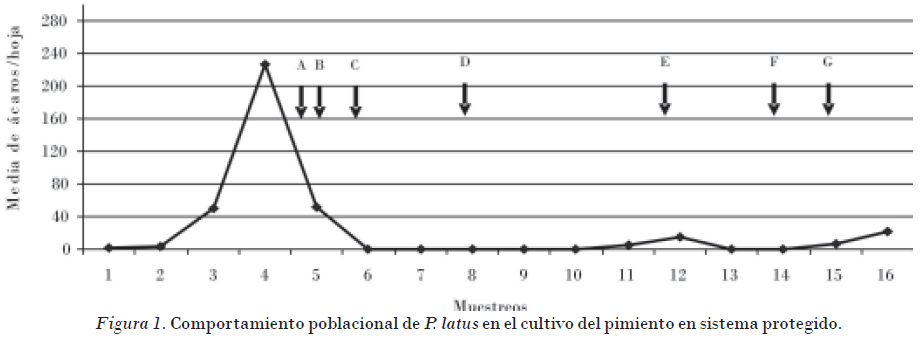
Polyphagotarsonemus latus is one of the main phytosanitary problems in protected crop of pepper (Capsicum annuum L.). Despite to the information lack about their incidence in these systems, population behavior of P. latus was studied in a protected crop house. House was divided in three sections and a total of 100 leaves were taken weekly. Attack intensity, distribution and an analysis of optimal sample number were determined. Mite populations were higher than application indexes from the second sampling. Dicofol 18.5 EC and abamectin 1.8 CE treatments decrease broad mite population but an incremental tendency was presented at the end of pepper crop cycle. The attack intensity and distribution of P. latus had similar behavior. Not significant differences in the P. latus adult population and inmature phases were detected in the three house sections, and it was determined that 65 leaves are enough to realize a satisfactory estimated of the total broad mite population. These results may be considered as possible modifications to Technical Instructive of Plant Health for Protected Crops of Higher Technology.
Article Details

This work is licensed under a Creative Commons Attribution-NonCommercial 4.0 International License.
Those authors who have publications with this journal accept the following terms of the License Attribution-NonCommercial 4.0 International (CC BY-NC 4.0):
You are free to:
- Share — copy and redistribute the material in any medium or format
- Adapt — remix, transform, and build upon the material
The licensor cannot revoke these freedoms as long as you follow the license terms.
Under the following terms:
- Attribution — You must give appropriate credit, provide a link to the license, and indicate if changes were made. You may do so in any reasonable manner, but not in any way that suggests the licensor endorses you or your use.
- NonCommercial — You may not use the material for commercial purposes.
- No additional restrictions — You may not apply legal terms or technological measures that legally restrict others from doing anything the license permits.
The journal is not responsible for the opinions and concepts expressed in the works, they are the sole responsibility of the authors. The Editor, with the assistance of the Editorial Committee, reserves the right to suggest or request advisable or necessary modifications. They are accepted to publish original scientific papers, research results of interest that have not been published or sent to another journal for the same purpose.
The mention of trademarks of equipment, instruments or specific materials is for identification purposes, and there is no promotional commitment in relation to them, neither by the authors nor by the publisher.
How to Cite
References
Almaguel, Lérida: «Ácaros de importancia económica en Cuba», Boletín Técnico no. 2, CID Inisav, La Habana, 1996.
Almaguel, Lérida; Nancy González; Orietta Fernández-Larrea; Elina Massó; Bárbara Roselló; María E. Márquez; E. Peña; Grisel Montero: «Utilización de Bacillus thuringiensis sobre ácaros en plátano, cítrico y papa», VIII Forum Nacional de Ciencia y Técnica, Palacio de Convenciones, La Habana, 5 de noviembre de 1993.
Casanova, A. S.; O. Gómez; M. Hernández; Maritza Chailloux; T. Depestre; F. R. Pupo; J. C. Hernández; V. Moreno; M. León; A. Igarza; C. Duarte; I. Jiménez; R. Santos; A. Navarro; A. Moreno; H. Cardozo; F. Piñeiro; N. Arozarena; L. Vilarno: Manual para la producción protegida de hortalizas, Instituto de Investigaciones Hortícolas Liliana Dimitrova, Ed. Liliana, Ministerio de la Agricultura, La Habana, 2006
CNSV: Instructivo técnico de sanidad vegetal para casas de cultivo protegido de alta tecnología. Minag-CNSV, La Habana, 1999.
––––: Programa de defensa fitosanitaria para las casas de cultivo protegido. Tomate, pimiento, melón y pepino, Minag, La Habana, 2002.
Coss-Romero, M.; J. E. Peña: «Relationship of Broad Mite (Acari: Tarsonemidae) to Host Phenology and Injury Levels in Capsicum annuum», Florida Entomol. 81:515-526, EE.UU., 1998.
Depestre, T.: Comunicación personal, Instituto de Investigaciones Hortícolas Liliana Dimitrova, 2006.
Gerson, U.; P. G. Weintraub: «Mites for the Control of Pests in Protected Cultivation», Pest Manag. Sci. 63(7):658-676, Inglaterra, 2007.
Peña, J. E: «Chemical Control of Broad Mite (Acarina: Tarsonemidae) in Limes (Citrus latifolia)», Proc. Fla. State Hort. Soc., 101:247-249, EE.UU., 1988.
Ramaker, P. M. J.; J. M. Rabasse: «Integrated Pest Management in Protected Cultivation», Novel Approches to Integrated Pest Management, Lewis Publisher, EE.UU., 1995, pp. 199-229.
Rodríguez, Mayra; L. Sánchez; L. Gómez; L. Hidalgo; E. González; M. Gómez; L. Díaz-Virulichi; A. Casanova; R. Cuadra; E. Fernández; R. Hernández: «Meloidogyne spp., plagas de las hortalizas: alternativas para su manejo en sistemas de cultivo protegido», Rev. Protección Veg. 20(1):1-10, La Habana, 2005.
Tal, Carmit; M. Coll; P. G. Weintraub: «Biological Control of Polyphagotarsonemus latus (Acari: Tarsonemidae) by the Predaceous Mite Amblyseius swirskii (Acari: Phytoseiidae)», IOBC/WPRS Bull. 30(5), Israel, 2007.
Weintraub, P. G.: «Integrated Control of Pests in Tropical and Subtropical Sweet Pepper Production», Pest. Manag. Sci. 63:753-760, Inglaterra, 2007.