
Comparación de la efectividad de insecticidas en el control del gusano barrenador del melón (Diaphania hyalinata (l.)) (lepidoptera: pyralidae)
Article Sidebar
Main Article Content
Abstract
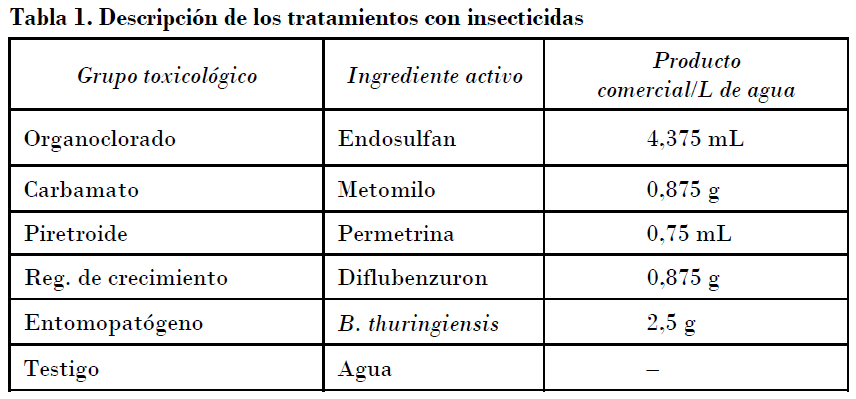
The efectiveness of commercial doses of two biorational insecticides, Bacillus thuringiensis var. kurstaki and diflubenzuron, and three neurotoxic insecticidas, endosulfan, methomyl and permetrin were compared for the control of Diaphania hyalinata under laboratory and field conditions Laboratory bioassays showed that neurotoxic insecticides caused 100% of larval mortality at 24 h after treatment. There were no significant differences among insecticides treatments at 48 h after their application. Field evaluations showed that there was significantly lower percentage (29.6%) of damaged leaves on diflubenzuron treated plants compare to that of the control plants. Plots treated with diflubenzuron and neurotoxic insecticides showed lower percentage of damaged fruits than those of the control plots. The yield components were not affected by D. hyalinata infestation. The biorational insecticides, particularly diflubenzuron, represent an excellent alternative to control D. hyalinata on cantaloupe melon crops.
Article Details

This work is licensed under a Creative Commons Attribution-NonCommercial 4.0 International License.
Those authors who have publications with this journal accept the following terms of the License Attribution-NonCommercial 4.0 International (CC BY-NC 4.0):
You are free to:
- Share — copy and redistribute the material in any medium or format
- Adapt — remix, transform, and build upon the material
The licensor cannot revoke these freedoms as long as you follow the license terms.
Under the following terms:
- Attribution — You must give appropriate credit, provide a link to the license, and indicate if changes were made. You may do so in any reasonable manner, but not in any way that suggests the licensor endorses you or your use.
- NonCommercial — You may not use the material for commercial purposes.
- No additional restrictions — You may not apply legal terms or technological measures that legally restrict others from doing anything the license permits.
The journal is not responsible for the opinions and concepts expressed in the works, they are the sole responsibility of the authors. The Editor, with the assistance of the Editorial Committee, reserves the right to suggest or request advisable or necessary modifications. They are accepted to publish original scientific papers, research results of interest that have not been published or sent to another journal for the same purpose.
The mention of trademarks of equipment, instruments or specific materials is for identification purposes, and there is no promotional commitment in relation to them, neither by the authors nor by the publisher.
How to Cite
References
Capinera, J. L.: «Melonworm (Diaphania hyalinata) Linnaeus (Insecta:Lepidoptera: Pyralidae)», Department of Entomology and Nematology. EENY-163, Institute of Food and Agricultural Sciences, University of Florida. EE.UU., 2000.
Desneux, N.; A. Decourtye; J. M. Delpuech: «The Sublethal Effects of Pesticidas on Beneficial Arthropods», Annual Review of Entomology 52:81-106, EE.UU., 2007.
Emmett, B. J.; B. M. Archer: «The Toxicity of Diflubenzuron to Honey Bee (Apis mellifera L.) Colonies in Apple Orchards», Plant Pathology 29(4):177-183, EE.UU., 1980.
FAO: «Diflubenzuron», World Health Organization, FAO. Data sheets on pesticides No. 77, http://www.inchem.org/documents/pds/pds/pest77_e.htm#1.0, 1996.
Grant, H. Y.: «Efecto de la toxicidad de Bacillus thuringiensis var. israeliensis para larvas de mosca Scatophaga sp. (Diptera: Scatophagidae) bajo condiciones de laboratorio», Memorias del XXXVI Congreso Nacional de Entomología y Fitopatología, ITESM, Querétaro, México, 2001, p. 186.
Joung, K. B.; J. C. Cote: «A Review of the Environmental Impacts of the Microbial Insecticide Bacillus thuringiensis», Technical Bulletin No. 29, Montreal, Canadá, 2000.
Lagunes T. A.; J. J. A. Villanueva: Toxicología y manejo de insecticidas, Colegio de Postgraduados, México, 1995.
Latorre, B. A.: Plagas de las hortalizas, FAO, Santiago de Chile, 1990, pp. 189-191.
Nejmanová, J.; J. Cvacka; I. Hrdy; J. Kuldova; J. Mertelik; A. Muck: «Residues of Diflubenzuron on Horse Chestnut (Aesculus hippocastanum) Leaves and Their Efficacy Against the Horse Chestnut Leafminer, Cameraria ohridella», Pest Management Science 62(3):274-278, 2006.
Rodríguez, A.: «Dinámica, control biológico y manejo de Diaphania hyalinata (L.) en el cultivo de la calabaza», Fitosanidad 8(1):59, Cuba, 2004.
Sánchez, R. M. Y.; B. H. L. Vargas; G. G. Sánchez: «Evaluación de dos variedades de Bacillus thuringiensis para el control de Diaphania hyalinata spp. (Lepidoptera:Pyralidae) en melón», Revista Colombiana de Entomología 25(1-2):17-21, 1999.
Schneider M. I.; G. Smagghe; A. Gobbi; E. Viñuela: «Toxicity and Pharmacokinetics of Insect Growth Regulators and Other Novel Insecticides on Pupae of Hyposoter didymator (Hymenoptera: Ichneumonidae), a Parasitoid of Early Larval Instars of Lepidopteran Pests», Journal of Economic Entomology 96(4):1054-1065, 2003.
Soria, F. M; J. M. Tun., A. T. Trejo; R. Terán: Tecnología para producción de hortalizas a cielo abierto en la península de Yucatán, CIGA-ITA no. 2, Conkal, Yucatán, México, 1996.