
Efecto antialimentario de Melia azedarach l. en dos especies de insectos fitófagos (lepidoptera: noctuidae)
Article Sidebar
Main Article Content
Abstract
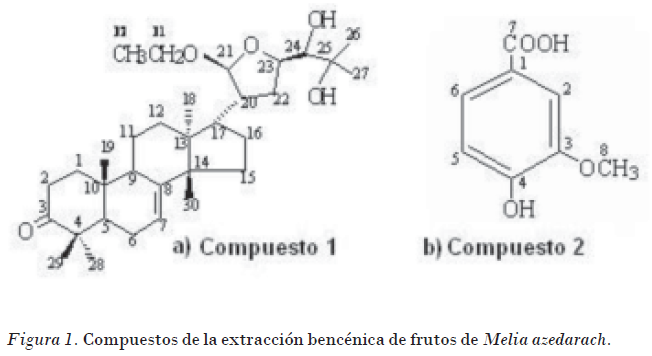
Dried and ground fruits of Melia azedarach L. plant, from Meliaceae family, were extracted with ethyl acetate. The resulting crude of ethyl acetate (T1) was fractionated later with benzene to obtain both the benzene and non benzene crude (T2 and T3, respectively), and the antifeeding effect of the extracts was tested on Spodoptera frugiperda and Mocis latipes (Lepidoptera: Noctuidae) larvae using the conventional leaf disks method and, in each case, the food acceptance coefficients (fd) were calculated. The greater antifeedant effect of the extracts on the two species of insects was observed in benzene extract T2. There was also investigated the antifeedant activity of 21bethoxymelianodiol and 3-methoxy-4-hydroxybenzoic acid which were obtained from benzenic crude (T2). Hidroxibenzoic compound presented good activity, and got to diminish larvae feeding in 80.3% to the second day of the test.
Article Details

This work is licensed under a Creative Commons Attribution-NonCommercial 4.0 International License.
Those authors who have publications with this journal accept the following terms of the License Attribution-NonCommercial 4.0 International (CC BY-NC 4.0):
You are free to:
- Share — copy and redistribute the material in any medium or format
- Adapt — remix, transform, and build upon the material
The licensor cannot revoke these freedoms as long as you follow the license terms.
Under the following terms:
- Attribution — You must give appropriate credit, provide a link to the license, and indicate if changes were made. You may do so in any reasonable manner, but not in any way that suggests the licensor endorses you or your use.
- NonCommercial — You may not use the material for commercial purposes.
- No additional restrictions — You may not apply legal terms or technological measures that legally restrict others from doing anything the license permits.
The journal is not responsible for the opinions and concepts expressed in the works, they are the sole responsibility of the authors. The Editor, with the assistance of the Editorial Committee, reserves the right to suggest or request advisable or necessary modifications. They are accepted to publish original scientific papers, research results of interest that have not been published or sent to another journal for the same purpose.
The mention of trademarks of equipment, instruments or specific materials is for identification purposes, and there is no promotional commitment in relation to them, neither by the authors nor by the publisher.
How to Cite
References
Ascher, K. R. S.; H. Schmutterer; C. P. W. Zebitz; S. N. H. Naqvi: The Persian Lilac or Chinaberry Tree: Melia azedarach L. Source of Unique Natural Products for Integrated Pest Management, Medicine, Industry and other Purposes, 605-642, Alemania, 1995.
Back, T. G.; R. P. Pharis: «Struture-Activity Studies of Brassinosteroids and the Search for Novel Analogues and Mimetics with Improved Bioactivity», J. Plant Growth Regul., 22:350-361, EE.UU., 2003.
Carpinella, M. C.; M. T. Defago; G. Valladares; S. Palacios: «Antifeedant and Insecticide Properties of a Limonoid from Melia azedarach (Meliaceae) with Potencial Use for Pest Management», J. Agric.Food Chem. 51:369-374, EE.UU., 2003.
Jiménez, A; C. Villareal; A. R. Toscano; M. Cook; T.J. Arnason; R. Bye; R. Mata: «Limonoids from Swietenia humilis and Guarea grandiflora (Meliaceae)», Phytochemistry 49 (7):1981-1988, EE.UU., 1998.
Koul, O.; J. S. Multani; G. Singh; S. Wahab: «Bioefficacy of Toosendanin from Melia dubia (syn. M. azedarach) Against Gram Pod-borer, Helicoverpa armigera (Hübner)», Current Science 83(11):1387-1391, India, 2002.
Marongiu, B.; S. Porcedda; A. Caredda; A. Piras: «Isolation of Juniperus phoenicea Volatiles by Supercritical Carbon Dioxide Extraction and Bioactivity Assays», J. Essent. Oil Res. 16:256-261, EE.UU., 2004.
Mikolajczak, K. L.; D. K. Reed: «Extractives of Seeds of Meliaceae: Effects on Spodoptera frugiperda (J. E. Smith), Acalymma vittatum (F.) and Artemia salina Leach.», Journal of Chemical Ecology, 13 (1): 99-110, EE.UU., 1987.
Morgan, E. D.: The Place of Neem Among Modern Natural Pesticides, Neem: Today and in the New Millennium, Kluwer Ac. Pub., Países Bajos, 2004, pp. 21-32.
Nathan, S. S.: «Effects of Melia azedarach on Nutritional Physiology and Enzyme Activities of the Rice leaffolder Cnaphalocrosis medinalis (Guenée) (Lepidoptera: Pyralidae)», Pesticide Biochemistry and Physiology 84:98-108, Inglaterra, 2006.
Ortiz, Y.; I. Spengler; R. Avilés; C. Pérez; Y. Rodríguez: «21ßetoximelianodiol, un protolimonoide novedoso aislado de los frutos de una especie cubana de Melia azedarach L.», Afinidad 61:511, España, 2004.
Pérez, M. A; R. Ocete, M. Lara: «Ensayos sobre la actividad antialimentaria de un extracto etanólico de hojas de Daphne gnidium L. frente a cuatro especies de insectos», Bol. San. Veg. Plagas, 18:435-440, España, 1992.
Rivera, A. M. M.; C. C. Guerra.; M. M. Figueredo.; R. R. Gálvez; R. A. O. Velazco: «Efecto de plaguicidas de origen botánico sobre el áfido Carolinaia cyperi Ainslie», Rev Cubana Plant Med. 8(3), 2003 (disponible en http://scielo.sld.cu).
Roig, J. T.: Plantas medicinales, aromáticas o venenosas de Cuba, Ciencia y Técnica, Instituto del Libro, La Habana, 1974.
Schröeder, D. R.; N. Koji: «A Simplified Isolation Procedure for Azadirachtin», Journal of Natural Products 50(2):241-44, EE.UU.,1987.
Siddiqui, B. S.; M. Rasheed; S. Faizia; S. A. Tariq.; M.T. Raiput; N. S. Naqvi: «Transformation of Azadiradione to Nimbocinol and 17-Hydroxynimbocinol, and Structure Pesticidal-Activity Relationship of Triterpenoids isolated from Azadirachta indica A. Juss. (Neem)», Helvetica Chimica Acta 86: 3342-3353, Suiza, 2003.
Simmonds, M. S. J.; A. P. Jarvis; S. Johnson; G. R. Jones; E. D. Morgan: «Comparison of Anti-feedant and Insecticidal Activity of Nimbin and Salannin Photo-Oxidation Products with Neem (Azadirachta indica) Limonoids», Pest Management Science 60:459-464, EE.UU., 2004.