
Estudio preliminar de la asociación Psyllobora nana Mulsant y mildiu en cultivos de plantas medicinales, condimenticias y otras en Cuba
Article Sidebar
Main Article Content
Abstract
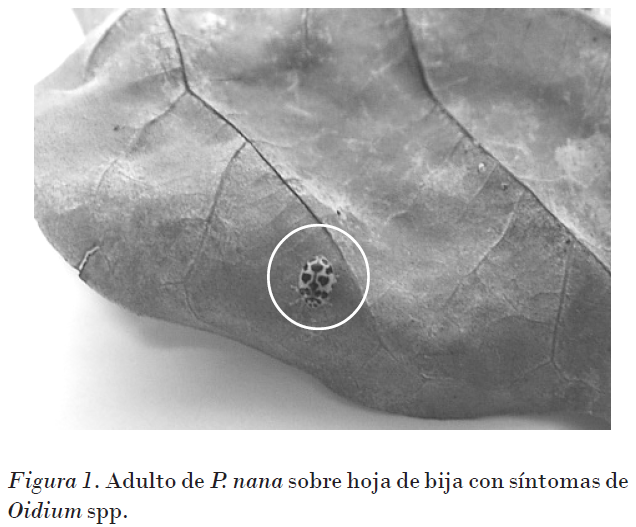
Inspections and collections in 14 medicinal plants present in six provinces of Cuba were carried out. The intensity of Oidium symptoms and the abundance of Psyllobora nana Mulsant were noted. A data matrix was conformed with the data of cultivations, localities, abundance of P. nana and pathogen intensity and a factorial analysis of correspondence was made to determine the level of association between the variables abundance of P. nana respect to pathogen intensity. Micophagous action of P. nana on fungus Oidium sp. in Bixa orellana L., Matricharia recutita L. Eryngium foetidium L., Stachytarpheta jamaicensis (L.) Vahl., Helianthus annuus L. and Vigna unguiculata L. is reported for the first time in Cuba. It was verified that exists a high level of association between the abundance of P. nana and the intensity of the disease infestation.
Article Details

This work is licensed under a Creative Commons Attribution-NonCommercial 4.0 International License.
Those authors who have publications with this journal accept the following terms of the License Attribution-NonCommercial 4.0 International (CC BY-NC 4.0):
You are free to:
- Share — copy and redistribute the material in any medium or format
- Adapt — remix, transform, and build upon the material
The licensor cannot revoke these freedoms as long as you follow the license terms.
Under the following terms:
- Attribution — You must give appropriate credit, provide a link to the license, and indicate if changes were made. You may do so in any reasonable manner, but not in any way that suggests the licensor endorses you or your use.
- NonCommercial — You may not use the material for commercial purposes.
- No additional restrictions — You may not apply legal terms or technological measures that legally restrict others from doing anything the license permits.
The journal is not responsible for the opinions and concepts expressed in the works, they are the sole responsibility of the authors. The Editor, with the assistance of the Editorial Committee, reserves the right to suggest or request advisable or necessary modifications. They are accepted to publish original scientific papers, research results of interest that have not been published or sent to another journal for the same purpose.
The mention of trademarks of equipment, instruments or specific materials is for identification purposes, and there is no promotional commitment in relation to them, neither by the authors nor by the publisher.
How to Cite
References
Acosta, O.; J. L. Armas; M. D. Ariosa; M. de los Ríos; R. Méndez; M. Santos: «Manejo integrado de plagas en plantas medicinales, aromáticas y condimenticias», Instructivo Técnico, Fitosanidad, Boletín no. 2, sept., Minagri, Cuba, 1998.
Castaño, J.; L. del Río: Guía para el diagnóstico y control de enfermedades en cultivos de importancia económica, Zamorano Academia Press, Escuela Agrícola Panamericana Zamorano, Honduras, 1994.
Cruz, B.; M. González; L. Soto: «Psyllobora nana (Coleoptera: Coccinellidae) controlador biológico del mildiu polvoriento», Ciencias de la Agricultura no. 36, 1989.
Cruz, B.; María L. Chiang; R. F. Castañeda: «Psyllobora nana (Coleoptera: Coccinellidae) controlador biológico», Ciencias de la Agricultura. No. 40, 168 p. 1990.
Duke, J.: «Phytochemical Database USDA-ARS-NGRL», Beltsbille Agricultural Research Center. Beltsbille, Maryland, http://www.ars.grin.gov/cgl-bin/duke/ethnobot.pl. 1998.
English-Loeb, G.; A. P. Norton; D. M. Gadoury; R. C. Seem; W. F. Wilcox: «Control of Powdery Mildew in Wild and Cultivated Grapes by a Tydeid Mite», Biological Control 14 (2):97-103, February 1999.
Farr, D. F.; Bills G. F.; Chamuris G. P. A.; Y. Rossman: Fungi on Plant and Plant Products in the United States, Second Printing, APS Press. St. Paul, Minnessota, 1995, p. 1013.
Fitomed: Base de Datos de Plantas Medicinales del Ministerio de Salud Pública (Minsap), http://www.infomed.sld.cu/fitomed/alb.html. 1998.
Gordon, R.: «North American Coccinellidae», Journal of the New York Entomological Society 93 (1):912, 1985.
Howard, J.; R. F. Mizell: «Common Name: Ladybirds, Ladybird Beetles, Lady Bugs (of Florida)», Universidad de la Florida, Deparment of Agriculture and Consumer Services, Featured Creatures. April, 2002, http://creatures.ifas.ufl.edu/beneficial/lady_beetles.htm [consultado: septiembre, 2005].
Marshall, S.: «Coccinellidae - The Ladybeetles», October, 2001. http://www.uoguelph.ca/~samarsha/lady-beetles.htm [consultado: septiembre, 2005].
Pérez, Yamilka; Danay López; María Ofelia López: «Nuevos hospedantes para la familia Erysiphaceae en Cuba», Fitosanidad 9 (1):73, 2005.
Roig, J. T.: Plantas medicinales, aromáticas o venenosas de Cuba, t. I y II, Ed. Científico-Técnica, La Habana, 1988.
Sahaza, D. P.: «El achiote (Bixa orellana L.)», http://www.unalmed.edu.co/~crsequed/ACHIOTE.htm [consulta: junio, 1999].
Sandoval, Ileana et al.:. «Plagas y enfermedades de las plantas ornamentales». Informe final de proyecto. Presentado al Comité de Expertos del Programa Desarrollo de Plantas Ornamentales, Inisav, 2005.
Scull, R.; M. Miranda; R. E. Infante: «Plantas medicinales de uso tradicional en Pinar del Río. Estudio etnobotánico I», http://www.sld.cu/revistas/far/far09198.htm, Rev. Cubana de Farm., vol. 32 (1):57-62, 1998.
StatSoft, Inc.: Statistica versión 6, 2003.