
Control químico y epidemiología de la mancha foliar del chile habanero (Capsicum chinense jacq.) en Yucatán, México
Article Sidebar
Main Article Content
Abstract
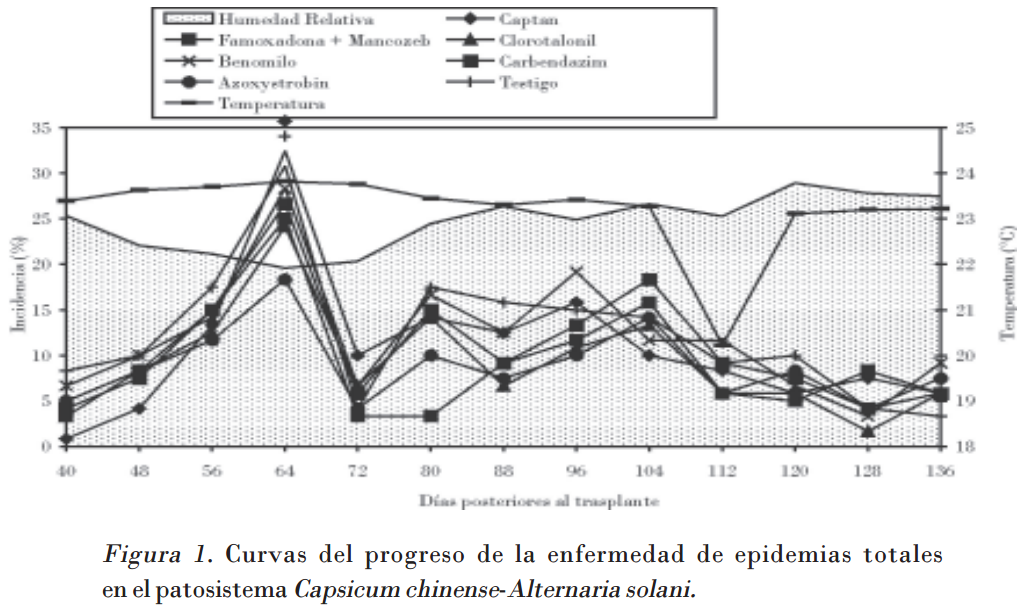
Alternaria solani Jones & Grout was identified as leave strain agent in hot pepper (Capsicum chinense Jacq.). In order to control it, contact fungicides captan, famoxodona+mancozeb and clorotalonil, and systemic benomil, carbendazim and azoxystrobin with a control not applied were tested. Disease intensity was measured through epidemiological parameters, fruits production, fruits weight, dried matter and plant height were also determined. Curves elaboration permitted the adjustment to Weibull model and lower perceptible infection rates in the famoxadona+mancozeb and azoxystrobin treatments with 0.007268 and 0.006159 unit/day respectively were estimated through the b-1 inverse parameter. The same treatments permitted the lower AUDPC with 308.1 and 242.5 %/day, respectively. In contrast, clorotalonil showed a Yfinal with 20.75%, this permitted the lowest incidence at the end of the culture. Treatments that obtained the higher amount and weight of fruits per experimental unit were those that inhibit in a higher percentage the disease development.
Article Details

This work is licensed under a Creative Commons Attribution-NonCommercial 4.0 International License.
Those authors who have publications with this journal accept the following terms of the License Attribution-NonCommercial 4.0 International (CC BY-NC 4.0):
You are free to:
- Share — copy and redistribute the material in any medium or format
- Adapt — remix, transform, and build upon the material
The licensor cannot revoke these freedoms as long as you follow the license terms.
Under the following terms:
- Attribution — You must give appropriate credit, provide a link to the license, and indicate if changes were made. You may do so in any reasonable manner, but not in any way that suggests the licensor endorses you or your use.
- NonCommercial — You may not use the material for commercial purposes.
- No additional restrictions — You may not apply legal terms or technological measures that legally restrict others from doing anything the license permits.
The journal is not responsible for the opinions and concepts expressed in the works, they are the sole responsibility of the authors. The Editor, with the assistance of the Editorial Committee, reserves the right to suggest or request advisable or necessary modifications. They are accepted to publish original scientific papers, research results of interest that have not been published or sent to another journal for the same purpose.
The mention of trademarks of equipment, instruments or specific materials is for identification purposes, and there is no promotional commitment in relation to them, neither by the authors nor by the publisher.
How to Cite
References
Barnett, L. H.; B. B. Hunter: Illustrated Genera of Imperfect Fungi, 4th ed., Ed. Burguess Publishing company. Minnesota, 1998.
Bauer, María de L.: Fitopatología, Ed. Limusa-Noriega, Colegio de Postgraduados, Montecillo, México. 1992.
Campbell, C. L.; L. V. Madden: Introduction to Plant Disease Epidemiology, John Wiley & Soons, Inc. New York, E.U., 1990.
CIP: «Early Blight on Potato and Tomato Disease Management», Centro Internacional de la Papa, htpp://www.cipotato.org/gilb/Pubs/ALAP_LB_TOC/alap_th2.htm. 1997 (consultado: 15/08/2005).
Gómez, R. O.: «Efectos microclimáticos y fisiológicos de la asociación con Tagetes erecta en el proceso infectivo y daño por Alternaria solani en jitomate». Tesis de Doctor en Ciencias en Fitopatología, Colegio de Postgraduados, Montecillo, México, 2001, pp. 12-18.
Kranz, J.: Epidemic of Plant Disease: Mathematical Analysis and Second Completely, revised edition, Spring-Verlag, New York, 1990.
Mendoza, Z. C.: Diagnóstico de enfermedades fungosas, Departamento de Parasitología Agrícola, Ed. Universidad Autónoma Chapingo, Chapingo, México, 1999.
Mora, L. F.: «Guía de producción de chile picante», Laboratorios Griffith, San José, Costa Rica, 1998.
Pennypeker, S. P.; H. D. Knoble; C. D. Antle; L. V. Madden: «A Flexible Model for Studying Plant Disease Progression». Phytopathology 70:232-235, 1980.
Rotem, J.: The Genus Alternaria. Biology, Epidemiology and Pathogenicity, APS Press, Minnesota, E.U., 1994.
Sánchez, B. M. A.: «Diagnóstico y control químico del tizón foliar en el crisantemo (Chrysanthemum moriflorum Ramat Kitamura.) en Yucatán, México». Tesis de Maestría en Ciencias en Horticultura Tropical, Instituto Tecnológico Agropecuario no. 2, Subdirección de Investigación y Graduados Agropecuarios, Conkal, Yucatán, México, 2003.
Soria, M. J. F.; J. M. S. Tun; R. A. Trejo; S. R. Terán: «Paquete tecnológico para la producción de chile habanero (Capsicum chinense Jacq.)», Ed. SEP-DGETA, Instituto Tecnológico Agropecuario no. 2, Conkal, Yucatán, México, 2002.
“Stevenson, R. E.; S. P. Pennypacker: «Effect of Radiation, Temperature, and Moisture on Conidial Germination of Alternaria solani», Phytopathology 78:926-930, 1988.
Thal, W. M.; C. L. Campbell; L. V. Madden: «Sensibity of Weibull Model Parameters Estimates to Variation in Simulated Disease Progression Data», Phytopathology 74:1425-1430, 1984.
Tun, D. J. C.: «Chile habanero, características y tecnología de producción», INIFAP-Produce, Mérida, Yucatán, México, 2001, pp. 13-24.