
Aislamiento, selección e identificación de bacterias del género Bacillus antagonistas de Pectobacterium carotovorum
Article Sidebar
Main Article Content
Abstract
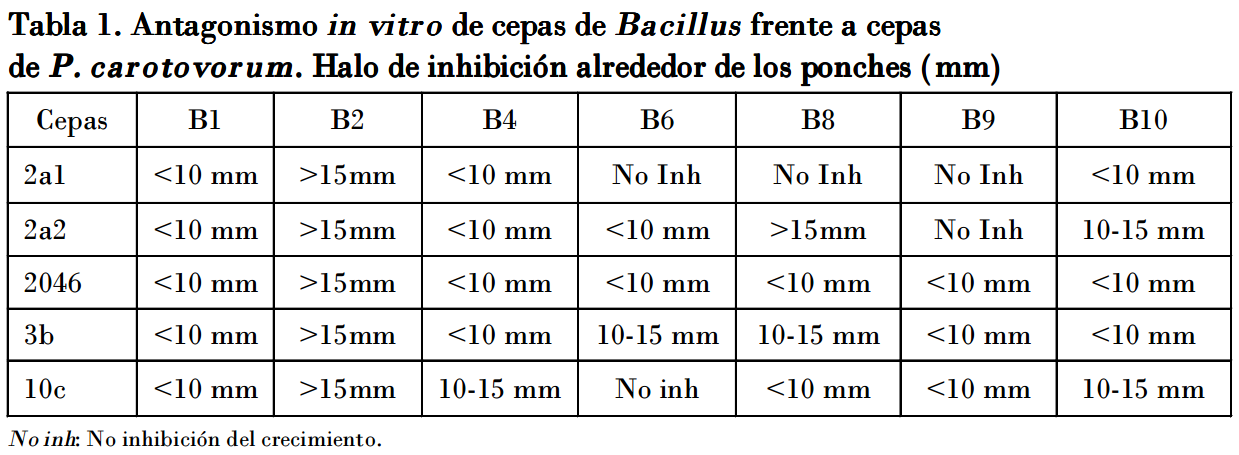
Soil bacterias belonging to the genera Bacillus were isolated and screened for antagonism in vitro against Pectobacterium carotovorum, causal agent of potato soft rot, using the diffusion in agar method. The isolated strains that showed antagonistic effect were identified until species by means of conventional biochemical tests. A total of 98 bacterial strains were obtained, so only seven of them inhibited growth of at least one of the P. carotovorum strains analyzed. B1 and B9 strains were identified as Bacillus licheniformis, B4 and B10 as Paenibacillus polymyxa and B2 as Brevibacillus laterosporus; while B6 and B8 strains were reported in this study as Bacillus sp. Strain B2 was the best aspirant for biological control agent due to the antagonistic activity shown against all the P. carotovorum strains used in this study.
Article Details

This work is licensed under a Creative Commons Attribution-NonCommercial 4.0 International License.
Those authors who have publications with this journal accept the following terms of the License Attribution-NonCommercial 4.0 International (CC BY-NC 4.0):
You are free to:
- Share — copy and redistribute the material in any medium or format
- Adapt — remix, transform, and build upon the material
The licensor cannot revoke these freedoms as long as you follow the license terms.
Under the following terms:
- Attribution — You must give appropriate credit, provide a link to the license, and indicate if changes were made. You may do so in any reasonable manner, but not in any way that suggests the licensor endorses you or your use.
- NonCommercial — You may not use the material for commercial purposes.
- No additional restrictions — You may not apply legal terms or technological measures that legally restrict others from doing anything the license permits.
The journal is not responsible for the opinions and concepts expressed in the works, they are the sole responsibility of the authors. The Editor, with the assistance of the Editorial Committee, reserves the right to suggest or request advisable or necessary modifications. They are accepted to publish original scientific papers, research results of interest that have not been published or sent to another journal for the same purpose.
The mention of trademarks of equipment, instruments or specific materials is for identification purposes, and there is no promotional commitment in relation to them, neither by the authors nor by the publisher.
How to Cite
References
Abdel-Alim, A.; M. Mikhail; P. Laux; W. Zeller: «Biological Control of Erwinia carotovora subsp. carotovora on Potatoes by Fluorescent Pseudomonads and Bacillus subtilis», IOBC Wprs Bulletin 25:139-144, 2001.
Földes, T.; I. Banhegyi; Z. Varga; J. Szageti: «Isolation of Bacillus Strains from the Rhizosphere of Cereals and in Vitro Screening for Antagonism Against Phytopathogenic, Food-Borne Pathogenic and Spoilage Microorganisms», Journal of Applied Microbiology 89:840-845, 2000.
Huck, T.; N. Porter; M. Bushell: «Positive Selection of Antibiotic Producing Soil Isolates», Journal of General Microbiology 137:2321-2329, 1991.
Justo de Oliveira, E.; L. Ravinivitch; R. Gomes; L. Konovaloff; J. Passos; V. Zahner: «Molecular Characterization of Brevibacillus laterosporus and Its Potential Use in Biological Control», Applied and Environmental Microbiology 70:6657-6664, 2004.
Kharbanda, D.: «Paenibacillus polymyxa Strain ATCC 202127 for Biocontrol of Bacteria and Fungi», Patent 6602500, Estados Unidos, 2003.
Kucharek, T.; J. Bartz: «Bacterial Soft Rot of Vegetables and Agronomic Crops», Plant Pathology Fact Sheet 2:12-18, 2000.
Lucas, A.:«Effect of Inoculation of Bacillus licheniformis on Tomato and Pepper», Agronomie 24:169-176, 2004.
Marahiel, M.; M. Nakano; P. Zabar: «Regulation of Peptide Antibiotic Production in Bacillus», Molecular Microbiology 7:631-636, 1993.
Montealegre, J.; R. Reyes; L. Pérez; R. Herrera; P. Silva; X. Besoain: «Selection of Bioantagonistic Bacteria to Be Used in Biological Control of Rhizoctonia solani in Tomato», Electronic Jounal of Biotechnology 6(2), 2003.
Pérez, N.: «Control biológico de patógenos vegetales», Manejo ecológico de plagas, cap. 7, Ed. Agustín García, 231-247, 2004.
Pérombelon, M.; G. Salmond: «Bacterial Soft Rots», Pathogenesis and Host Specificity in Planta Diseases, vol. 1, Prokariotes, Oxford, Pergamon, Inglaterra, 1995, pp. 1-20.
Sharga, B.; G. Lyon: «Bacillus subtilis BS 107 As an Antagonist of Potato Blackleg and Soft Rot Bacteria», Canadian Journal of Microbiology 44:777-783, 1998.
Shoda, M.: «Bacterial Control of Plant Diseases», Journal of Bioscience and Bioingeniery 89:515-521, 2000.
Sneath, P. H. A.: «Section 13: Endospore-Forming Gram-Positive Rods and Cocci», Bergey´s Manual of Systematic Bacteriology, vol. 2, Williams & Wilkins, 1986, pp.1104-1207.
Timmusk, S.: «Mechanism of Action of the Plant Growth Promoting Bacterium Paenibacillus polymyxa», Commprehensive Summaries of Uppsala Disertations from the Faculty of Science and Technology, 2003.
Todar, K.: The Genus Bacillus, Department of Bacteriology, University of Wisconsin-Madison, 2003.
Toth, I.; K. Bell; M. Choleva; P. Birch: «Soft Rot Erwiniae: from Genes to Genomes», Molecular Plant Pathology 4:17-30, 2003.
Whipps, J.: «Microbial Interaction and Biocontrol in the Rhizosphere», Journal of Experimental Botany 52:487-511, 2001.
Yap, M.; J. Barak; A. Charkowsk: «Genimic Diversity of Erwinia carotovora subsp. carotovora and Its Correlation with Virulence», Applied and Environmental Microbiology 70:3013-3023, 2004.