
Effect of chitosan salts in post-harvest quality guava Enana Roja Cubana E. E. A.18-40
Article Sidebar
Main Article Content
Abstract
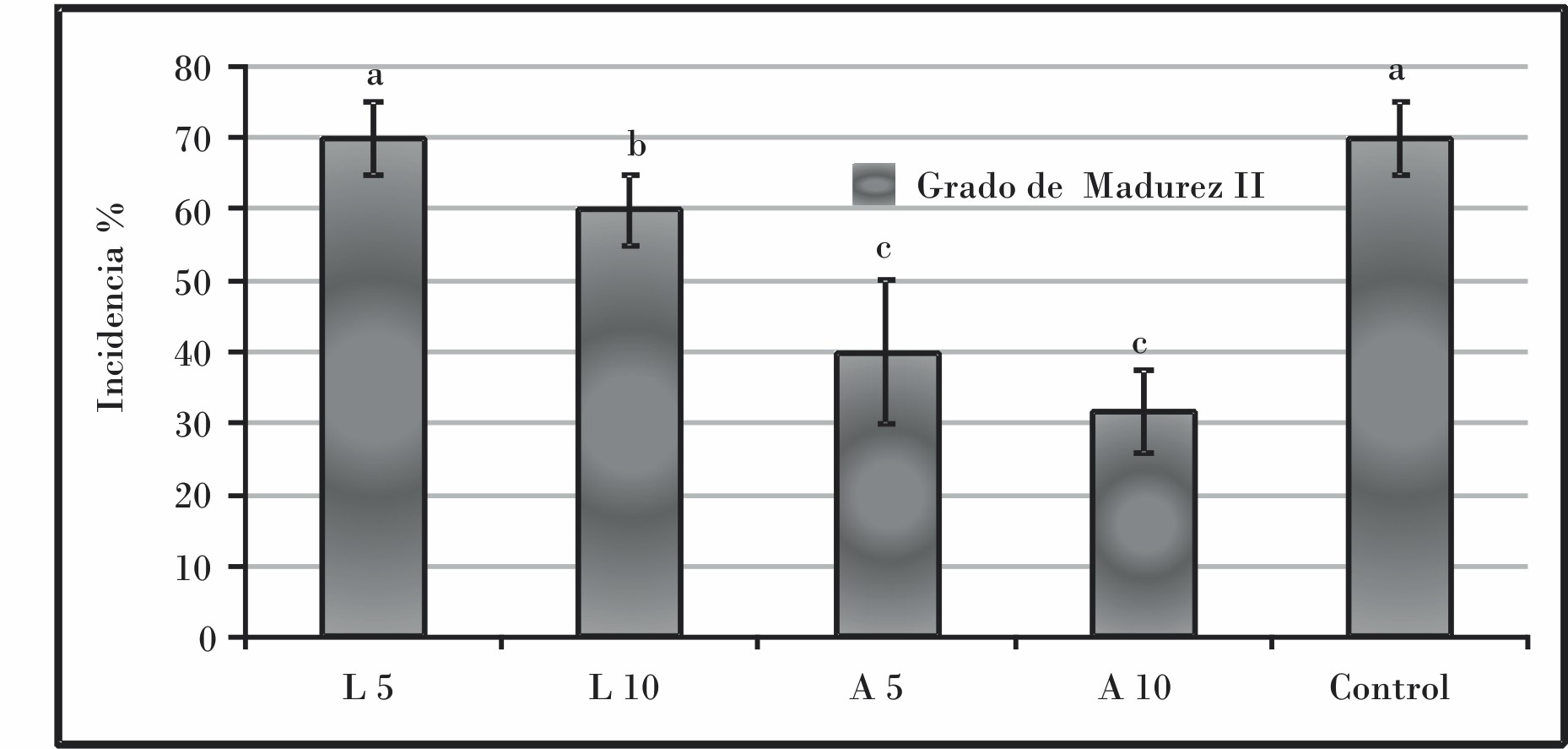
Guava is fruit highly perishable and affected by anthracnose disease in postharvest. Chitin is a biopolymer abundant in the exoskeleton of crustaceans and molluscs. It has fungicidal properties and the ability to form films. The aim of this study was to evaluate of lactate and acetate chitosan salts at 5 g • L-1 and 10 g • L-1 in guava fruits Enana Roja E. E. A. 18-40 harvested with physiological maturity and stored at 16 ºC ± 1 ° C or eight days on the control of anthracnose and matury index. It was determined the incidence anthracnose (%), the effectiveness of treatments in the control of the disease (%), loss of fresh mass (%), firmness of the mesocarp (kgf), total soluble solids (ºBrix), titratable acidity (%), maturity index (SST/acidity). The salts contributed to lower incidence by anthracnose, with acetate showed greater effectiveness in the control of the disease. The fresh mass losses were significantly lower to the control with lactate 5 g L-1 and acetate 10 g • L-1. With the application of the two salts, fruits had greater firmness, as well as the SST and acidity did not show significant differences to the control. The maturity index of fruits with lactate 5 g • L-1 was significantly lower than the rest of the treatments. The results showed the positive effect of the chitosan salts in the quality and delay of the ripening of the fruits, and the perspectives of the application of this biostimulant in the postharvest of the guava.
Article Details

This work is licensed under a Creative Commons Attribution-NonCommercial 4.0 International License.
Those authors who have publications with this journal accept the following terms of the License Attribution-NonCommercial 4.0 International (CC BY-NC 4.0):
You are free to:
- Share — copy and redistribute the material in any medium or format
- Adapt — remix, transform, and build upon the material
The licensor cannot revoke these freedoms as long as you follow the license terms.
Under the following terms:
- Attribution — You must give appropriate credit, provide a link to the license, and indicate if changes were made. You may do so in any reasonable manner, but not in any way that suggests the licensor endorses you or your use.
- NonCommercial — You may not use the material for commercial purposes.
- No additional restrictions — You may not apply legal terms or technological measures that legally restrict others from doing anything the license permits.
The journal is not responsible for the opinions and concepts expressed in the works, they are the sole responsibility of the authors. The Editor, with the assistance of the Editorial Committee, reserves the right to suggest or request advisable or necessary modifications. They are accepted to publish original scientific papers, research results of interest that have not been published or sent to another journal for the same purpose.
The mention of trademarks of equipment, instruments or specific materials is for identification purposes, and there is no promotional commitment in relation to them, neither by the authors nor by the publisher.
How to Cite
References
Abbott, W. S. 1925. “A method of compoting the effectiveness of on insecticide”. Journal Economic Entomology. 18:267-267.
Achipiz, S.; Castillo, A.; Mosqueda, S.; Hoyos, J 2013. “Efecto de recubrimiento a base de almidón sobre la maduración de la guayaba (Psidium guajava)”. Biotecnología en el Sector Agropecuario y Agroindustrial. Edición Especial (2):92-100.
Ayala, A.; Colina, M.; Molina, J.; Vargas, J.; Rincón, D.; Medina, J.; Rosales, L.; Cárdenas, H. 2014. “Evaluación de la actividad antifúngica del quitosano contra el hongo Mycosphaerella Fijiensis Morelet que produce la Sigatoka negra que ataca el plátano”. Revista Iberoame- ricana de Polímeros. 15(6):312-338.
Bautista-Baños, S.; Ventura-Aguilar, R. I.; Correa-Pacheco, Z.; Corona-Rangel, M. L. 2017. “Quitosano: un polisacárido antimicrobiano versátil para frutas y hortalizas en poscosecha. Una revisión”. Revista Chapingo Serie Horticultura. XXIII (2):103-121.
Benhabiles, M.; Salah, R.; Lounici, H.; Drouiche, N.; Goosen, M.; Mameri, N. 2012. “Antibacterial activity of chitin chitosan and its oligomers prepared from shrimp shell waste”. Food Hydrocolloids 29(1):48-56.
Bello-Lara, J.; Balois-Morales, R.; Juárez-López, P.; Alia-Tejacal, I.; Peña-Valdivia, C.; Jiménez-Zurita, J.; Sumaya-Martínez, M.; Jiménez-Ruiz, E. 2016. “Coatings based on starch and pectin from (‘Pear’ banana (Musa ABB), and chitosan applied to postharvest ‘Ataulfo’ mango frui”. Revista Chapingo Serie Horticultura. 22(3):209-218.
Berúmen, G.; Coronado, L.; Ochoa, V.; Chacón, M.; Gutiérrez, P. 2015. “Efecto del quitosano en la inducción de resistencia contra Colletotrichum sp. en mango (Mangifera indica L.) cv. Tommy Atkins”. Investigación y Ciencia de la Universidad Autónoma de Aguas Calientes. (66):16-21.
Cechim, F. 2014. “Quitosana na indução de resistência e controle in vitro de mofo cinzento, podridão parda e podridão amarga. Câmpus Pato Branco, Brasil: Universidade Tecnológica Federal do Paraná”, Tese apresentada ao Programa de Pós-Graduação em Agronomia, como requisito parcial à obtenção do título de Doutor. http://WWW. repositorio.utfpr.edu.br/.../PB_PPGAG_D_Cechim, Consultado el 5 de septiembre de 2016.
Coronado, L.; Chávez, M.; Chacón, M.; Gutiérrez, P. 2017. “Efecto del quitosano para el control in vitro de Colletotrichum sp aislado de mango (Mangifera indica L.) cv. Tommy Atkins”. Biotecnología y Sustentabilidad, año II (1):72-77.
Dutta, P.; Tripathi, S.; Mehrotra, G.; Dutta, J. 2009. “Perspectives for chitosan based antimicrobial films in food applications”. Food Chemistry. 114(4):1173-1182.
El-Eleryan, E. 2015. “Effect of chitosan and green tea on the quality of Washington Navel orange during cold storage”. American Journal Plant Physiology 10(1):43-54.
El-Sayed, M.; Hassan, M. 2015. “Decay of Guava Fruit (Psidium guajava L.) Quality Caused by Some Mold Fungi”. Journal of Agricultural Technology 11(3):713-730.
Fischer, H.; Da Silva, B. L.; Soares, A. R. 2012. “Efeito de fungicidas e produtos alternativos no controle da antracnose e da pinta preta da goiaba Semina”. Ciências Agrárias Londrina. 33, suplemento 1: 2753-2766.
Gutiérrez, N., Dussan, S.; Castro, J. 2012. “Fisiología y atributos de calidad de la guayaba ‘pera’ (Psidium guajava cv.) en poscosecha”. Revista de Ingeniería (37):26-30.
Hong, K.; Xie, J.; Zhan, L.; Sun, D.; Gong, D. 2012. “Effects of Chitosan Coating on Postharvest life and Quality of Guava (Psidium guajava L.) Fruit during Cold Storage”. Scientia Hort .144:172-178.
Instituto de Investigaciones en Fruticultura Tropical (IIFT), 2011. “Instructivo técnico para el cultivo de la guayaba”. La Habana, Cuba, Comité Editorial IIFT, 38 p.
Kong, M.; Chen, X.; Xing, K.; Park, H. 2010. Antimicrobial properties of chitosan and mode of action: A state of the art review. International Journal of Food Microbiology 14(1):51-63.
Kumar, A.; Singh, O.; Kohli, K. 2017. “Post-harvest changes in functional and sensory properties of guava (Psidium guajava L. cv. Pant Prabhat) fruits as influenced by different edible coating”. Journal of Pharmacognosy and Phytochemistry 6(6):1109-1116.
Martínez, L.; Maqueira, L.; Nápoles, M.; Núñez, M. 2017. “Efecto de bioestimulantes en el rendimiento de dos cultivares de frijol (Phaseolus vulgaris L.) biofertilizados”. Cultivos Tropicales. 38(2):113-118.
Merida, M.; Palmateer, A. 2017. “Florida Plant Disease Management Guide: Guava (Psidium guajava)”. http://edis.ifas.ufl.edu/pdffiles/PG/ PG13300.pdf. Consultado 17 de octubre 2018.
Mulkay, T.; Paumier, A.; González, J.; González, I. 2016. “Efecto de sales de quitosana sobre Colletotrichum gloeosporioides (Penz.) Penz. & Sacc. aislado de la antracnosis del mango”. CitriFrut. 33(1) enero-junio:46-51.
Parambir, K.; Brar, J.; Gill, K. 2017. “Response of guava fruits to post harvest treatments of ‘chitosan’ under cold and ambient storage conditions”. International Journal of Science, Environment and Technology 6 (3):1948-1955.
Paumier, A.; Súarez, M.; Mulkay, T. 2018. “Defectos de mayor incidencia que deterioran la calidad comercial en frutas de guayaba (Psidium guajava L.) Enana Roja Cubana E.E.A 18-40”. CitriFrut, 35(2) julio-diciembre:35-42.
Pichyangkura, R.; Chadchawan, S. 2015. “Biostimulant activity of chitosan in horticulture (Review)”. Scientia Horticultura 196:49-65.
Rama, K.; Sudhakar, D. 2014. “Effect of Chitosan Coating on the Physiochemical Characteristics of Guava (Psidium guajava L.) Fruits During Storage at Room Temperature”. Indian Journal of Science and Technology. 7(5):554-558.
Ramírez, M.; Rodríguez, A. T.; Alfonso, L.; Peniche, C. 2010. “La Quitina y sus derivados bipolímeros con potencialidades de aplicación agrícola”. Biotecnología Aplicada. 27:262-269.
Statsoft Statistica (Data analysis software system), version 6, 2001, www, StatSof.com.
Soares-Colletti, A.; Fischer, I.; S. Lourenço 2014. “Incidence of postharvest diseases on ‘Kumagai’ and ‘Pedro Sato’ guavas at whole sale markets in Brazil”. Tropical Plant Pathology. 39(6):478-482.
Torres-Rodríguez, J. A.; Reyes-Pérez, J. J.; González-Gómez, L. G.; Jiménez-Pizarro, M.; Boicet-Fabre, T.; Enríquez-Acosta, E. A.; Rodríguez-Pedroso, A. T.; Ramírez-Arrebato, M. A.; González-Rodríguez, J. C. 2018. “Respuesta agronómica de dos variedades de maíz blanco (Zeas mays, L.) a la aplicación de Quitomax, Azofert y Ecomic”. Biotecnia. XX (1):3-7.
Younes, I.; Rinaudo, M. 2015. “Chitin and chitosan preparation from marine sources. Structure, properties and applications”. Marine drugs. 13(3):1133-1174.