
Efectos de una cobertura viva de Teramnus labialis (l.f.) sprengel sobre las arvenses en campos citrícolas
Article Sidebar
Main Article Content
Abstract
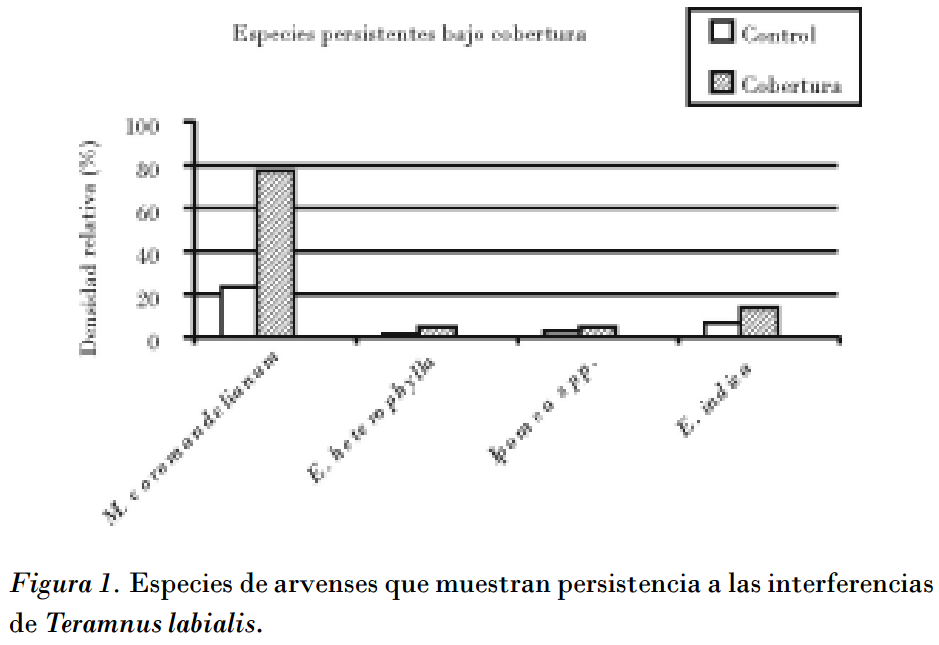
Results about the study of leguminous cover crops in citrus fields obtained during the 90´s in Ciego de Ávila, Cuba, determined to evaluate the effectiveness of introducing the cover crop plant Teramnus labialis (L.f.) Sprengel cv dark seed as a way to obtain a sustainable production of Valencia Late orange (Citrus sinensis L. Osbeck), basically focused on both soil conservation and the development and improved production of that cultivar. The introduced species demonstrated its usefulness in most of productive indicators of those citrus plantations. From the results obtained, an experiment was carried out in order to determine the feasibility of the use of that native leguminous cover crop to effectively manage weed populations. The experiments were conducted at the Agricultural Production Cooperative José Martí in Ceballos in the province of Ciego de Ávila. It was achieved a decrease in dissemination of every weed species in the areas under the cover crop treatment. Malvastrum coromandelianum was the more persistent species.
Article Details

This work is licensed under a Creative Commons Attribution-NonCommercial 4.0 International License.
Those authors who have publications with this journal accept the following terms of the License Attribution-NonCommercial 4.0 International (CC BY-NC 4.0):
You are free to:
- Share — copy and redistribute the material in any medium or format
- Adapt — remix, transform, and build upon the material
The licensor cannot revoke these freedoms as long as you follow the license terms.
Under the following terms:
- Attribution — You must give appropriate credit, provide a link to the license, and indicate if changes were made. You may do so in any reasonable manner, but not in any way that suggests the licensor endorses you or your use.
- NonCommercial — You may not use the material for commercial purposes.
- No additional restrictions — You may not apply legal terms or technological measures that legally restrict others from doing anything the license permits.
The journal is not responsible for the opinions and concepts expressed in the works, they are the sole responsibility of the authors. The Editor, with the assistance of the Editorial Committee, reserves the right to suggest or request advisable or necessary modifications. They are accepted to publish original scientific papers, research results of interest that have not been published or sent to another journal for the same purpose.
The mention of trademarks of equipment, instruments or specific materials is for identification purposes, and there is no promotional commitment in relation to them, neither by the authors nor by the publisher.
How to Cite
References
Argel, P. J.; M. Villareal: «Nuevo maní forrajero perenne. Arachis pintoi Krapovickas y Gregory. Cultivar Porvenir», Ministerio de Agricultura y Ganadería (MAG) y Centro Internacional de Agricultura Tropical (CIAT), Boletín Técnico, 1998.
Casamayor, R.: «Control de malezas en el cultivo de los cítricos», Curso Integral de Citricultura, Instituto de Investigaciones de Cítricos y Frutales (IICF), La Habana, 1996, pp. 118-137.
––––: «Comparativo de varias formulaciones de Diuron y Bromacil para el control de malezas en el cultivo de los cítricos», Memorias del Primer Encuentro Nacional de Ciencias de Malezas, INSV, INICA, La Habana, 1999, p. 135.
Gutiérrez, R. I.; G. Pérez; R. Benega; Lourdes Gómez: «Coberturas vivas de leguminosas en el plátano (Musa sp.) FHIA 03», Cultivos Tropicales, 23(3):11-12, 2002a.
––––: «Influencia de una cobertura de Neonotonia wightii en los cambios florísticos de una plantación de naranja Valencia late (Citrus sinensis l. Osbeck)», Cultivos Tropicales, 23(3):5-9, 2002b.
Ingels, C.: «Protecting Groundwater Quality in Citrus Production. UC Sustainable Agriculture. Research and Education Program», Division of Agriculture and Natural Resources, Ed. SAREP, University of California, Oakland, California, 1994.
López, S.: «Uso de leguminosas de cobertura en plantaciones de cítricos», Memorias del III Simposio Internacional sobre Sistemas de Producción en Cítricos, vol. 2, Universidad Autónoma de Chapingo, México, PIISCI, 1996.
McCloskey, W. B.; G. C. Wright: «Evaluation and Management of a Salina’ Strawberry Clover Cover Crop in Citrus: First Year Preliminary Results», 2000, (http://ag.arizona.edu/pubs/crops/az1138/. (con acceso en internet el 10 de junio de 2001).
Osorio, R.: «Estudio comparativo de los métodos de control de malezas en cítricos prevalecientes en la cuenca de Tlacolula, Veracruz, México». Tesis en opción al título de Ingeniero Agrónomo, Universidad Autónoma de Chapingo, México, 2000.
O’Connell, N. «Citrus Project Explores Cover Crop Potential», (http://cetulare.ucdavis.edu/update/citrus.htm). In focus, 2000 (con acceso el 14 de junio de 2001).
Pérez, R.; J. Carrera; A. Borroto; C. Mazorra; A. Ozuna; A. Arencibia; Z. Rodríguez; J. R. García; María del C. Santana: «Establecimiento de leguminosas como cobertura para sistemas mixtos de producción sostenible en una finca de cocos (Cocus nucifera)», Pastos y Forrajes 3(19):261, 1996.
Pérez, E.; C. Pedroso: «Malezas en cítricos en Cuba», Ciencia y Técnica en la Agricultura. Protección de Plantas 10(4):39-64, 1987.
Primavesi, Ana: Agricultura em regioes tropicais, Manejo Ecológico do Solo, Ed. Nobel, Brasil, 1990.
Sakovich, N.; B. Faber: «Grower Comments from Citrus Cover Crop Field Meeting», (http://www.sarep.ucdavis.edu/ccrop/ccres/1996/34.htm) (con acceso el 20 de junio de 2001).
Zaragoza, C.: «Las coberturas del suelo», Rev. Horto Fruticultura, (5):60-62, 1994.
––––: «El laboreo de conservación en el viñedo», Fruticultura Profesional (91):6-13, 1997.