
Medios de cultivo para la reproducción masiva de Aschersonia aleyrodis webber
Article Sidebar
Main Article Content
Abstract
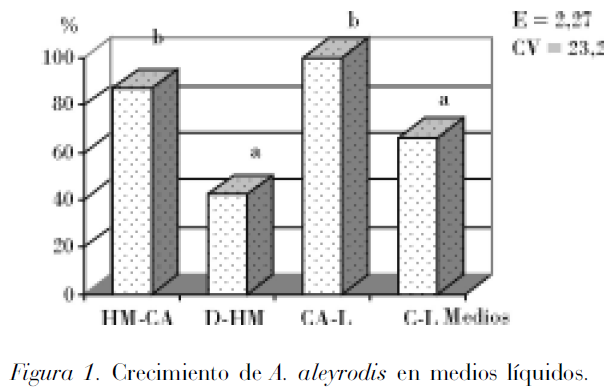
In order to select a culture media that guarantees massive reproduction of Aschersonia aleyrodis Webber for its later employment as biopesticide, a research work was realized in Plant Health Laboratory of Ciego de Ávila province. Several liquid media composed by maize flour-milled rice (HM-CA), maize flour waste (DHM), fine maize powder (M), milled rice-yeast (CA-L), cane juice sirup-torula yeast (MZ-L), maize flour (HM), barley-yeast (Cl), potato broth (CP) and sweet potato broth (CB) were assessed, and as solid media were considered milled rice-soy bean residues (CA-RS), maize flour-soy bean residues (HM-RS), dipped wheat (TR), milled rice (A), ground wheat (TM) and maize flour (B). Different culture media deposited in flasks, were sterilized and then were inoculated with a suspension of 108 conidia/ mL of concentration, after being 24 hours in rest for their later incubation. In liquids media was evaluated superficial growth, and in both liquids and solids were evaluated initial time to beginning growth, purity, spores concentration, viability and virulence on B. tabaci. Result obtained showed that liquids (HM-CA) and (CA-L) had the best growths, but with low concentrations between 104 and 105, viability of 60.2 and 73.7% respectively, and with low virulence besides minor purity than the solids; about these last ones (A) initiated the growth three days from inoculation and reached a concentration of 108 espores/ mL, with viability and virulence between 90 and 97%, so it is catalogued like the best
Article Details

This work is licensed under a Creative Commons Attribution-NonCommercial 4.0 International License.
Those authors who have publications with this journal accept the following terms of the License Attribution-NonCommercial 4.0 International (CC BY-NC 4.0):
You are free to:
- Share — copy and redistribute the material in any medium or format
- Adapt — remix, transform, and build upon the material
The licensor cannot revoke these freedoms as long as you follow the license terms.
Under the following terms:
- Attribution — You must give appropriate credit, provide a link to the license, and indicate if changes were made. You may do so in any reasonable manner, but not in any way that suggests the licensor endorses you or your use.
- NonCommercial — You may not use the material for commercial purposes.
- No additional restrictions — You may not apply legal terms or technological measures that legally restrict others from doing anything the license permits.
The journal is not responsible for the opinions and concepts expressed in the works, they are the sole responsibility of the authors. The Editor, with the assistance of the Editorial Committee, reserves the right to suggest or request advisable or necessary modifications. They are accepted to publish original scientific papers, research results of interest that have not been published or sent to another journal for the same purpose.
The mention of trademarks of equipment, instruments or specific materials is for identification purposes, and there is no promotional commitment in relation to them, neither by the authors nor by the publisher.
How to Cite
References
Berlanga P., Angélica María; V. Hernández Velásquez: «Aschersonia aleyrodis Webber en el control microbial de mosca blanca de los cítricos Dialeurodes spp.». Centro Nacional de Referencia de Control Biológico, DGSV-SAGAR, Estación FFCC, Tecomán, Colima, México, 2002. http://www.procesosvirtuales.com/documentos/archivos/DT-BT01-001.pdf. 2002.
Cabrera, R. I.; Delmis Domínguez: «Metodología para la reproducción de Hirsutella thompsonii en cultivo mixto», Instituto Nacional de Cítricos, La Habana, 1987.
Fernández-Larrea, Orietta: «Actualidad y perspectivas en la producción e investigación de bioplaguicidas. Situación en Cuba», V Encuentro Nacional Científico-Técnico de Bioplaguicidas, Instituto de Investigaciones de Sanidad Vegetal, La Habana, 22- 23 de octubre de 1997, pp. 9-15.
Fernández-Larrea, Orietta: «La reproducción de los hongos entomopetógenos y antagonistas. Experiencia cubana», Instituto de Investigaciones de Sanidad Vegetal, La Habana, 2000 (inédito).
Fransen, J. J.: «Aschersonia aleyrodis as a Microbial Control Agent of Greenhouse Whitefly», Doctorate Thesis, Agricultural University of Wageningen, Holanda, 1987a.
––––: «Control of Greenhouse Whitefly, Trialeurodes vaporarior, by the Fungus Aschersonia aleyrodis. Integrated Control in Glass House», Budapest, Bulletin SROP (France) Apr. 10(2):57-61, 1987b.
Gottwald, A. C.: «Biotécnica de aislamientos y reproducción masiva a nivel de laboratorio de esporas del hongo Aschersonia aleyrodis nativo de México», Memorias VI Reunión Nacional de Control Biológico, Culiacán, 1978, pp. 22-29.
López, Miriam: «Metodología de reproducción y aplicación de Beauveria bassiana, Departamento de Lucha Biológica, Instituto de Investigaciones de Sanidad Vegetal, MINAGRI, La Habana, 1985.
Luján, Mercedes; Esperanza Sánchez; Tania Vásquez; Teresa Cabrera: «Metodología de propagación bifásica o líquida de estática del hongo Verticilllium lecanii (Limm.)», INISAV-CNSV, La Habana, 1990.
Meekes, E. T.; J. J. Frasen; J. C. Van Lenteren: «The Use of Entomopathogenic Fungi for the Control of Whiteflies», Mededelingen Faculteit Landbouwkundige, Toegepaste biologistche Wetenschappen Universiteit (2)111-115, 1994.
Norma Cubana 72-02: «Métodos de ensayos. Biotecnología agrícola. Biopreparados entomopatógenos. Biotecnología agrícola», INISAV, MINAGRI, La Habana, 1993.
Norma Cubana 72-03. «Biopreparado del entomopatógeno Verticilium lecanii. Especificaciones. Biotecnología Agrícola», INISAV, MINAGRI, La Habana, 1993.
Norma Cubana 72-05: «Biopreparado del entomopatógeno Beauveria bassiana. Especificaciones. Biotecnología Agrícola», INISAV, MINAGRI, La Habana, 1993.