
Damage of Rumina decollata (L.) (Gastropoda: Subulinidae) to chardcrop.
Article Sidebar
Main Article Content
Abstract
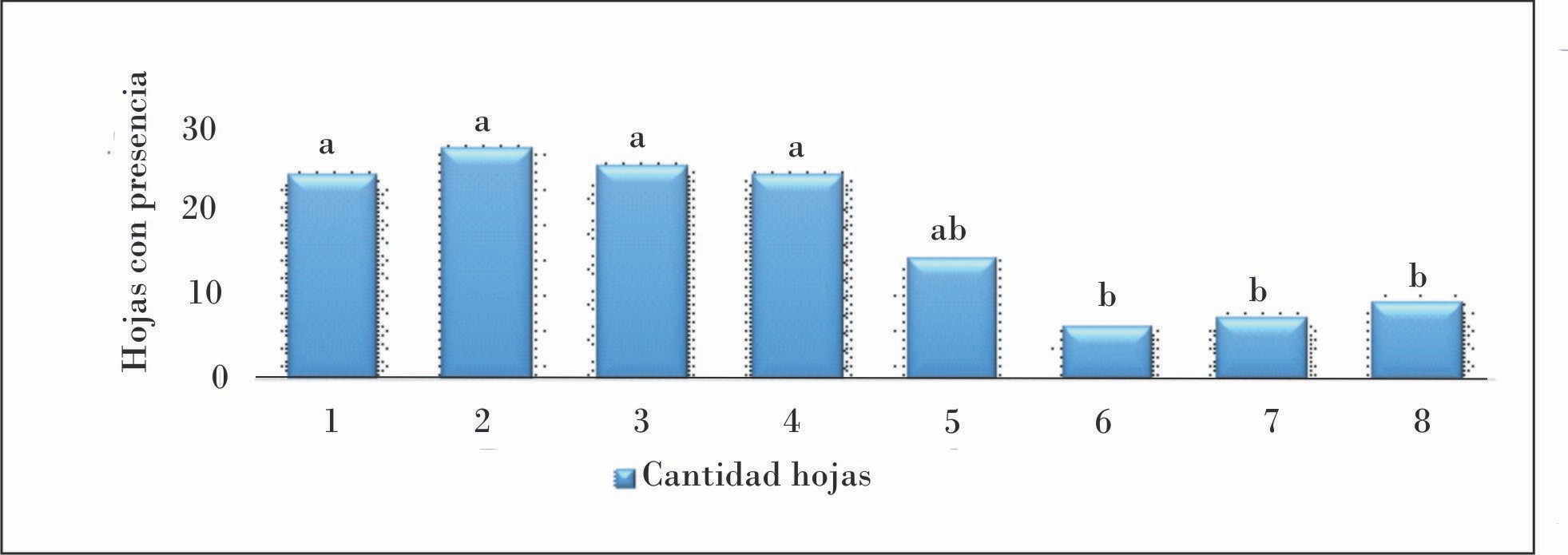
Among the mollusc species that most affect the cultivation of chard in Cuba is the snail Rumina decollata L., reported as a pest of importance by several authors, although without quantitative evidence. This study was carried out with the objective of assessing the damage caused by R. decollata to chard crop in the UBPC Organopónico Vivero Alamar. The population density was evaluated and for this the modified Andrews (1987) method was used, three technified canteros were selected, whe- re a wooden frame of 25 x 25 cm was regularly distributed 16 times; Population density data were transformed to Log (n + 1) and entered into the R program. A multiple regression analysis was developed with the use of the adjusted GAM (Generalized Additive Models) model, the regression trees were subjected to validation cross to define the best. The snail R. decollata selects the four lowest leaves of the vegetable and caused a 9 % incidence and the damage began when the temperature was between 25-34 °C, the relative humidity between 71-74 % and the population densities were between 4-7 m2 snails. From the results of this research it can be affirmed that R. decollata is an occasional plague. This is one of the reasons why it has not been possible to quantify the damages caused by this species in the world.
Article Details

This work is licensed under a Creative Commons Attribution-NonCommercial 4.0 International License.
Those authors who have publications with this journal accept the following terms of the License Attribution-NonCommercial 4.0 International (CC BY-NC 4.0):
You are free to:
- Share — copy and redistribute the material in any medium or format
- Adapt — remix, transform, and build upon the material
The licensor cannot revoke these freedoms as long as you follow the license terms.
Under the following terms:
- Attribution — You must give appropriate credit, provide a link to the license, and indicate if changes were made. You may do so in any reasonable manner, but not in any way that suggests the licensor endorses you or your use.
- NonCommercial — You may not use the material for commercial purposes.
- No additional restrictions — You may not apply legal terms or technological measures that legally restrict others from doing anything the license permits.
The journal is not responsible for the opinions and concepts expressed in the works, they are the sole responsibility of the authors. The Editor, with the assistance of the Editorial Committee, reserves the right to suggest or request advisable or necessary modifications. They are accepted to publish original scientific papers, research results of interest that have not been published or sent to another journal for the same purpose.
The mention of trademarks of equipment, instruments or specific materials is for identification purposes, and there is no promotional commitment in relation to them, neither by the authors nor by the publisher.
How to Cite
References
Andrews, K. L. (1987): “Técnicas de muestreo para la determinación de la densidad poblacional y actividad de las babosas Veronicellidae”. Ceiba. 28 (2): 5-7.
Auffenberg, K. y Stange, L. A. (2011): Snail-Eating Snails of Florida, Gastropoda. University. EENY251.
Batts, J. H. (1957): “Anatomy and cycle of snail Rumina decollata (Pulmonata: Achatinidae)”. The Southwestern Naturalist. 2 (2-3) abril –julio: 74- 82.
Brantlinger (1953): “A European Snail”. Arizona Cooperative Economic Insect Report 3: 849.
Bruner, S.; F., Valdés (1953): “Medios para combatir los principales insectos que atacan a las hortalizas”. Estación Agronómica Santiago de las Vegas, Cuba. Circular no. 88, diciembre, pp. 23-47.
CAB International (2007): Crop Protection Compendium. Wallingford, UK: CAB International.
CIBA-GEIGY (1981): Manual para ensayos de campo en la protección vegetal. 2da. ed. Werner Püntner, División Agricultura. Basilea, Suiza.
Clavijo, S.A. (1993). Fundamentos del manejo de plagas. Universidad Central de Venezuela: 135.
Correa, A (1993): “Caracoles terrestres (Mollusca: Gastropoda) de Santiago, Nuevo León, México”. Rev. Biol. Trop., 41 (3): 684 p.
Costa, S. M. M.; A. Montenegro, T.; Arregui; M. I.; Sánchez De Pinto; M.A.; Nazareno; B. L., Mishima (2013): “Caracterización de acelga fresca de Santiago del Estero (Argentina). Comparación del contenido de nutrientes en hoja y tallo. Evaluación de los carotenoides presentes”. Cienc. Tecnol. Aliment., Campinas, 23(1): 33-37.
Fisher, T. W.; R. E., Orth; S. C. Swanson (1980): “Snail against snail”. California Agriculture, November- December: 18-20.
Herrera, N.S.; y Castellanos L. G. (2013): “Informe sobre la incidencia de moluscos plaga en organopónicos del municipio de Cienfuegos, Cuba”. Centro Agrícola, 40(1): 89-90.
Hernández, M. Q.; y Reyes B. T. (2013): “Composición y estructura en agregaciones de moluscos terrestres en el complejo de vegetación de mogote, Escaleras de Jaruco, Cuba”. Rev. Biol. Trop. 61 (4): 1769-1783.
Le Gall, M.: y Tooker J. F. (2017): “Developing ecologically based pest management programs for terrestrial molluscs in field and forage crops”. J. Pest Sci. 90(3): 825-838.
Matamoros, M. (2014): “Los moluscos fitófagos en la agricultura cubana”. Agricultura Orgánica, 20 (2): 9-13.
Matamoros, M. (2014a): “Los moluscos fitófagos en la agricultura cubana”. Agricultura Orgánica, 20 (2): 9-13.
Mc Donnell, R.; Santangelo, R.; Paine, T. and Hoddle, M. (2006): “The feeding behaviour of Rumina decollata (Subulinidae: Gastropoda) raises questions about its efficacy as a biological control agent for Cornu aspersum (Helicidae: Gastropoda)”. Biocontrol Science and Technology, vol. 26, no. 3, 331-336.
Oliva-Olivera, W.: y Real R. (2009): “Moluscos terrestres de las eleva- ciones cársticas de Viñales, Pinar del Río, Cuba”. Rev. Biol. Trop. 57 (3): 589-604.
Pilsbry, H. A. (1905): Rumina decollata. Man. Conch17: 212 pp.
Rascop, Ann-Marie (1960): “The biology of Rumina decollata (Linnaeus) Pulmonata: Achatinidae”. A Thesis Master of Science Submitted to the faculty of the Department of Zoology. University of Arizona. 57 p.
Rodríguez, A.; Concepción N. C.; Buides J. F.; Ortiz J. E.; Prades F. C.; y García R. R. (2011): Manual técnico para organopónicos, huertos intensivos y organoponía semiprotegida. La Habana, Cuba: Editorial Pueblo y Educación.
R Development Core Team (2016): R: “A language and environment for statistical computing. Foundation for Statistical Computing, Vienna, Austria”. http://www.R-project.org.
Sánchez, C. R.; Núñez Y. O.; Rodríguez O. R.; Ricardo C. V.; Cruz B.; y García B. C. (2016): “Buenas prácticas para el control de caracoles y babosas”. Boletín Informativo de la Agricultura Urbana. 12 (21): 6.
Vázquez, L. L.; y E. Fernández (2007): “Manejo agroecológico de plagas y enfermedades en la agricultura urbana. Estudio de caso. Ciudad de La Habana, Cuba. Agroecología 2: 21-31.
Vázquez, L. L.; Fernández E.; Lauzardo J.; García T.; Alfonso J.; Ramírez R. (2005): “Manejo agroecológico de plagas en fincas de la agricultura urbana (MAPFAU)”. Ed. CIDISAV. Ciudad de La Habana. 54 pp.
Wagh, S. T.; Razvi N. A. (2016): “Marascuilo method of multiple comparisons (an analytical study of caesarean section delivery)”. International Journal of Contemporary Medical Research. 3 (4): 1137-1140.